
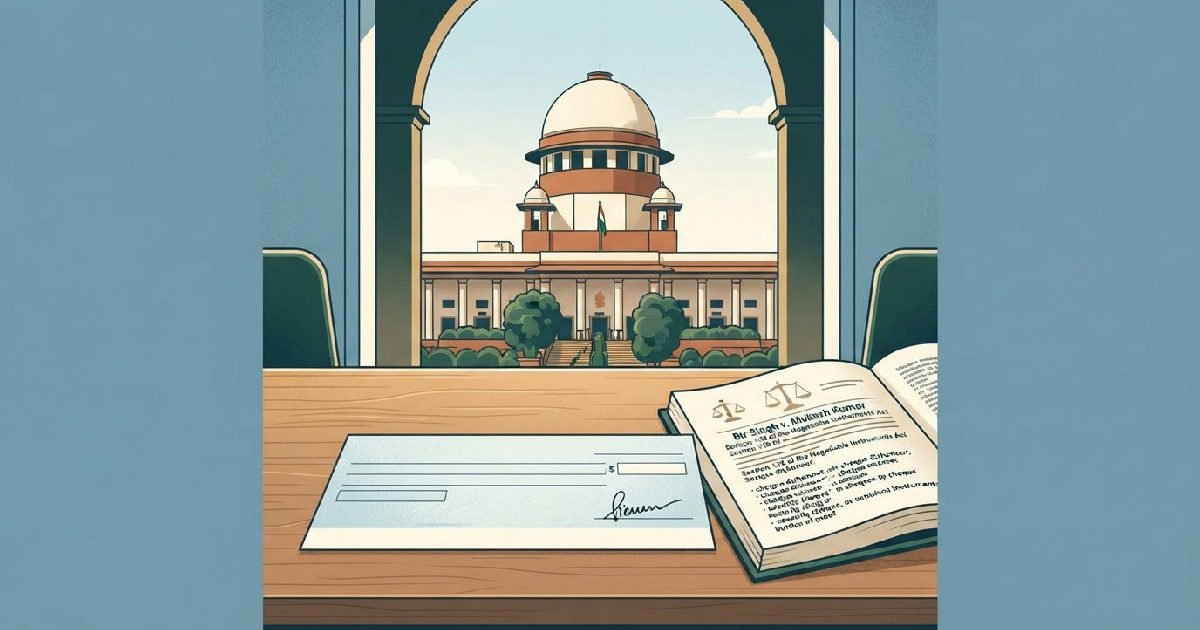
Handing over a blank signed cheque creates a legally binding commitment, making the drawer liable under Section 138 of the Negotiable Instruments Act, 1881, if dishonoured. This crucial interpretation gained significant clarity with the Supreme Court’s landmark ruling in Bir Singh v. Mukesh Kumar on February 6, 2019.
This ruling challenges the widespread misconception that a blank signed cheque filled later for a higher amount cannot lead to criminal proceedings, particularly if the amount filled in later exceeds the original debt. Legal experts across India, including those in Delhi, now widely acknowledge the robust legal framework that places a significant burden of proof on the drawer to demonstrate misuse.
Upholding Cheque Validity: The Legal Standard
The legal landscape surrounding blank signed cheques has often been a point of contention. Many individuals assume that such instruments carry no inherent liability, but Indian jurisprudence consistently counters this belief.
It reinforces the fundamental principle that a signature on a cheque signifies an underlying intent. Central to this understanding is Section 20 of the NI Act, which addresses “inchoate instruments.”
This provision legally implies that when a person delivers a signed instrument, they implicitly grant authority to the holder to complete it by filling in the necessary particulars, including the amount. Therefore, if a signed but otherwise blank cheque is voluntarily given to a payee for payment, the payee retains the legal right to fill in the amount and other relevant details.
This act alone does not automatically invalidate the cheque or absolve the drawer of their obligations. The courts firmly uphold the principle that the drawer’s criminal liability under Section 138 remains, even if the cheque was initially blank when signed.
This stance prevents individuals from easily evading responsibility by claiming the cheque was incomplete at the time of issuance. Indian legal principles emphasize the significant weight of a signed financial instrument.
Presumptions and the Burden of Proof on blank signed cheque filled later for a higher amount
A cornerstone of cheque dishonour cases under the NI Act lies in the legal presumptions enshrined in Sections 118 and 139. Once the drawer’s signature on a cheque is admitted, the law automatically presumes that the cheque was issued for the discharge of a legally enforceable debt or liability.
This statutory presumption significantly shifts the burden of proof. It becomes the responsibility of the accused—the drawer—to convincingly rebut this presumption by presenting credible evidence that no such liability existed or that the cheque was somehow misused.
Simply claiming that the cheque was blank when signed, or vaguely stating it was provided as security without further substantiation, is generally insufficient to escape criminal liability. The courts require concrete proof to overturn the strong statutory presumptions that favour the complainant.
Landmark Supreme Court Clarification
The legal position was definitively clarified by the Supreme Court of India in the pivotal judgment of Bir Singh v. Mukesh Kumar, delivered on February 6, 2019. This ruling provided crucial guidance that has since shaped countless cheque dishonour cases across the country.
A bench comprising Justice R. Banumathi and Justice Indira Banerjee unequivocally held that the person who signs and hands over a cheque grants implied authority for it to be filled. This means the act of signing imparts a significant legal consequence, regardless of whether the other details are present.
The judgment underscored that even a blank cheque leaf, when voluntarily signed and handed over for payment, inherently attracts the presumption under Section 139 of the NI Act. This presumption stands firm unless the accused can present cogent and compelling evidence to the contrary, challenging its basis.
Delhi High Court’s Stance on Alterations and Security
Further reinforcing these principles, the Delhi High Court has also contributed significantly to the jurisprudence surrounding blank cheques. In Ravi Chopra v. State & Another, a judgment dated March 13, 2008, the court ruled on the issue of material alteration.
The Delhi High Court held that merely filling in the name, date, and amount on a blank cheque by the payee does not constitute a “material alteration” under Section 87 of the NI Act. This is contingent on the drawer’s signature being authentic and undisputed, thereby preserving the cheque’s validity.
The issue of cheque given as security also frequently arises in these cases. While a cheque issued purely as security might offer a defence if no existing liability is present, dishonour typically attracts Section 138 if a legally enforceable debt existed when the cheque was presented.
However, if the accused can demonstrate that the cheque was issued solely as security for a future or contingent liability that never materialised, they might have grounds to challenge the complaint. This defence requires more than a mere assertion and often involves substantial documentary evidence.
Recent Judicial Reinforcement
The judicial commitment to these principles remains strong, with recent rulings consistently upholding the liability associated with blank signed cheques. A Delhi High Court ruling on September 29, 2026, explicitly affirmed a conviction under Section 138 of the NI Act.
The court stated that an unsupported claim of issuing a blank cheque as security could not adequately rebut the statutory presumptions. This decision highlights the ongoing judicial expectation for robust evidence from the defence, rather than simple denials.
Similarly, on December 5, 2023, the Delhi High Court reiterated that the dishonour of a cheque provided as security still attracts Section 138, particularly when a legally enforceable debt exists. This ruling also extended to cases where cheques are dishonoured due to “payment stopped” or “account closed.”
Adding to this consistent judicial stance, the Kerala High Court, in its December 4, 2023, judgment in P.K. Uthuppu Vs. N.J. Varghese and Ors., further affirmed the principle. It held that a blank cheque, voluntarily signed and issued for debt discharge, does not invalidate the strong presumption under Section 139 of the NI Act.
Navigating Liability: Practical Advice for Parties
Given the strict interpretations by Indian courts, both payees and drawers must exercise considerable diligence when dealing with cheques. For payees, maintaining meticulous records is paramount.
Detailed documentation and working that substantiate the figure filled into a blank cheque can be critical evidence in court. This proactive approach strengthens the payee’s position and helps to counter any claims of unauthorised alteration or excessive amount filling.
Conversely, drawers must be equally vigilant. Before responding to any legal notice, it is crucial to compare the filled amount on a dishonoured cheque with one’s personal ledger or financial records. This careful review can identify discrepancies early.
Crucially, drawers should avoid admitting the full filled figure on informal communication platforms like WhatsApp if they believe it is incorrect. Such informal admissions can inadvertently undermine their defence later in court proceedings. It is always best to maintain formal and accurate communication.
Generally, it is advisable to avoid issuing blank signed cheques whenever feasible. If they must be used, maintaining comprehensive written records of all transactions, agreements, and repayment schedules is essential to prevent future disputes.
Should a blank signed cheque be misused, the drawer should immediately issue a stop payment instruction to their bank. Furthermore, preserving all available evidence, such as chat logs, call recordings, messages, and detailed transaction specifics, can be vital for substantiating a defence regarding the actual amount due or misuse, especially when considering filing a cheque bounce case.
Implications for Criminal Law and Financial Conduct
The consistent judicial stance on blank signed cheques has significant implications for criminal law, particularly concerning financial transactions. It reinforces the seriousness with which cheque dishonour cases are viewed, positioning them firmly within the ambit of criminal liability under the NI Act.
This legal clarity serves as a deterrent against casual or negligent handling of negotiable instruments. Individuals and businesses alike are expected to exercise due diligence, understanding that a signed cheque carries substantial legal weight, regardless of whether all particulars are filled in at the moment of signing.
For the legal fraternity, these rulings provide a more predictable framework for prosecuting and defending cheque bounce cases. Lawyers can better advise clients on the strength of their claims or defences, reducing ambiguity and fostering more efficient judicial processes.
Ultimately, these judgments underscore a broader objective: to instil greater discipline in financial dealings and uphold the credibility of negotiable instruments as a reliable mode of payment. The courts are actively working to prevent the NI Act from being undermined by technical defences related to the state of a cheque at its initial issuance.
| Judgment Name | Court | Date of Decision | Key Holding |
|---|---|---|---|
| Bir Singh v. Mukesh Kumar | Supreme Court of India | February 6, 2019 | Implied authority to fill blank cheque; presumption under Section 139 stands |
| Ravi Chopra v. State & Another | Delhi High Court | March 13, 2008 | Filling blank cheque by payee not a material alteration if signature authentic |
| P.K. Uthuppu Vs. N.J. Varghese and Ors. | Kerala High Court | December 4, 2023 | Blank cheque for debt discharge does not invalidate Section 139 presumption |
Can a blank signed cheque really lead to a criminal case under Section 138?
Yes, absolutely. Indian courts, including the Supreme Court, have consistently ruled that a blank signed cheque, once handed over, implies authority for the payee to fill in the details. If it then bounces, the drawer can face criminal charges under Section 138 of the Negotiable Instruments Act, 1881.
What is the “presumption” under Section 139 of the NI Act?
The presumption under Section 139 means that once your signature on a cheque is admitted, the law assumes the cheque was issued to clear a legally enforceable debt or liability. The burden then shifts to you, as the drawer, to prove otherwise with concrete evidence.
What if I gave a blank cheque as security, but the amount filled is too high?
While a cheque given as security can attract Section 138, if you can demonstrate that the filled amount significantly exceeds the actual, legally enforceable debt, or that the cheque was misused, it could form a valid defence. However, you must provide compelling evidence beyond a mere statement.
Cheque amount does not match what you signed for? Call or Whatsapp for consultation.
Related: https://arpitmarwah.com/cheque-bounce-lawyers-in-delhi/