
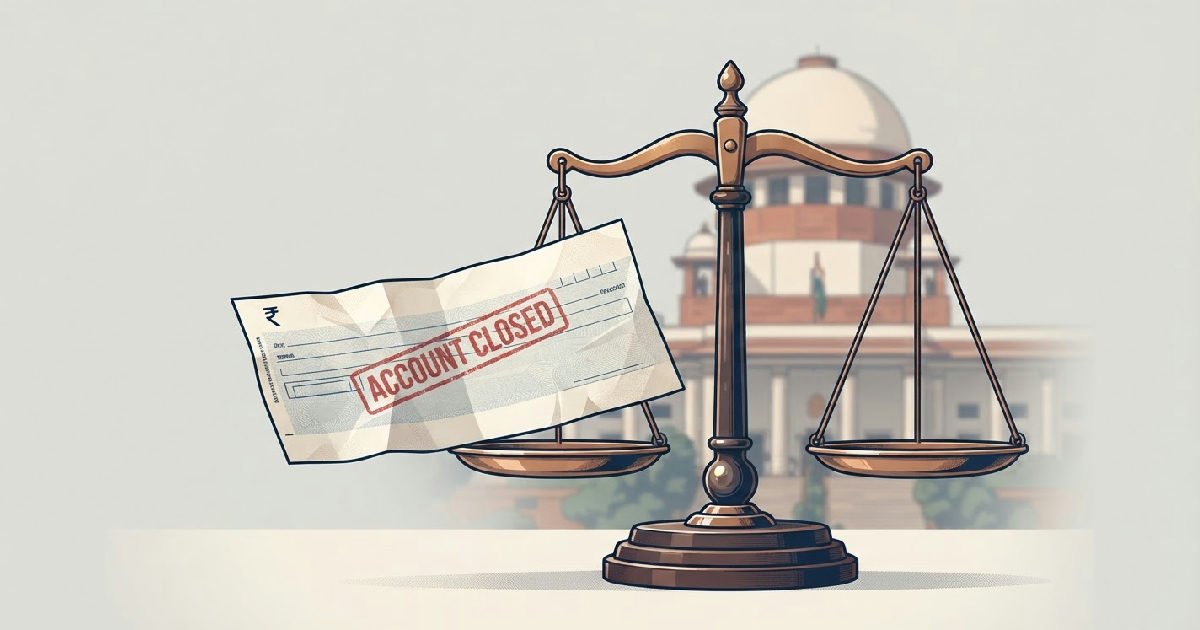
The Supreme Court of India has consistently held that the dishonour of a cheque due to an “account closed” notification falls squarely within the ambit of Section 138 of the Negotiable Instruments Act, 1881.
This ruling ensures that individuals who issue cheques from accounts that are subsequently shut down are not exempt from the legal repercussions intended for cheque bounces. The judiciary views an account closure as a specific form of insufficient funds, maintaining the sanctity of financial instruments in commercial dealings across the country, including Delhi.
Supreme Court’s Stance on Cheque Returned Account Closed
This critical interpretation was notably solidified in the landmark judgment of Nepc Micon Ltd. & Others v. Magma Leasing Limited, which was adjudicated by the Supreme Court on April 24, 1999.
The court clarified that if an account is closed, the funds available in it are effectively zero, thereby triggering the provisions of Section 138. This legal stance underscores the commitment to upholding the credibility of cheques as a reliable mode of payment, preventing unscrupulous practices.
For decades, the Supreme Court has maintained a clear position on cheques returned with an “account closed” memo. Its reasoning centres on the principle that the act of closing an account, subsequent to issuing a cheque, inherently demonstrates a lack of funds available to honour that instrument. This perspective directly addresses attempts to circumvent legal responsibility by altering the status of an account.
The 1999 ruling in Nepc Micon Ltd. & Others v. Magma Leasing Limited remains a cornerstone in this area of law. The judges concluded that treating “account closed” as distinct from “insufficient funds” would create a loophole.
Such a loophole would undermine the very purpose of Section 138, which is designed to promote faith in cheque transactions. This robust interpretation has provided a clear legal framework for prosecuting cheque dishonour cases.
The legislative intent behind the Negotiable Instruments Act, 1881, was always to provide a deterrent against the careless issuance of cheques. By broadening the interpretation of “insufficient funds” to include accounts that have been closed, the Supreme Court has effectively reinforced this original objective.
This approach helps to safeguard the interests of payees and ensures that drawers remain accountable for their financial commitments, cementing trust in the financial system.
Delhi High Court Reinforces Applicability
Echoing the Supreme Court’s definitive stance, the Delhi High Court has also consistently affirmed that the dishonour of a cheque due to reasons like “account closed” or “payment stopped” falls within Section 138 of the NI Act.
Justice Rajnish Bhatnagar made pertinent observations on December 5, 2023, while presiding over a petition seeking to quash an NI Act case. His remarks further solidified the judicial consensus in the capital.
The Delhi High Court has additionally broadened its interpretation to include instances where dishonoured cheques were initially issued as a form of security. This implies that even if a cheque was not intended for immediate encashment but rather as collateral, its dishonour can still lead to prosecution under Section 138.
This is a crucial clarification, particularly for business contracts and loan agreements where security cheques are common practice.
These consistent rulings from both the apex court and the Delhi High Court provide much-needed clarity for both payees and drawers in cheque bounce cases. They send a strong message that procedural manoeuvres, such as closing an account after issuing a cheque, will not absolve a drawer of their statutory liability.
The focus remains on the underlying debt or liability for which the cheque was issued.
Essential Conditions for Invoking Section 138
While the reason for a cheque’s dishonour might vary, several fundamental conditions must be met for Section 138 of the Negotiable Instruments Act, 1881, to be applicable. These conditions are rigorously enforced by courts, ensuring that the legal process is fair and judicious. Understanding these prerequisites is vital for anyone involved in a cheque dishonour dispute.
Firstly, the cheque must have been issued specifically for the discharge of a legally enforceable debt or liability. This means that a cheque given as a gift or for an illegal purpose would not typically fall under Section 138’s purview. The existence of a clear financial obligation is paramount.
Secondly, the cheque must be presented to the bank within a strict timeframe. This period is three months from the date of its issuance or within its period of validity, whichever comes earlier. Failure to present the cheque within this window can significantly weaken the payee’s case. You can learn more about specific presentation periods in cheque presented after three months scenarios.
Finally, the cheque must be returned unpaid by the bank due to insufficient funds, or because the amount exceeds the arrangement with the bank. Importantly, as confirmed by various rulings, other reasons such as “account closed” or “payment stopped” are also included under this umbrella of dishonour reasons.
These encompass a broad range of circumstances where the drawer’s bank is unable to process the payment as intended.
Navigating Notice Requirements for Payees
Once a cheque is dishonoured, the payee must adhere to a strict set of procedural steps and timelines to initiate proceedings under Section 138. Any deviation from these requirements can jeopardize the entire case, regardless of the validity of the underlying debt. Swift and precise action is therefore crucial.
The payee must dispatch a written demand notice to the drawer within 30 days of receiving the bank’s “cheque return memo” or dishonour slip. This notice serves a critical purpose: formally demanding payment of the cheque amount. It acts as a final opportunity for the drawer to rectify the situation without facing criminal prosecution.
Upon receiving this demand notice, the drawer is granted a fixed period of 15 days to make the outstanding payment. This grace period allows them to settle the matter amicably. If the drawer fails to make the payment within these 15 days, the payee then has the legal right to file a criminal complaint.
The complaint must be filed before a Metropolitan Magistrate (in Delhi) or a Judicial Magistrate. This must occur within one month after the 15-day payment window expires. These stringent timelines are designed to ensure expeditious resolution of cheque dishonour cases, promoting efficiency in the legal system.
| Action | Timeline | Starting Point |
|---|---|---|
| Cheque Presentation | Within 3 months of issue / validity | Cheque Issuance Date |
| Demand Notice to Drawer | Within 30 days | Receipt of Cheque Return Memo |
| Drawer’s Payment Window | 15 days | Receipt of Demand Notice |
| Filing Criminal Complaint | Within 1 month after payment window expires | End of 15-day Payment Window |
Key Defences for the Drawer in Delhi
While Section 138 provides a powerful recourse for payees, drawers are not without avenues for defence. Several legitimate circumstances can prevent the application of this section, or at least weaken the prosecution’s case. It’s important for a drawer facing such charges to understand these potential defences.
One primary defence emerges if the account was closed *prior* to the issuance of the cheque. Section 138 specifically states that the cheque must be drawn on an account “maintained by him” with the bank. If the account ceased to exist before the cheque was written, it fundamentally alters the premise of the offence.
This situation implies that the drawer was not maintaining the account when the instrument was issued.
Another valid defence arises if the drawer’s account was frozen, blocked, or attached by a statutory authority. In such cases, the account is effectively outside the drawer’s control. If they are legally prevented from accessing or operating the account, it becomes impossible to honour the cheque, and the intent element of the offence may not be fulfilled.
Furthermore, the absence of a legally enforceable debt or liability at the time the cheque was presented remains a critical defence. If the underlying transaction was illegal, or if the debt had already been paid or was otherwise invalid, Section 138 would not apply. The cheque must be against a genuine, recoverable obligation.
Lastly, material alteration of the cheque can also serve as a defence. If the bank, or indeed the payee, filled in critical details like the date or amount without proper authority or the drawer’s consent, this could be argued as a valid reason for the cheque’s dishonour not falling under Section 138. Such alterations can invalidate the instrument itself.
Consequences and Interim Compensation
Should a drawer be found guilty under Section 138 of the Negotiable Instruments Act, 1881, the legal ramifications can be significant. The Act prescribes stringent penalties to ensure compliance and deter the issuance of cheques without sufficient backing. These consequences serve as a serious warning to those who fail to honour their financial commitments.
A guilty verdict can lead to imprisonment for a term that may extend up to two years. Alternatively, the court may impose a fine that can be as high as twice the amount of the dishonoured cheque.
In many instances, the court has the discretion to impose both imprisonment and a fine, depending on the specifics and severity of the case. These penalties are designed to be punitive and restitutive.
An important provision, Section 143A, allows the court to order the accused to pay interim compensation during the trial itself. This compensation can amount to up to 20% of the cheque amount.
This measure provides immediate relief to the payee, mitigating some of the financial hardship caused by the dishonoured cheque, even before the final judgment is pronounced. This interim relief is a crucial aspect of the evolving legal framework for cheque bounce cases.
Crucial Considerations for All Parties
For both payees and drawers involved in a cheque dishonour scenario, several practical considerations can significantly impact the outcome of a Section 138 case. Navigating this legal landscape requires diligence and strategic planning to protect one’s interests.
Timely action stands out as paramount. Strict adherence to the specified timelines for sending notices and filing complaints is not merely a formality; it is a critical determinant of the case’s strength. Any undue delays can inadvertently weaken the payee’s position and provide the drawer with grounds for defence. This emphasis on promptness ensures that legal processes move efficiently and fairly.
Maintaining meticulous records is equally vital. Both parties should retain all relevant documents, including the bounced cheque itself, the bank’s official dishonour memo, copies of all legal notices sent or received, and any correspondence related to the transaction. Comprehensive evidence provides a clear narrative and substantiates claims or defences presented in court.
It’s also worth noting that an offence under Section 138 is compoundable under Section 147 of the NI Act. This means that even if a criminal complaint has been filed and proceedings are underway, the parties retain the option to reach an out-of-court settlement.
Such a resolution can save both sides considerable time, legal costs, and the emotional toll of a prolonged legal battle, offering a pragmatic pathway to closure.
Can I file a Section 138 case if the cheque is returned as “account closed”?
Yes, absolutely. Both the Supreme Court of India and the Delhi High Court have consistently ruled that a cheque dishonoured because the “account closed” reason is equivalent to insufficient funds under Section 138 of the Negotiable Instruments Act, 1881.
What are the key timelines for the payee after a cheque is dishonoured?
The payee must send a legal demand notice to the drawer within 30 days of receiving the cheque return memo. If payment isn’t made within 15 days of the drawer receiving the notice, the payee has one month to file a criminal complaint.
What are some valid defences a drawer can use against a Section 138 case?
Defences include demonstrating that the account was closed before the cheque was issued, the account was frozen by a statutory authority, there was no legally enforceable debt, or the cheque underwent material alteration without consent.
Memo says account closed? Call or Whatsapp for consultation.
Related: https://arpitmarwah.com/cheque-bounce-lawyers-in-delhi/
Comments (2)
Same Cheque Presented Twice in Delhi – Does the Second Memo Start a New 138 Clock?
says October 12, 2026 at 6:31 am[…] the cheque itself is valid is paramount. For instance, if a cheque is returned due to an account being closed, or insufficient funds, it falls under the purview of Section […]
Flat Handed Over but Club and Amenities Still Closed in Delhi NCR
says October 12, 2026 at 6:49 am[…] This notice should explicitly detail the missing amenities, the extent of the delay, and the potential legal ramifications of continued […]