
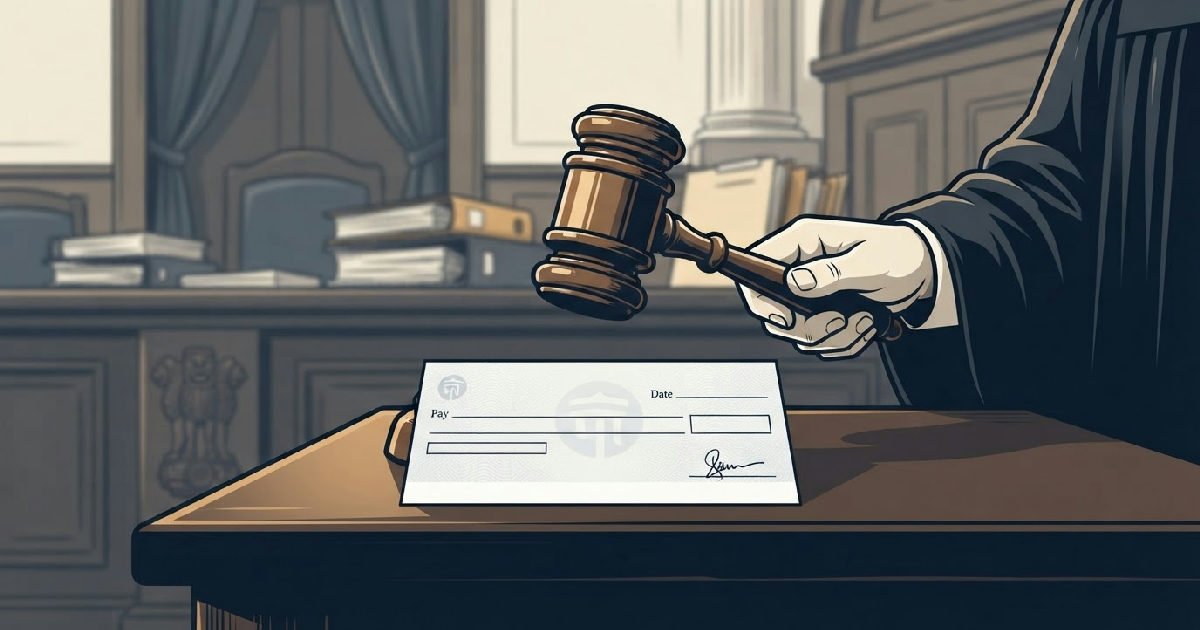
Delhi’s legal landscape continues to grapple with the complexities of blank signed cheque cases under Section 138 of the Negotiable Instruments Act, 1881. While the mere act of signing a blank cheque doesn’t automatically shield a drawer from prosecution, it similarly doesn’t guarantee an instant conviction.
The onus often falls on the courts to meticulously determine if the cheque’s completion was authorised and if a genuine, legally enforceable debt existed at the time of presentation.
Prosecution when blank cheque filled in Delhi
This nuanced area of criminal law requires careful consideration of intent and obligation. A drawer who issues a blank cheque, even innocently, may still face legal ramifications if it’s later dishonoured. But the specific circumstances surrounding its issuance and subsequent filling are paramount in establishing culpability or defence.
The legal foundation for the validity of a blank signed cheque in India is firmly established under Section 20 of the Negotiable Instruments Act, 1881. This pivotal section recognises such instruments as “inchoate,” essentially granting the holder the authority to complete them. This means that a document, signed but left blank in whole or in part, can still be treated as a valid negotiable instrument.
This statutory provision creates an initial presumption of authority for the person who completes the cheque. Consequently, a defence solely based on the cheque being blank when signed generally won’t suffice to negate its legal standing. What a cheque bounce lawyer often scrutinises is the nature of this implied authority and any agreements surrounding it.
The legal battle then shifts to other critical aspects of the transaction.
For individuals in Delhi, understanding this initial legal validity is crucial before navigating the intricacies of a cheque bounce complaint. The law acknowledges that commercial dealings often involve instruments completed at a later stage, provided certain conditions are met. This framework ensures that such instruments maintain their utility while offering protections against misuse.
Navigating Section 138 of the NI Act
Section 138 of the Negotiable Instruments Act outlines the criminal offence of cheque dishonour. For a prosecution to succeed, several core elements must be proven by the complainant. These include the cheque being drawn for a legally enforceable debt, its presentation, and its dishonour due to insufficient funds or similar reasons.
The drawer must also fail to make payment after receiving a legal demand notice. When a blank signed cheque is involved, these standard elements gain additional layers of complexity. The courts in Delhi don’t simply rubber-stamp convictions; they delve deeper into the specifics of each transaction.
The Framework of Cheque Bounce Cases
In cases involving a blank signed cheque, the prosecution under Section 138 of the NI Act faces specific considerations. While the cheque’s legal validity is established by Section 20, the circumstances of its completion become central to the legal arguments.
The drawer often has grounds to challenge the claim by questioning whether the amount filled was authorised, or if a legally enforceable debt truly existed at the time of presentation. This shift in focus requires precise evidence regarding the cheque’s issuance.
Rebutting the Defence in Cheque Cases
For a drawer to mount an effective defence in a blank signed cheque case, simply stating the cheque was blank may not be sufficient. A compelling defence typically requires presenting credible evidence or raising a plausible argument that casts doubt on the complainant’s claim regarding the completed instrument.
Instead, the defence generally needs to establish a probable case, making their version of events plausible. This can often be achieved through careful examination of the complainant’s evidence, highlighting inconsistencies, or presenting their own documentary proof. In cases involving security cheque scenarios, the legal interpretations often provide nuanced avenues for defence.
Legal Requirements for a Conviction
A conviction under Section 138 for a dishonoured blank signed cheque necessitates fulfilling specific legal requirements that go beyond the usual cheque bounce case. Complainants cannot rely solely on the fact that a cheque was issued and subsequently dishonoured. They must meticulously demonstrate several key elements, particularly around the completion of the instrument.
The courts demand clear evidence regarding the circumstances under which the blank cheque was provided. This scrutiny aims to ensure that the instrument was not misused or completed fraudulently, and that the drawer had indeed incurred a legitimate financial obligation.
Proving Authorisation to Fill
One of the most critical aspects for a complainant in a blank cheque case is proving that they had the explicit or implied authority to fill in the amount. This isn’t always straightforward and often requires presenting evidence of prior agreements, business dealings, or communications between the parties. Without such proof, the drawer’s defence that the cheque was completed without their consent gains significant weight.
For example, if a blank cheque was given as security for a loan, the complainant must show that the loan amount filled in reflects the actual outstanding debt and that the drawer authorised filling that specific sum upon default.
The absence of such authorisation can be a significant hurdle for the prosecution, potentially leading to acquittal. Disputing the amount or payee can often be a complex legal area.
Establishing a Legally Enforceable Debt
Even if authorisation to fill the cheque is established, the complainant must still prove the existence of a legally enforceable debt or liability for which the cheque was issued. This is a fundamental prerequisite for any Section 138 case.
In scenarios involving blank cheques, the defence often challenges whether such a debt existed at all, or if the amount claimed genuinely corresponds to a past obligation.
Relevant documentary evidence becomes crucial. If the debt itself is disputed, or if it’s proven that the debt was not legally enforceable, then the cheque, regardless of its completion, cannot form the basis of a valid prosecution under Section 138. The legal principle demands that the cheque serve to discharge a present, valid obligation.
Challenges for Complainants and Defendants
The involvement of a blank signed cheque introduces unique challenges for both parties in a Section 138 proceeding. For complainants, what might seem like an open-and-shut case based on a dishonoured instrument can quickly become an arduous evidentiary battle. Conversely, defendants gain additional avenues for defence, but they too must present their case convincingly rather than merely relying on assertions.
The judicial process in Delhi places a significant emphasis on verifiable facts and documentary proof. Both sides must be prepared for rigorous scrutiny of their claims and counter-claims.
The Complainant’s Burden of Proof
The complainant bears the initial and substantial burden of proof in a blank cheque case. Beyond proving the basics of cheque dishonour, they must establish the circumstances under which the blank cheque was given. This includes showing the purpose of issuance, the quantum of debt, and the specific authority granted to fill in the cheque details. Mere possession of a dishonoured, completed cheque is insufficient.
They often need to produce supporting documents or written communication that evidences the transaction and the drawer’s consent for the cheque’s completion. Without this comprehensive evidence, their case can falter. This elevates the standard of proof compared to other cheque bounce scenarios.
Strategic Defenses for the Drawer
For a drawer accused in a blank cheque case, several strategic defences can be employed. The primary defence often revolves around challenging the authority to fill the cheque or disputing the existence of a legally enforceable debt. Evidence could include proof that the cheque was given for security, and the principal debt was already repaid, or that the amount filled far exceeds the actual liability.
Additionally, the drawer might argue that the cheque was misused, perhaps by being filled for an amount or to a payee not originally intended. They could also assert that the cheque was stolen or lost and subsequently completed without their knowledge. Stopping payment often depends on the legitimacy of the reasons for stopping the payment itself.
Impact on Delhi’s Legal Landscape
The increasing number of blank signed cheque cases has had a noticeable impact on Delhi’s judicial system, particularly in lower courts handling cheque bounce complaints. Judges are becoming increasingly meticulous in examining the evidence presented, often demanding more than just the dishonoured cheque slip. This has led to longer litigation periods and a higher standard of proof for complainants.
Legal professionals in the capital often advise clients to be extremely cautious when issuing or accepting blank signed cheques. The ambiguities inherent in such instruments can lead to protracted legal battles, regardless of the underlying merits of the claim. This judicial vigilance reflects a broader effort to prevent the misuse of negotiable instruments while still upholding their commercial efficacy.
Court Scrutiny and Case Precedents
Delhi courts are increasingly scrutinising the specifics of blank cheque transactions, leading to a body of case precedents that further define the evidentiary requirements. Judgments often highlight the need for concrete evidence of the debt and the authority to fill. This helps in distinguishing legitimate commercial transactions from cases of potential exploitation or fraud.
Recent rulings have reiterated that while Section 20 grants validity, it does not absolve the complainant from proving the foundational debt and authorisation. This legal evolution ensures a more balanced approach, protecting both honest creditors and drawers from unwarranted prosecution. The courts aim for justice based on substance, not merely the form of the instrument.
Broader Implications for Commercial Transactions
The legal stance on blank signed cheque cases has significant implications for commercial transactions throughout Delhi. Businesses and individuals are now more aware of the risks associated with providing or receiving such instruments. The emphasis on clear documentation for debts and explicit agreements for cheque completion is stronger than ever.
This heightened scrutiny encourages better financial practices, promoting transparency and reducing the likelihood of disputes. While blank cheques offer flexibility, the judicial precedent underscores that such convenience must be balanced with clear contractual understanding. This ultimately strengthens the integrity of the financial ecosystem and reduces unnecessary litigation for cheque bounce cases in Delhi.
| Aspect | Detail |
|---|---|
| Legal Validity | A blank signed cheque is legally valid under the Negotiable Instruments Act, 1881, per Section 20. |
| Holder’s Authority | Section 20 recognizes the authority of a holder to complete an inchoate instrument. |
| Prosecution | A person can be prosecuted and convicted under Section 138 of the NI Act for dishonour. |
Is a blank signed cheque legally valid in India?
Yes, under Section 20 of the Negotiable Instruments Act, 1881, a blank signed cheque is considered an “inchoate instrument” and is legally valid. The person to whom it is delivered is generally authorised to complete it for a legally enforceable debt.
Can a drawer avoid prosecution if the cheque was blank when signed?
Not automatically. While the cheque’s blank nature provides a strong defence avenue, the drawer must still prove to the court that the amount filled was unauthorised or that no legally enforceable debt existed when the cheque was presented for payment. Mere assertion is usually insufficient.
What evidence is crucial in cases involving a blank signed cheque?
Evidence relating to the underlying debt is crucial. For the complainant, proof of authorisation to fill the cheque is vital. For the defence, evidence challenging the debt’s existence or the scope of authorisation is paramount.
Blank-cheque dispute in Delhi? Call or Whatsapp for free consultation.
Related Service: https://arpitmarwah.com/cheque-bounce-lawyers-in-delhi/