
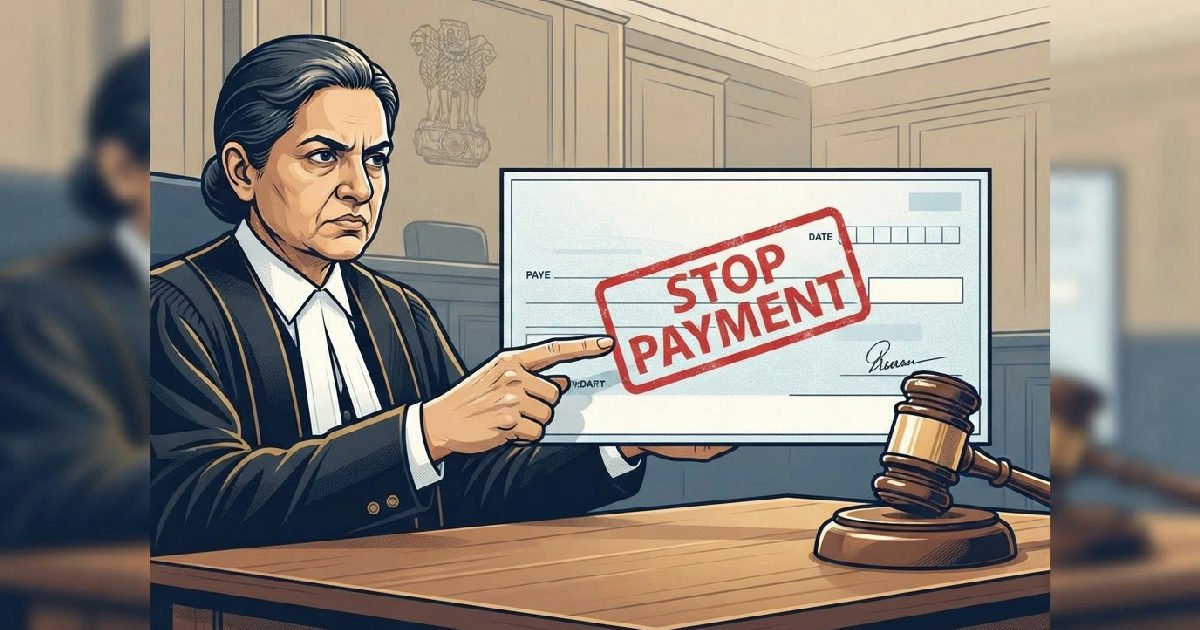
A “stop payment” instruction on a cheque does not automatically shield the drawer from prosecution under Section 138 of the Negotiable Instruments Act, 1881. This crucial legal stance, which the Supreme Court affirms in multiple landmark judgments, underscores the judiciary’s commitment to maintaining the credibility of cheque transactions and enforcing financial accountability across the nation.
Many individuals believe that issuing a stop payment instruction effectively closes the matter, preventing legal repercussions. However, if a cheque was issued to settle a legally enforceable debt or liability, and all other conditions stipulated by Section 138 are met, a stop payment can still lead to a demand notice and subsequently a criminal complaint.
Can stop payment not shield cheque dishonour
Issuing a “stop payment” order to a bank might seem like a straightforward way to prevent a cheque from being encashed. But India’s legal framework, particularly Section 138 of the NI Act, views such actions with a critical lens when a legitimate debt is involved.
Courts consistently prioritise the underlying transaction and the intent behind issuing the cheque. They scrutinise the existence of a legally enforceable debt, the proper presentation of the cheque, and the subsequent procedural steps taken by the payee, rather than solely relying on the bank’s reason code for dishonour.
This judicial approach prevents drawers from using stop payment instructions as a facile escape route from their financial obligations. The law aims to instill discipline and ensure that cheques remain a reliable medium for commercial transactions.
India Reinforces Cheque Credibility
The Courts have been unequivocal in its interpretation of how “stop payment” instructions interact with Section 138 of the NI Act. Its rulings emphasize that allowing such instructions to negate liability would fundamentally undermine the trust placed in cheque-based payments.
This perspective views a stop payment order, especially without a valid underlying justification, as a deliberate act. It often signifies a conscious decision by the drawer not to honour their financial commitment, potentially indicating a higher degree of dishonest intent compared to a cheque bouncing merely due to insufficient funds.
Landmark Rulings Uphold Liability
Several pivotal Supreme Court judgments have shaped the current legal landscape. In Modi Cements Ltd. v. Kuchil Kumar Nandi (1998), the Court definitively held that Section 138 is attracted even when a cheque is dishonoured due to a “stop payment” instruction.
Earlier, cases like Electronics Trade & Technology Development Corpn. Ltd. v. Indian Technologists & Engineers (Electronics) (P) Ltd. (1996) and K.K Sidharthan v. T.P Praveena Chandran (1996) had already laid the groundwork, reinforcing that a cheque returned with “stop payment” instructions still falls within the ambit of Section 138 if presented for encashment against a valid debt.
These rulings collectively form a robust precedent, guiding lower courts in their adjudication of similar matters.
Why ‘Stop Payment’ Signifies Intent
From a legal standpoint, a “stop payment” instruction can be seen as stronger evidence of deliberate default. Unlike an accidental insufficient funds situation, stopping payment is a conscious, active choice made by the drawer.
This conscious act makes it harder for the drawer to claim ignorance or oversight. Courts, therefore, often consider it indicative of a wilful decision to avoid payment, which can strengthen the payee’s case in a Section 138 complaint. This distinction is crucial for understanding the severity with which such actions are viewed in the legal system.
Essential Conditions for Section 138 Liability
For a cheque dishonoured because of a “stop payment” instruction to attract liability under Section 138, several specific conditions must be rigorously met by the payee. These conditions are statutory and must be followed sequentially for a criminal complaint to be maintainable in court.
It’s not enough for a cheque to simply bounce; the entire process, from issuance to filing the complaint, must align with the NI Act’s stipulations. Understanding these requirements is critical for both drawers and payees engaged in cheque transactions.
The Legally Enforceable Debt Requirement
Crucially, the cheque must have been drawn for the discharge, in whole or in part, of any legally enforceable debt or other liability. If the underlying transaction is illegal, unlawful, or does not constitute a genuine, legally enforceable debt, then Section 138 will not apply, regardless of the stop payment instruction.
This requirement is fundamental, as the law does not aim to enforce payments arising from unenforceable or illicit agreements. The payee bears the initial burden to establish the existence of such a debt, which the drawer may then attempt to rebut.
Procedural Steps for Payees
Beyond the underlying debt, the cheque must be presented to the bank within its period of validity, typically three months from its drawing date. Upon dishonour, the bank must return the cheque unpaid, often with the specific remark “payment stopped by drawer.”
Subsequently, the payee must issue a written demand notice to the drawer within 30 days of receiving the bank’s return memo, demanding payment of the cheque amount.
If the drawer fails to make the payment within 15 days of receiving this notice, the payee then has a window of one month after the expiry of the 15-day notice period to file a criminal complaint before a jurisdictional magistrate court. Failing any of these steps can invalidate the complaint.
These procedural safeguards ensure that drawers are given ample opportunity to rectify the situation before criminal proceedings are initiated. They also ensure that the legal process is followed diligently, preventing frivolous complaints. For more details on the legal process, one can refer to articles on bad cheque prosecution.
| Condition | Requirement | Rationale |
|---|---|---|
| Legally Enforceable Debt | Cheque for valid, lawful debt/liability. | Prevents misuse for illegal transactions. |
| Presentation Period | Within 3 months of cheque date. | Ensures timely encashment attempt. |
| Dishonour Reason | Bank returns as “payment stopped by drawer”. | Confirms drawer’s deliberate action. |
| Demand Notice | Issued by payee within 30 days of memo. | Formal communication of non-payment. |
| Failure to Pay | Drawer doesn’t pay within 15 days of notice. | Establishes non-compliance after warning. |
| Complaint Filing | Within 1 month post-notice period expiry. | Mandatory legal step to initiate proceedings. |
Genuine Defenses Against Stop Payment Allegations
While a “stop payment” instruction doesn’t automatically defeat a Section 138 case, drawers are not without recourse. There are legitimate defenses that, if successfully proven, can rebut the presumption of liability. The onus, however, often shifts to the accused to demonstrate the validity of their reasons.
These defenses typically revolve around challenging the fundamental premises of a Section 138 complaint, such as the existence of a valid debt or the circumstances under which the cheque was issued. Understanding these avenues is crucial for anyone facing such a legal challenge.
Proving a True Dispute Existed
A genuine dispute regarding the underlying contract or transaction can serve as a potent defense. If the drawer can convincingly demonstrate that the “stop payment” instruction was issued due to fundamental flaws in the transaction, such as non-delivery of goods, delivery of defective goods, or a significant breach of contract by the payee, the offense under Section 138 might not be made out.
The key here is “genuine.” Courts will differentiate between a legitimate disagreement over services or goods and a fabricated dispute designed merely to evade payment. For instance, a last-minute stop payment after services have been rendered or goods fully accepted would likely be viewed with scepticism.
The Burden of Rebuttal for Drawers
Section 139 of the NI Act creates a presumption that a cheque was issued for a legally enforceable debt. While this presumption can initially work against the drawer, it is rebuttable. The accused has the burden to present a probable defense and prove circumstances that negate the presumption.
For example, if the drawer can show the cheque was lost or stolen, or issued under coercion or threat, and sufficient funds were available in their account at the time of presentation, it could potentially establish a strong defense.
Similarly, if there was a complete lack of consideration for the cheque, Section 138 would not apply. Such specific situations highlight when not to file a cheque bounce case, as the underlying claim may be weak.
Penalties and Judicial Scrutiny for Non-Compliance
The implications of being found guilty under Section 138 of the NI Act are significant, reflecting the legislature’s intent to deter financial indiscipline. The legal process itself involves detailed scrutiny of all evidence presented by both sides.
Courts don’t simply look at the reason for dishonour; they delve deeper into the narrative surrounding the cheque. This comprehensive approach ensures that justice is served, balancing the need to uphold financial trust with protecting individuals from unjustified claims.
Consequences of a Guilty Verdict
If found guilty of an offense under Section 138, the drawer faces severe penalties. These can include imprisonment for a term of up to two years, a fine that may extend to twice the amount of the cheque, or both. The severity of these penalties underscores the criminal nature of the offense and its serious implications for the convicted party.
Beyond the direct legal consequences, a conviction can also carry social and professional ramifications, including damage to reputation and creditworthiness. For directors of companies, specific liabilities can arise, as explored in discussions around whether a company director can go to jail for cheque bounce.
What Courts Prioritise in Evidence
In adjudicating Section 138 cases involving “stop payment” instructions, courts meticulously examine several key pieces of evidence. This includes the details of the underlying debt, the cheque itself, the bank’s return memo clearly indicating the reason for dishonour, and the formal demand notice issued by the payee.
Critically, courts do not solely rely on the bank’s reason code. Instead, they seek to understand the full context of the transaction. Factual disputes regarding rates or quality of services are typically addressed during the full trial, rather than being used to quash proceedings at their initial stage, ensuring a thorough examination of all claims.
Implications for Financial Transactions and Discipline
The consistent judicial stance on “stop payment” instructions under Section 138 has far-reaching implications for commercial and personal financial dealings in India. It reinforces the seriousness with which cheque transactions are viewed and encourages greater fiscal discipline among individuals and businesses alike.
This legal clarity provides a stronger safeguard for payees, assuring them that issuing a cheque carries genuine legal weight. For drawers, it serves as a stern reminder that cheques are not to be issued lightly or with the intention of later avoiding payment through facile instructions to their bank.
The rulings bolster the overall integrity of India’s payment system, fostering greater trust and predictability in financial exchanges.
Does “stop payment” automatically protect me from a Section 138 case?
No, issuing a “stop payment” instruction does not automatically protect you from a Section 138 cheque dishonour case. Indian courts, including the Supreme Court, have consistently ruled that if the cheque was issued for a legally enforceable debt, and other conditions are met, you can still face legal action.
What evidence do courts look at in a stop payment cheque dishonour case?
Courts examine the underlying debt or liability for which the cheque was issued, the cheque itself, the bank’s return memo indicating “payment stopped by drawer,” and the demand notice sent by the payee. They look beyond just the bank’s reason for dishonour to understand the full context of the transaction.
What are valid defenses if I stopped payment on a cheque?
Valid defenses could include proving a genuine dispute over the underlying contract (e.g., non-delivery of goods), demonstrating the cheque was lost or stolen, showing it was issued under coercion, or proving there was no legally enforceable debt for which the cheque was given. The burden of proving such a defense typically lies with the drawer.WhatsApp or call for a free consultation
WhatsApp or call for a free consultation.
Related Service: Cheque Dishonour Law