
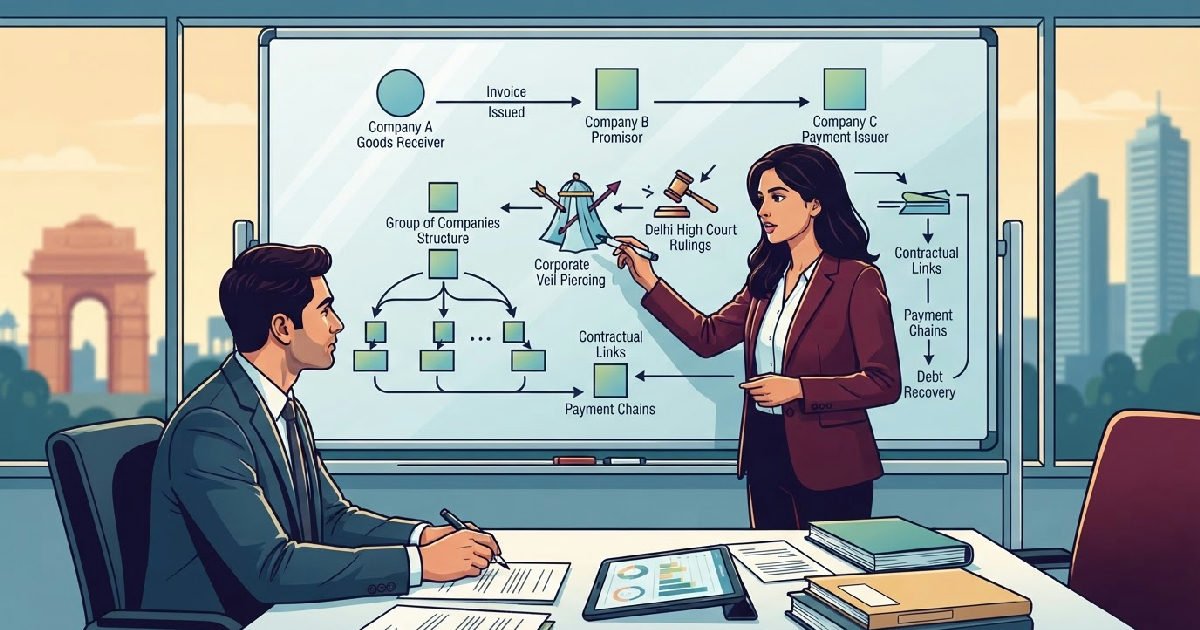
Navigating debt recovery in Delhi can quickly become a complex affair, particularly when commercial transactions span multiple entities within a corporate group. Businesses often face scenarios where invoices in one group company, payment assurances come from another, and a cheque ultimately bears the name of a third.
In such intricate situations, commercial lawyers in Delhi caution against a blanket approach of suing an entire corporate group. Instead, they meticulously map the contractual relationship, identifying which specific entity contracted for the goods, which received them, and which issued the payment instrument.
Invoices In One Group Company: Delhi High Court doctrine
A foundational principle of Indian company law asserts that a company maintains a separate legal personality, distinct from its shareholders or management. This means each entity generally holds its own rights and liabilities.
However, the doctrine of “piercing the corporate veil” serves as a crucial exception. Traditionally, Indian courts have invoked this doctrine in instances of outright fraud or when a company was explicitly formed to evade legal obligations.
The Delhi High Court has, notably, expanded the scope of this doctrine. Since at least April 3, 2023, the court has applied it on grounds of equity and to serve the ends of justice, particularly in the enforcement and execution of decrees.
This progressive stance allows the court to disregard a company’s separate identity. It attributes acts to those in direct operational control, preventing the corporate structure from frustrating the enforcement of legitimate legal obligations.
Director Liability and Corporate Misuse
When a corporate structure is demonstrably misused to perpetrate fraud or to shield wrongdoers, the Delhi High Court has affirmed that the corporate veil can be pierced. This makes it possible to hold individuals accountable for their actions.
Directors, for instance, can face personal liability if the corporate framework is employed for fraudulent or illegal acts. A significant example is in cheque dishonour cases, where the court has held directors personally liable for illegal activities facilitated by corporate structures.
The “Group of Companies” Doctrine in Practice
The Supreme Court of India has upheld the “group of companies doctrine,” particularly regarding its application to bind non-signatories to an arbitration agreement. This doctrine suggests that an arbitration agreement made by one company can, under specific conditions, extend to non-signatory entities within the same group.
However, the Delhi High Court has taken a more circumspect view when it comes to extending this doctrine to individual directors. The court has maintained that directors cannot be automatically joined as parties to arbitration proceedings against the company purely through this doctrine.
The relationship between a company and its directors is typically seen as principal and agent. An agent is generally not personally liable for actions performed on behalf of the principal, unless a specific contract states otherwise.
Distinct Legal Entities Under NI Act
Further clarifying the separation, the Delhi High Court has reaffirmed that each entity within a corporate group retains its distinct legal identity, especially concerning the Negotiable Instruments Act, 1881 (NI Act). Liabilities are not to be indiscriminately extended across the entire group.
Vicarious liability, as defined under Section 141 of the NI Act, specifically applies to individuals who are directly responsible for a company’s affairs. It does not automatically encompass other group companies, underscoring the need for precise identification of the defaulting entity.
Strategic Approach to Money Recovery in Delhi
Commercial lawyers in Delhi follow a structured, multi-step process for money recovery. This methodical approach aims to maximise the chances of success while navigating the complexities of corporate structures.
The initial and most critical step involves a thorough review of all pertinent documentation. This includes signed agreements, purchase orders, invoices, delivery receipts, and communication records, ensuring every piece of paperwork is meticulously organised.
Should initial polite reminders fail, a formal legal notice for money recovery in Delhi is the next crucial step. This notice, drafted by a lawyer, serves as an official warning before further legal action is pursued.
It must precisely detail the exact amount owed, reference specific invoices, state the original payment deadline, and clearly warn of impending legal action if payment isn’t received within a specified timeframe, usually 15 to 30 days. These notices are typically sent via registered post with acknowledgement due, providing crucial proof of delivery.
Before initiating formal litigation, negotiation and settlement attempts are often explored. This can be a pragmatic step to resolve disputes efficiently and avoid the time and cost associated with court proceedings.
Documentation and Legal Notices
Proper documentation is the bedrock of any successful money recovery case. Without a complete paper trail, establishing liability and the exact amount owed becomes significantly more challenging.
The legal notice itself is a powerful tool. Its formal nature often prompts debtors to take the claim seriously, sometimes leading to an out-of-court settlement before escalation to full legal action.
Available Legal Avenues
Depending on the specific circumstances of the case, various legal avenues are available for money recovery. Selecting the correct forum is critical for timely and effective resolution.
For outstanding debts based on invoices or contractual agreements where no cheque is involved, a commercial or civil recovery suit is the standard course of action. These are filed before a Commercial Court for disputes meeting commercial criteria.
If a cheque issued by the debtor company is dishonoured, Section 138 of the NI Act provides a specific and potent legal recourse. A legal notice must be issued within 30 days of the cheque bouncing, followed by a court complaint within 30 days if payment isn’t received.
This can lead to severe penalties, including imprisonment or a fine up to twice the cheque amount. For a faster resolution based on clear documentary evidence, a summary suit under Order XXXVII CPC offers an expedited procedure.
This mechanism allows for quicker disposal, as the defendant needs explicit court permission to defend the case. For corporate debtors, proceedings under the Insolvency and Bankruptcy Code (IBC) before the National Company Law Tribunal (NCLT) can be initiated by financial or operational creditors.
Arbitration remains a viable option if the contract contains a valid arbitration clause. It provides a private and potentially faster alternative dispute resolution mechanism. Additionally, registered micro and small enterprises can refer disputes to an MSME Facilitation Council, which can award statutory interest and often requires the buyer to deposit a substantial portion of the awarded amount if challenged.
| Legal Recourse Type | Applicability | Key Feature |
|---|---|---|
| Commercial/Civil Recovery Suit | Outstanding debt from invoices, contracts without cheque | Standard action in Commercial Courts |
| Cheque Bounce Case (Section 138 NI Act) | Dishonoured cheque from debtor company | Strict timelines; potential imprisonment/fine |
| Summary Suit (Order XXXVII CPC) | Money recovery based on written contracts, promissory notes | Fast-track procedure; defendant needs court permission to defend |
| IBC Proceedings (NCLT) | Insolvency against corporate debtors | Creditor-initiated; aims for resolution or liquidation |
| Arbitration | Contract with valid arbitration clause | Private, potentially faster dispute resolution |
| MSME Facilitation Council | Registered Micro and Small Enterprises disputes | Conciliation and statutory-interest award |
Key Considerations for Multi-Entity Suits
When multiple entities are involved, careful strategic planning is paramount. Commercial lawyers in Delhi stress the importance of mapping the exact contractual relationship to avoid procedural pitfalls.
This means precisely identifying which entity placed the order, which received the goods or services, and critically, which entity was responsible for payment or issued the instrument. Failing to do so can lead to a “maintainability fight,” where the opposing party challenges the very basis of the suit.
Avoid blanket suits that name every sister concern without clear justification. Such broad actions often backfire, bogging down proceedings in arguments about proper parties rather than the merits of the debt. A skilled money recovery lawyer will tailor the legal action to the specific entities directly involved.
Jurisdiction is another vital consideration. The correct forum depends on factors such as the value of the claim, the geographical location, any specific MSME status, and pre-agreed dispute resolution clauses in the contract. Jurisdiction is typically determined by the defendant’s residence or where the cause of action arose.
Finally, the limitation period cannot be overlooked. A civil suit for recovery must generally be filed within three years from the date payment became due and remained unpaid. Missing this deadline can irrevocably bar a legitimate claim.
Specialised Legal Expertise in the Capital
Delhi hosts a robust legal ecosystem, with numerous law firms specialising in commercial litigation and debt recovery. These firms provide crucial guidance for businesses navigating complex payment disputes.
Firms like Sarthak Advocates & Solicitors, SPJ Advocates & Co., KNK Legal, and Aegis Legal LLP are among those offering comprehensive services. Their expertise spans commercial fraud, commercial liability, and contract enforcement, operating across various judicial bodies.
These legal professionals represent clients in diverse forums, including the Delhi High Court, District Courts, Debt Recovery Tribunal (DRT), and the National Company Law Tribunal (NCLT). Their work ensures that businesses can pursue their legitimate claims effectively, even against seemingly impenetrable corporate structures.
The evolving interpretation of corporate law by the Delhi High Court, particularly regarding the corporate veil, provides crucial avenues for recovery in complex inter-company transactions. Understanding these nuances is key for any business seeking to enforce payment obligations.
Ultimately, a detailed and precise legal strategy, grounded in thorough documentation and a clear understanding of the involved entities, remains the most effective path for money recovery in India’s capital.
Can I sue all sister companies if one company owes me money?
No, commercial lawyers in Delhi generally advise against suing all sister concerns without clear justification. Each company has a separate legal identity, and a blanket suit can lead to a “maintainability fight” which delays or jeopardises your recovery efforts. It’s crucial to identify the specific entities involved in the contractual relationship.
What is the “corporate veil” and when can it be pierced in Delhi?
The corporate veil protects a company’s separate legal identity from its owners or directors. In Delhi, courts traditionally pierced it for fraud or legal evasion. However, the Delhi High Court has expanded this to include grounds of equity and to meet the ends of justice, especially in decree enforcement, if the corporate structure is misused.
What legal action should I take if a cheque from a group company bounces?
If a cheque from a group company is dishonoured, you should initiate a Cheque Bounce Case under Section 138 of the Negotiable Instruments Act, 1881. You must issue a legal notice within 30 days of the bounce and, if payment isn’t made, file a complaint in court within another 30 days. This can result in significant penalties for the defaulting entity.
Call or Whatsapp for free consultation.
Related Service: https://arpitmarwah.com/commercial-lawyers-in-delhi/