
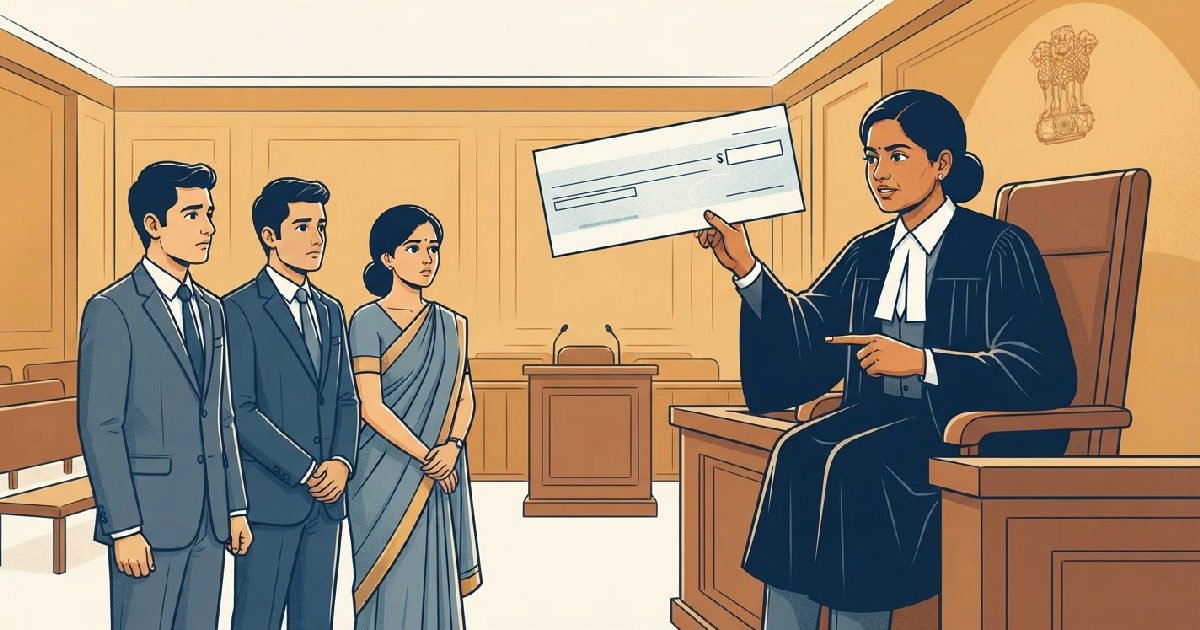
India’s Supreme Court has recently provided critical clarifications regarding the criminal liability of company directors in cheque bounce cases, emphasizing that merely holding a directorship is insufficient for prosecution.
Understanding the responsibilities of a company director is crucial in these matters.
A company director must be aware of their legal obligations and potential liabilities.
These pronouncements underscore a nuanced approach, demanding specific allegations of involvement rather than automatically implicating all board members under Sections 138 and 141 of the Negotiable Instruments Act, 1881 (NI Act). The legal landscape is evolving, distinguishing between strategic governance and day-to-day operational control, which impacts how directors are held accountable for dishonoured instruments.
For a company director, understanding these nuances is essential to avoid potential legal pitfalls.
A company director’s role can significantly impact the company’s financial health.
It is imperative for a company director to maintain accurate records of all financial transactions.
Each company director must take their duties seriously to safeguard their position.
Shifting Sands of Director Liability for Cheque Bounce
A company director’s decisions can have far-reaching implications for the entire organization.
Being a company director requires a deep understanding of corporate laws.
A company director must navigate complex legal frameworks effectively.
For years, a bounced cheque from a company could cast a wide net of potential criminal action, often creating uncertainty for directors who might not have been directly involved in the transaction. This perceived overreach sparked numerous legal challenges, leading to a series of judicial reviews aimed at refining the application of the law.
For every company director, understanding their limits is vital.
The responsibilities of a company director should never be underestimated.
Every company director must stay informed about changing regulations.
A company director is often the first point of contact in legal disputes.
The obligations placed on a company director can be extensive and demanding.
A company director must ensure compliance with all financial regulations.
Being a company director means taking accountability for financial decisions.
A company director must prioritize transparency in their dealings.
The role of a company director is not only about authority but about responsibility.
A company director must keep abreast of the latest legal developments to ensure compliance.
Each company director is expected to uphold the integrity of the company’s operations.
A company director should seek expert advice whenever in doubt about legal matters.
The current interpretation seeks to balance protecting creditors with preventing the indiscriminate targeting of individuals in corporate roles.
This shift is particularly significant in India’s business environment, where director liability in cheque bounce cases has often been a contentious issue. It impacts countless company executives, especially those in non-operational or advisory capacities, providing a clearer framework for their responsibilities and potential exposure. Companies and their boards must now meticulously document roles and responsibilities to align with these judicial expectations.
The core of India’s cheque bounce law lies in Section 138 of the NI Act, which criminalises the dishonour of cheques issued for a legally enforceable debt.
A cheque must be presented within three months of its issuance, dishonoured by the bank due to insufficient funds or other reasons, and the drawer must fail to make payment within 15 days of receiving a statutory notice demanding payment. This notice gives the drawer 30 days from bank intimation to rectify the situation.
While Section 138 primarily addresses the liability of the drawer, Section 141 extends this responsibility to individuals within a corporate entity.
It stipulates that “every person who, at the time the offence was committed, was in charge of, and was responsible to the company for the conduct of the business of the company, as well as the company, shall be deemed to be guilty of the offence”.
This vicarious liability has historically been a complex and frequently litigated aspect of corporate law.
The Negotiable Instruments Act: Core Offense
The Negotiable Instruments Act, 1881, was enacted to bolster confidence in commercial transactions and streamline the enforcement of payments made through instruments like cheques. Its provisions are designed to ensure that financial commitments are honored, imposing criminal penalties when cheques are deliberately dishonoured without a valid reason.
To successfully prosecute under Section 138, several conditions must be met: the cheque must represent a legally enforceable debt, it must be presented within its validity period, and the drawer must fail to respond to a statutory notice. Each step is critical, forming a strict procedural framework that complainants must adhere to.
Extending Liability: Section 141 and Company Involvement
The legislative intent behind Section 141 was to prevent companies from using their distinct legal identity to shield individuals responsible for corporate defaults. Without it, unscrupulous directors could potentially issue large cheques knowing the company’s limited assets might protect them from personal criminal repercussions.
However, the broad wording of the section often led to sweeping allegations against all directors, regardless of their actual involvement in the day-to-day operations or the specific transaction. This indiscriminate application prompted a series of judicial interventions aimed at refining the scope of personal liability.
Judicial Scrutiny: Who is “In Charge and Responsible”?
Recent Supreme Court rulings have consistently reinforced that a directorship alone is not sufficient to establish criminal liability under the NI Act.
In a landmark 2005 decision, S.M.S. Pharmaceuticals Ltd. vs Neeta Bhalla and Anr., the Supreme Court ruled that merely holding the position of a director is not enough to initiate criminal proceedings under Section 138. Specific allegations of active involvement in the company’s business at the time of the offense are required.
This judicial stance was further affirmed on March 4, 2025, in K.S. Mehta v. Morgan Securities and Credits Pvt. Ltd. Here, the Supreme Court clarified the scope of vicarious liability for non-executive directors under Section 141. It quashed criminal proceedings against directors who were not actively involved in the financial or operational management of the company, setting a clear precedent.
A company director’s proactive engagement can prevent legal issues from escalating.
A company director must also consider the implications of insolvency on their role.
Ultimately, a company director is responsible for the overall governance of the company.
A company director must navigate the complexities of financial obligations carefully.
The scrutiny of a company director’s actions can lead to significant legal consequences.
A company director must prepare for legal challenges arising from cheque bounce cases.
Similarly, a Supreme Court bench comprising Justice Sanjay Karol and Justice Augustine George Masih quashed criminal proceedings against a director in Saroj Pandey v. Govt of NCT of Delhi on April 9, 2026. This ruling reinforced the crucial distinction between strategic governance roles and hands-on, day-to-day operational management.
Understanding the implications of cheque bounce cases is vital for every company director.
Every company director should remain vigilant in documenting their business dealings.
The Court in Susela Padmavathy Amma vs. Bharti Airtel Limited also reiterated that vicarious liability only arises if the director was indeed in charge and responsible for the company’s business conduct at the time of the offense.
Mere Directorship Not Enough for Prosecution
The legal principle is now unequivocally clear: a criminal complaint must specifically outline how a director was “in charge of, and responsible to the company for the conduct of its business” at the time the cheque was issued and subsequently dishonoured. Generic accusations, such as simply naming all board members, are no longer deemed sufficient for prosecution.
Complainants must provide concrete evidence and specific particulars detailing the director’s role and their direct connection to the cheque bounce. This shift places a higher burden on accusers to conduct thorough due diligence before implicating individuals who may have had no operational control over the specific transaction.
The Role of Non-Executive and Independent Directors
Non-executive or independent directors, by their very nature, primarily provide strategic oversight and guidance rather than engaging in the day-to-day financial decisions of a company. Unless there are concrete allegations of their direct involvement in the specific transaction leading to the cheque bounce, they are increasingly being shielded from prosecution.
The Supreme Court has consistently stated that their title alone does not automatically satisfy the requirements of being “in charge of” and “responsible for” the company’s business. This clarification provides much-needed protection for individuals serving on boards in advisory capacities, distinguishing them from executive roles with direct financial authority.
Impact of Resignation on Liability
A crucial aspect of director liability pertains to those who have resigned. A director who has formally resigned before the issuance of a cheque cannot be held liable for its subsequent dishonour, even if the underlying debt originated during their tenure. The pivotal factor is the act of issuing the cheque itself.
This means that the timing of a director’s resignation relative to the cheque’s issuance date is critical. Proper documentation of resignation, including board resolutions and regulatory filings, becomes paramount for directors seeking to avoid future liability for company defaults.
The Realities of Punishment and Financial Penalties
The offense under Section 138 is serious, punishable with imprisonment for a term that may extend to two years, a fine that may extend to twice the amount of the cheque, or both. While many cheque bounce cases are ultimately settled or compounded out of court, especially with proactive legal engagement, the threat of jail time is a tangible reality that no director should ignore.
Courts particularly take cheque bounce cases seriously when certain aggravating factors are present. This includes instances where the statutory notice demanding payment was ignored, the underlying debt is undisputed in substance, or the accused repeatedly avoids court appearances. A pattern of default or deliberate evasion can significantly influence the severity of the judicial outcome, pushing towards stricter penalties.
Notable Sentences in Cheque Bounce Cases
Several high-profile cases underscore the judicial system’s willingness to impose both imprisonment and substantial financial penalties. On August 13, 2017, a Delhi court sentenced V.P. Aggarwal, the Managing Director of Prakash Industries Ltd., to a one-year jail term.
The court also directed him and his firm to pay a total of ₹10 crore to two Sahara group companies, Sahara India Airlines Ltd (SIAL) and Sahara India Financial Corporation Ltd (SIFCL), for 20-year-old cheque bounce cases, with each receiving ₹5 crore.
Another significant case saw a Mumbai metropolitan magistrate sentence Rajiv Khandelwal, the 54-year-old managing director of Pan Asia Industries Ltd., to one year in prison on April 13, 2017. He was also ordered to pay ₹9 crore as compensation after his company’s cheques, amounting to ₹5.50 crore, had bounced in 1996.
The court further directed that he serve an additional three months in prison if he failed to pay the compensation within one month, highlighting the severe consequences of non-compliance.
Insolvency and Personal Accountability: No Blanket Immunity
Many directors mistakenly believe that once a company enters into insolvency proceedings under the Insolvency and Bankruptcy Code (IBC), they are automatically shielded from criminal liability in cheque bounce cases. However, judicial pronouncements have consistently clarified that this is not a safe assumption.
While a moratorium under Section 14 of the IBC applies to legal proceedings against the corporate debtor (the company), it does not automatically extend to criminal proceedings under Sections 138 and 141 of the NI Act against individual directors. The two legal frameworks operate independently with distinct objectives.
The Supreme Court has repeatedly affirmed that company directors remain subject to criminal prosecution in cheque bounce cases, even when the corporate entity has undergone debt resolution or liquidation. The insolvency process does not provide blanket immunity for individuals who were directly responsible for signing or issuing dishonoured instruments. Directors must get current legal papers examined before relying on IBC as a shield.
India’s Cheque Bounce Crisis: Mounting Pendency and Delays
The sheer volume of cheque bounce cases represents a significant and escalating burden on India’s judicial system. As of December 18, 2024, over 43 lakh (4.3 million) cheque bounce cases were pending across various courts nationwide. This enormous backlog contributes to substantial delays in the dispensation of justice, impacting both individuals and businesses.
The average resolution time for cases filed under Section 138 of the NI Act in subordinate courts currently stands at 1,326 days, which translates to over three years and seven months. This duration starkly contrasts with the legislative intent outlined in Section 143 of the NI Act, which explicitly states that judges should endeavour to complete such trials within a six-month timeframe.
Delhi’s Disproportionate Burden
The capital region, Delhi, faces a particularly acute challenge regarding cheque bounce cases. As of October 9, 2025, Delhi’s trial courts were grappling with 5.55 lakh (555,000) pending cheque bounce cases. This staggering figure constitutes approximately 36% of the total judicial pendency within the city’s court system.
Alarmingly, this number increased by 1 lakh cases in just nine months, indicating an average of 370 new cheque bounce cases being filed every single day in Delhi. The city also records the highest number of cheque bounce cases relative to its population, highlighting a critical legal and commercial issue that continues to strain judicial resources.
| Region | Pending Cheque Bounce Cases | As of Date |
|---|---|---|
| Rajasthan | Over 6.4 lakh | December 2024 |
| Delhi | 5.55 lakh | October 2025 |
| All India Total | Over 43 lakh | December 2024 |
Navigating the Legal Maze: Strategic Steps for Directors
Given the complexities and severe potential consequences, directors must adopt a proactive and highly informed approach when confronted with a cheque bounce notice. Ignoring such a notice is arguably the gravest error one can make, as it can be interpreted as an admission of default and significantly prejudice any future defence strategies.
Legal experts strongly advise against sending angry or partially admitting replies, which can unintentionally create further legal complications and weaken a director’s position. Instead, the immediate priority should be to methodically gather all relevant documents. This includes the dishonoured cheque itself, the bank return memo indicating the reason for dishonour, and any underlying contracts, invoices, or board resolutions pertaining to the transaction.
Verifying that the company has been correctly named as an accused party in the complaint is also a critical step. If the company is not properly impleaded, the complaint against the director may not be maintainable, offering a potential line of defense. Swift action is crucial, and legal pathways for recovering dishonored payments are complex and require expert navigation.
Crucially, directors should seek expert legal advice well before the critical 15-day notice period expires. This allows for the formulation of a proper, legally sound response or the initiation of timely settlement discussions. A well-considered reply or an earnest attempt at resolution is often far more effective and less risky than silence or ill-advised communication.
Many cheque bounce lawyers in Delhi offer initial consultations to assess the situation.
Can any director be held liable for a cheque bounce from their company?
No, not every director automatically faces liability. The Supreme Court has clarified that mere directorship is insufficient. For prosecution, the complaint must contain specific allegations demonstrating that the director was “in charge of, and responsible to the company for the conduct of its business” at the time the offense occurred.
What should a director do immediately after receiving a cheque bounce notice?
Upon receiving a cheque bounce notice, a director should immediately collect all relevant documents, including the dishonoured cheque, bank return memo, and any related contracts or invoices. It is crucial not to ignore the notice or send an angry reply. Seeking legal advice before the 15-day notice period expires is highly recommended to assess the situation and plan an appropriate response.
Does the company’s insolvency protect its directors from cheque bounce cases?
No, a company’s insolvency does not automatically protect its directors from criminal liability in cheque bounce cases. While a moratorium under the Insolvency and Bankruptcy Code (IBC) protects the corporate debtor (the company), it does not extend to criminal proceedings under the Negotiable Instruments Act against individual directors. Directors remain subject to prosecution even if the company is undergoing debt resolution or liquidation.