
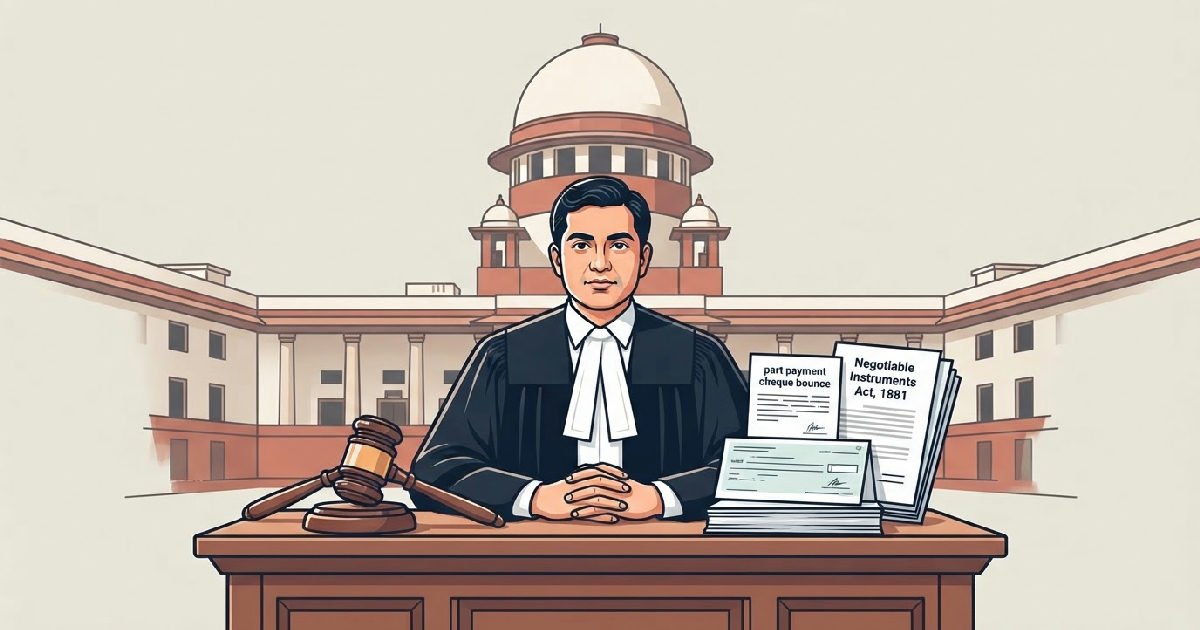
On October 12, 2022, the Supreme Court of India delivered a pivotal judgment in Dashrathbhai Trikambhai Patel v. Hitesh Mahendrabhai Patel (Criminal Appeal No. 1497 of 2022).
This landmark decision clarified the intricate relationship between part payment after the cheque bounce and the ongoing validity of an offence under Section 138 of the Negotiable Instruments Act, 1881, specifically addressing how part payment cheque bounce cases are handled.
The ruling confirms that a subsequent part payment does not automatically extinguish the criminal liability for cheque bounce. However, it significantly influences the potential for settlement and the calculation of the outstanding debt. This guidance is crucial for both drawers and payees navigating these complex legal waters.
Understanding the Part Payment After The Cheque Bounce Framework in India
India’s legal framework for cheque dishonour primarily rests on Section 138 of the Negotiable Instruments Act, 1881 (NI Act). This specific provision criminalises the act of a cheque being returned unpaid, provided it was issued to settle a legally enforceable debt or liability.
For an offence under Section 138 to be established, several conditions must first be met. The cheque needs presentation within its three-month validity period, followed by its dishonour due to reasons like insufficient funds or a stop payment instruction from the drawer.
Subsequently, the payee must issue a demand notice to the drawer within 30 days of receiving the ‘cheque return memo’ from the bank. The drawer then has 15 days from receipt of this notice to make the payment; failure to do so triggers the legal offence.
This notice process is a crucial step in the legal journey, often determining the viability of a case, as explored in detail by cheque bounce lawyers in Delhi.
The Dashrathbhai Trikambhai Patel Ruling Explained
The Supreme Court’s pronouncement in Dashrathbhai Trikambhai Patel v. Hitesh Mahendrabhai Patel directly addresses the ambiguity surrounding part payments. The judgment firmly establishes that an offence under Section 138 is initiated the moment the drawer fails to make payment within 15 days of receiving the demand notice, irrespective of any subsequent partial remittance.
Specifically, the Court elucidated that even if a part payment is made after the demand notice period, it does not automatically absolve the drawer of the criminal charge. Instead, such payments serve to reduce the amount claimed in the subsequent legal proceedings, often leading to potential compounding of the offence.
The judiciary’s stance here reflects a pragmatic approach: acknowledging the original offence while encouraging settlement. This means the criminal case continues, but the financial liability for which the case proceeds is adjusted downwards, providing a clear path for resolution.
Defining the Commencement of the Offence
A core element of the Supreme Court’s decision lies in pinpointing when the offence under Section 138 truly commences. The Court unequivocally stated that the offence is complete the moment the 15-day period for payment lapses after the demand notice is served, and the payment remains outstanding.
Any payment made after this specific 15-day window, even if it covers a portion of the bounced cheque amount, cannot undo the fact that an offence has already been committed. This clarification removes previous uncertainties about the legal status of the case post-partial payment.
Impact on Compoundability of Offences
While the criminal liability remains, part payments significantly influence the compoundability of the offence. Compounding allows the parties to settle the matter out of court with the court’s permission, often resulting in the withdrawal of the criminal case upon full payment of the agreed-upon sum.
The acceptance of a part payment by the payee generally indicates a willingness to settle, which courts view favourably. This can expedite the resolution process, saving both parties from prolonged litigation and the associated costs and stresses.
Implications for Complainants and Accused Parties
For individuals and businesses who have received a bounced cheque, the ruling provides a clearer path forward. They can accept part payments without fear of weakening their Section 138 case, knowing that the criminal liability remains intact and the offence is not automatically wiped out.
Conversely, drawers who make part payments after a cheque dishonour should understand this action doesn’t automatically negate the criminal proceedings. While it may demonstrate good faith, the legal process will likely continue, though perhaps towards a facilitated settlement rather than a full trial.
Both sides must diligently document any partial payments to ensure their legal standing in court. A receipt explicitly stating the payment is for a specific bounced cheque and whether it’s ‘full and final’ or a ‘part payment’ is crucial for legal clarity and to prevent future disputes.
Protecting the Complainant’s Position
This judgment strengthens the hand of the complainant, as it ensures that the deterrent effect of Section 138 is not diluted by partial payments. Creditors can pursue their claims with confidence, knowing their legal rights are preserved even when debtors attempt staggered repayments.
It prevents situations where a drawer might make a small, insufficient payment solely to claim the entire criminal case is now invalid. The payee retains the right to pursue the remaining amount through the established legal channels.
Navigating Defence Strategies for the Accused
For the accused, the ruling means that making a part payment, while beneficial for demonstrating intent to clear the debt, does not automatically serve as a complete defence. Defence strategies must therefore focus on the specific terms of the payment and the overall circumstances.
It becomes essential to prove that such payments were indeed made and acknowledged. This impacts how how long a cheque bounce case takes in Delhi and its eventual outcome.
Key Aspects of Section 138 Cases: Pre & Post Part Payment
The Supreme Court’s ruling provides important distinctions on how cases under Section 138 are treated before and after a part payment is made post-notice. This distinction is crucial for understanding the evolving nature of liability and potential resolution pathways in cheque dishonour cases. The following table highlights these critical differences:
| Aspect | Before Part Payment (After Notice) | After Part Payment (Post-Notice) |
|---|---|---|
| Offence Status | Initiated and continues with full original liability. | Continues, but the financial liability is reduced. |
| Claim Amount in Court | Full value of the dishonoured cheque. | Adjusted by the amount of part payment received. |
| Settlement Potential | High, based on the full outstanding amount. | Higher, as part payment shows willingness to resolve. |
| Criminal Liability | Present, subject to legal prosecution. | Present, but often leads to compounding of the offence. |
| Evidentiary Value | Focus on cheque dishonour and notice. | Part payment acts as evidence of debt acknowledgement. |
This clear demarcation ensures that while part payments mitigate the financial extent of the claim, they do not absolve the criminal implications entirely. It reinforces the legal framework’s intent to deter cheque dishonour, compelling drawers to fulfill their obligations while also creating an environment conducive to settlement discussions based on the remaining outstanding amount.
Strategic Considerations for Managing Part Payments
The ruling implicitly addresses scenarios where cash payments are made without proper documentation—often referred to as a ‘cash drop.’ Such undocumented transactions significantly undermine the drawer’s position, as they cannot legally prove the reduction of debt, complicating their defence.
Lawyers routinely advise clients to obtain proper receipts detailing the amount, date, purpose, and remaining outstanding balance for any payment. Without such proof, the payment might not be acknowledged in court, or worse, could be denied by the payee, leading to further disputes.
Crucially, if a payment is not the full amount, drawers should avoid having the receipt state ‘full and final settlement.’ This could complicate future claims and potentially misrepresent the actual financial arrangement, making the position of replying to a cheque bounce legal notice much harder.
Documentation as a Shield
The emphasis on documentation cannot be overstated. For drawers, a properly acknowledged receipt provides concrete evidence of their efforts to settle the debt and reduces the actual claim amount. It is their primary protection against claims of non-payment.
For payees, providing a clear receipt for a part payment ensures transparency and prevents any future allegations of misrepresentation or denial of received funds. It maintains the integrity of their legal claim while acknowledging the payment.
Avoiding Pitfalls of Undocumented Transactions
Undocumented payments, especially cash transactions, are fraught with risk for both parties. Without a paper trail, there is no verifiable record of the transaction, which can lead to disputes over whether a payment was made at all, or its exact amount.
This lack of proof can severely disadvantage the drawer in court, potentially leading to the court disregarding their claim of part payment. It underscores the critical need for formal and recorded financial dealings, even in situations of dispute.
Navigating Legal Complexities: The Role of Legal Counsel
Given the intricate nature of Section 138 cases and the added layer of complexity introduced by part payments, expert legal counsel becomes indispensable. Lawyers specialising in cheque bounce cases can guide both complainants and accused through the process, ensuring compliance with all legal requirements.
For drawers, a lawyer can advise on the best way to make and document part payments to maximise their impact on potential settlement or mitigation of penalties. For payees, legal advice is critical in determining whether to accept a part payment and how to proceed with the case while reflecting the adjusted amount.
Legal professionals are skilled in deciding whether to seek compounding of the offence, amend the figures in the complaint, or continue with the original case. Their strategic advice can often lead to a faster and more favourable resolution for their clients, minimising legal costs and time.
Expert Guidance on Settlement Negotiations
Legal counsel plays a vital role in negotiating settlements, especially when part payments have already been made. They can help draft settlement agreements that accurately reflect the reduced liability and ensure that the terms are legally binding and enforceable.
This expertise is particularly valuable in formalising the compounding of an offence, a process that requires court approval. A well-negotiated settlement can prevent the case from dragging on for years, offering a quicker and more predictable outcome.
Ensuring Legal Compliance and Proper Procedure
Beyond negotiation, lawyers ensure that all procedural aspects of a Section 138 case, including the proper issuance of notices and filing of complaints, are meticulously followed. This is crucial as procedural errors can lead to delays or even the dismissal of a case.
They also provide essential advice on the collection and presentation of evidence, including proof of part payments. This diligence ensures that their client’s position is robustly supported throughout the legal proceedings, whether they are the complainant or the accused.
The Broader Impact on Financial Transactions
This Supreme Court judgment contributes to greater clarity in India’s commercial landscape, encouraging more transparent financial dealings. It signals that debtors cannot evade liability by making token part payments without facing the full legal consequences of a dishonoured cheque.
For creditors, the ruling reinforces confidence in the NI Act as a robust mechanism for recovering debts, even when debtors attempt partial settlements. It means the criminal aspect, designed as a deterrent, remains effective and provides substantial protection against dishonest debtors.
Ultimately, the decision serves to promote more responsible issuance and handling of cheques across the country. It underscores that a cheque is a serious financial instrument, and its dishonour carries significant legal ramifications, regardless of subsequent partial actions or good-faith efforts to repay.
Enhancing Creditor Confidence
The clarity offered by the Court empowers creditors, assuring them that their legal recourse under Section 138 remains potent. They can now accept part payments as a step towards resolution, rather than a potential compromise of their original legal claim.
This certainty encourages continued reliance on cheques as a secure form of payment in commercial transactions. It reduces the perceived risk associated with extending credit or accepting post-dated cheques in business dealings.
Promoting Fairer Debt Resolution
While upholding criminal liability, the judgment also promotes fairer debt resolution by encouraging and legitimising part payments as a path to settlement. It allows for flexibility in resolving disputes while ensuring the debtor remains accountable.
This balanced approach helps prevent exploitation by either party, ensuring that debtors are not unduly penalised for genuine attempts at repayment, and creditors are not left without recourse for outstanding dues.
Future Outlook for Section 138 Cases
The clarification provided by the Dashrathbhai Trikambhai Patel ruling may lead to more streamlined resolutions in cheque bounce cases. With the legal standing of part payments now clearer, parties might be more inclined towards structured settlements rather than prolonged litigation.
This judgment also signifies the judiciary’s continued emphasis on upholding the sanctity of financial instruments like cheques. It’s part of a broader effort to ensure that the NI Act effectively serves its purpose of instilling confidence in commercial transactions and maintaining financial discipline.
Despite the increased clarity, both debtors and creditors must remain vigilant. They need to understand their rights and obligations fully, especially when dealing with any form of partial payment after a cheque has bounced, ensuring all actions comply with the spirit and letter of the law.
Potential for Reduced Litigation Burden
By providing clear guidelines on how part payments affect criminal liability, the Supreme Court’s decision could potentially reduce the burden on courts. Cases involving part payments might be resolved more quickly through compounding, rather than proceeding to full trial.
This efficiency gain would be a welcome development, given the large number of cheque bounce cases that typically clog the Indian judicial system, often delaying justice for other matters.
Ongoing Evolution of Cheque Bounce Law
This ruling is another example of the dynamic nature of cheque bounce law in India, which continually adapts to commercial realities. It highlights the importance of staying informed about legal developments, as interpretations can significantly alter the landscape for both individuals and businesses.
As financial transactions evolve, so too will the legal frameworks governing them, necessitating continuous legal vigilance and adaptation from all involved parties to ensure compliance and protection of rights.
Does a part payment after a cheque bounces completely dismiss the Section 138 case?
No, the Supreme Court clarified that a part payment made after a cheque dishonour does not automatically dismiss the criminal offence under Section 138 of the Negotiable Instruments Act. The offence is initiated when the drawer fails to pay within 15 days of receiving the demand notice.
How does a part payment affect the legal proceedings in a cheque bounce case?
While the criminal offence continues, a part payment reduces the outstanding debt amount for which the case is being pursued. This often facilitates a potential settlement or compounding of the offence, where the reduced sum is paid, and the case is withdrawn with court permission.
What should one do if making or receiving a part payment for a bounced cheque?
It is crucial to properly document any part payment with a clear receipt. This receipt should specify the amount paid, the date, and whether it’s a partial settlement, avoiding terms like “full and final” unless the entire debt is cleared. Legal advice is highly recommended to ensure proper handling.
Call or Whatsapp for free consultation.
Related Service: https://arpitmarwah.com/cheque-bounce-lawyers-in-delhi/
https://arpitmarwah.com/cheque-dishonor-lawyer/