
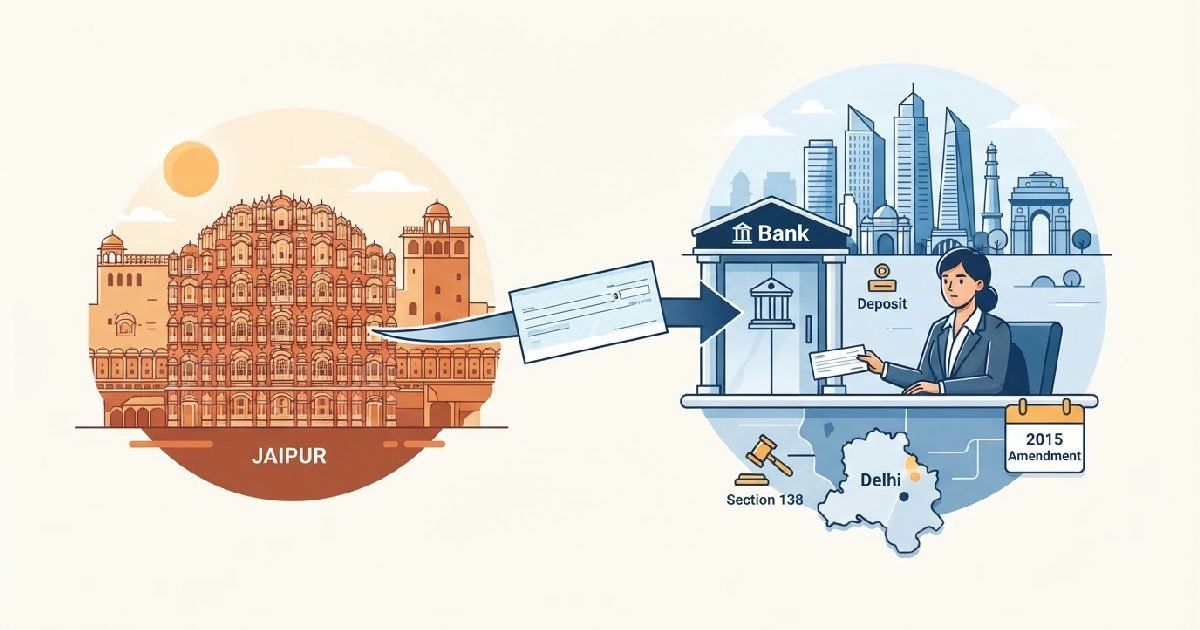
Jurisdiction for cheque bounce cases: Complainant Bank In Delhi
Filing a Section 138 Negotiable Instruments Act (NI Act) cheque bounce case in India has seen significant changes, particularly concerning jurisdiction.
When a payee’s bank is located in Delhi and the cheque’s drawer resides in another state, such as Jaipur, the critical factor for determining where to file the complaint now hinges on the payee’s bank branch where the cheque was presented for collection.
This pivotal shift stems from the Negotiable Instruments (Amendment) Act, 2015, which came into force retrospectively on 2015-06-15, the same day the enabling Ordinance was promulgated.
This legislative amendment fundamentally reshaped the legal landscape for dishonoured cheques. It ensures that complainants in Delhi, even when dealing with out-of-state drawers, file cases in the correct local jurisdiction. The aim was to streamline the process, reduce “forum shopping,” and offer clear guidance for aggrieved parties seeking legal recourse.
Defining the Primary Jurisdictional Rule
The 2015 amendment clearly stipulates that if a cheque is delivered for collection to the payee’s account, the complaint must be filed within the local jurisdiction of the bank branch where the payee maintains that account and where the cheque was presented. This means a Delhi bank branch receiving the deposited cheque determines the court’s location.
So, even if a drawer is based in Jaipur, if the cheque was deposited into a payee’s account at a bank branch in Delhi, the case would rightfully be heard in a Delhi court. This provision was designed to provide clarity and prevent endless litigation over jurisdictional disputes.
The Critical Role of the 2015 Amendment
Before the 2015 amendment, jurisdiction in cheque bounce cases was often a contentious issue. The Supreme Court’s 2014 ruling in Dashrath Rupsingh Rathod vs. State of Maharashtra had restricted jurisdiction to the place where the cheque was dishonoured by the drawee bank, typically the drawer’s bank. This created challenges for payees, especially those whose drawers were in different states.
The Negotiable Instruments (Amendment) Act, 2015, explicitly superseded this judgment. Its retrospective application was a key feature, meaning even pending cases filed before 2015-06-15 were subject to transfer to courts with the appropriate jurisdiction as per the new provisions. This retrospective validation was crucial for consistency across the judicial system.
The amendment’s primary purpose was to prevent what lawyers call “forum shopping,” where parties might try to file cases in courts perceived as more favourable. It also aimed to reduce harassment for accused individuals by clearly defining the proper court.
But, crucially, it also ensures that genuine complainants retain accessible legal remedies without undue geographical barriers. Determining which court in Delhi has jurisdiction is now much more straightforward.
Navigating Delhi’s Decentralized Court System
Delhi’s court system is decentralized, with cheque bounce cases primarily heard by Metropolitan Magistrate courts. These courts operate within various district court complexes across the capital. Understanding which specific court has jurisdiction is paramount for effective litigation.
For instance, Saket Court handles cases originating from South and South-East Delhi. Meanwhile, Tis Hazari Court covers Central and West Delhi. Other significant court complexes include Patiala House Courts for New Delhi District, Rohini Courts for North-West District, Dwarka Courts for South-West District, and Karkardooma Courts for the East District, along with Rouse Avenue Courts for Special Commercial Divisions.
Pinpointing the Correct Bank Branch
The precise location of the payee’s bank branch where the cheque was deposited for collection is the deciding factor. It’s not enough to simply know that the payee has an account in Delhi. Lawyers handling cheque bounce cases must meticulously examine the deposit slip to confirm the specific branch.
A common misconception is that a party’s residence or business location in, say, South Delhi, automatically grants Saket Court jurisdiction. This isn’t true. The legally relevant bank branch determines the court. The drawer’s GST address, while useful for proving the underlying transaction or debt, does not dictate the territorial jurisdiction for filing a Section 138 complaint.
The Step-by-Step Process for Cheque Dishonour
When a cheque bounces, a clear sequence of actions must be followed to initiate a Section 138 complaint. Adhering to these procedural steps and strict timelines is crucial for the legal validity of the case.
These steps are meticulously defined within the Negotiable Instruments Act to ensure fairness and provide a structured path for redressal, starting from the moment of dishonour to the potential filing of a criminal complaint.
The initial phase involves the bank officially notifying the payee of the cheque’s dishonour, providing a “Cheque Return Memo” that specifies the reason. This memo is indispensable as evidence.
Following its receipt, the payee is granted a critical 30-day period to dispatch a formal legal notice to the drawer, demanding the payment of the outstanding amount. This notice serves as a prerequisite for further legal action, giving the drawer a final opportunity to rectify the situation voluntarily.
Should the drawer fail to settle the debt within 15 days of receiving the demand notice, the offence under Section 138 is deemed complete, paving the way for a criminal complaint.
The payee then faces another stringent deadline: a 30-day window from the expiry of the 15-day notice period to file the complaint in the appropriate Metropolitan Magistrate court. Strict adherence to these timelines is paramount, as any delay can jeopardise the entire legal proceeding.
Understanding Dishonour and the Memo
The process begins when the cheque is presented for payment and subsequently dishonoured by the bank. The bank then issues a “Cheque Return Memo,” clearly stating the reason for the dishonour. This memo is a vital piece of evidence and the starting point for legal action.
Issuing the Demand Notice
Upon receiving the dishonour memo, the payee has a strict 30-day window to send a legal notice to the drawer. This notice formally demands payment of the cheque amount. The drawer then has 15 days from the receipt of this notice to make the payment.
If the drawer fails to make the payment within these 15 days, the offence under Section 138 is considered to have occurred. This opens the path for the payee to file a criminal complaint.
Filing the Criminal Complaint
Following the expiration of the 15-day notice period, the payee has exactly 30 days to file a criminal complaint in the relevant Metropolitan Magistrate court. Missing this 30-day deadline can significantly complicate the case, potentially leading to dismissal. It underscores why experienced cheque bounce lawyers in Delhi emphasize prompt action.
Interim Compensation and Opportunities for Settlement
The legal framework surrounding cheque bounce cases also includes provisions designed to provide some immediate relief to complainants and encourage out-of-court settlements. These measures aim to alleviate the financial burden on the payee, reduce the strain on the judicial system, and offer avenues for quicker, mutually agreeable resolutions outside of protracted litigation.
A significant advancement in this regard is Section 143A of the NI Act, introduced in 2018. This provision empowers courts to mandate that the accused pay up to 20% of the cheque amount as interim compensation to the complainant.
This crucial payment can be ordered at the very outset of the trial and is typically required within 60 days, offering a much-needed financial cushion to the aggrieved party during the often-lengthy legal process.
Furthermore, Section 147 of the NI Act facilitates the “compounding” or settlement of the offence at any stage. Delhi courts actively promote early settlements, often leveraging their dedicated Mediation Centres.
This approach is highly beneficial for both parties, as it enables a faster resolution than a full trial, potentially saving substantial legal costs and time while fostering an environment where a mutually agreeable settlement can lead to the withdrawal of the complaint.
Interim Compensation Under Section 143A
A significant addition to the NI Act is Section 143A, introduced in 2018. This provision empowers courts to order the accused to pay up to 20% of the cheque amount as interim compensation to the complainant. This can happen at the very beginning of the trial, with the payment typically due within 60 days.
This provides some financial relief to the payee during what can often be a lengthy legal process.
Compounding of Offence via Section 147
Section 147 of the NI Act allows for the “compounding” or settlement of the offence at any stage of the proceedings. Delhi courts actively encourage early settlement through their various Mediation Centres. This approach benefits both parties, offering a quicker resolution than a full trial and potentially saving significant legal costs and time.
A mutually agreeable settlement can often be reached, leading to the withdrawal of the complaint.
Key Jurisdictional Facts Post-2015 Amendment
The 2015 amendment marked a watershed moment in the adjudication of cheque bounce cases, fundamentally altering the landscape for determining jurisdiction. Prior to this, the legal position, as crystallized by judicial pronouncements, often led to practical difficulties and protracted disputes over where a case could legitimately be filed. The amendment sought to bring much-needed clarity and predictability to this aspect of the law.
Crucially, the primary jurisdiction for filing a Section 138 complaint shifted from the location of the drawer’s bank, where the cheque was dishonoured, to the specific branch of the payee’s bank where the cheque was deposited for collection.
This change was a direct response to issues like “forum shopping” and the harassment faced by payees who often had to travel to distant locations to pursue their claims. The new rule ensures that cases are heard in a jurisdiction more convenient for the complainant.
| Aspect | Pre-2015 Amendment (Dashrath Rathod ruling) | Post-2015 Amendment (NI Act, 2015) |
|---|---|---|
| Primary Jurisdiction | Drawer’s bank (place of dishonour) | Payee’s bank branch (where cheque delivered for collection) |
| Purpose of Change | Limited jurisdiction, led to forum shopping | Clarified jurisdiction, prevented forum shopping, reduced harassment |
| Retrospective Application | No explicit provision | Yes, applicable to pending cases as of 2015-06-15 |
| Alternative Jurisdiction | Limited to drawer’s bank location | Drawer’s bank (if payee presents cheque in any other way than through own account) |
Furthermore, the amendment’s retrospective application was a key feature, validating even pending cases filed before its effective date of June 15, 2015, under the new jurisdictional rules. This not only ensured uniformity across the judicial system but also provided relief to numerous litigants whose cases were previously stuck in jurisdictional limbo.
While the primary focus is on the payee’s bank, the law also provides for the drawer’s bank to be considered in specific scenarios, offering a comprehensive framework.
What is the primary change introduced by the 2015 amendment?
The 2015 amendment to the Negotiable Instruments Act primarily shifted the jurisdiction for cheque bounce cases. Previously, jurisdiction was often tied to the location of the drawer’s bank where the cheque was dishonoured. Post-amendment, the determining factor is the specific branch of the payee’s bank where the cheque was delivered for collection, making it more convenient for the complainant to file the case.
How does interim compensation work under Section 143A?
Section 143A, introduced in 2018, allows courts to order the accused to pay interim compensation to the complainant. This compensation can be up to 20% of the cheque amount and can be mandated at the very beginning of the trial. Typically, this payment is required to be made within 60 days, providing financial relief to the payee during the ongoing legal proceedings.
Can a cheque bounce case be settled out of court?
Yes, cheque bounce cases can be settled out of court through a process known as “compounding of offence” under Section 147 of the NI Act. Courts, particularly in Delhi, actively encourage such settlements through their Mediation Centres.
A mutually agreeable settlement can be reached at any stage of the proceedings, leading to the withdrawal of the complaint and often saving both parties significant time and legal expenses.
Out-of-state drawer, Delhi bank? Call or Whatsapp for free consultation.
Related Service: https://arpitmarwah.com/cheque-bounce-lawyers-in-delhi/