
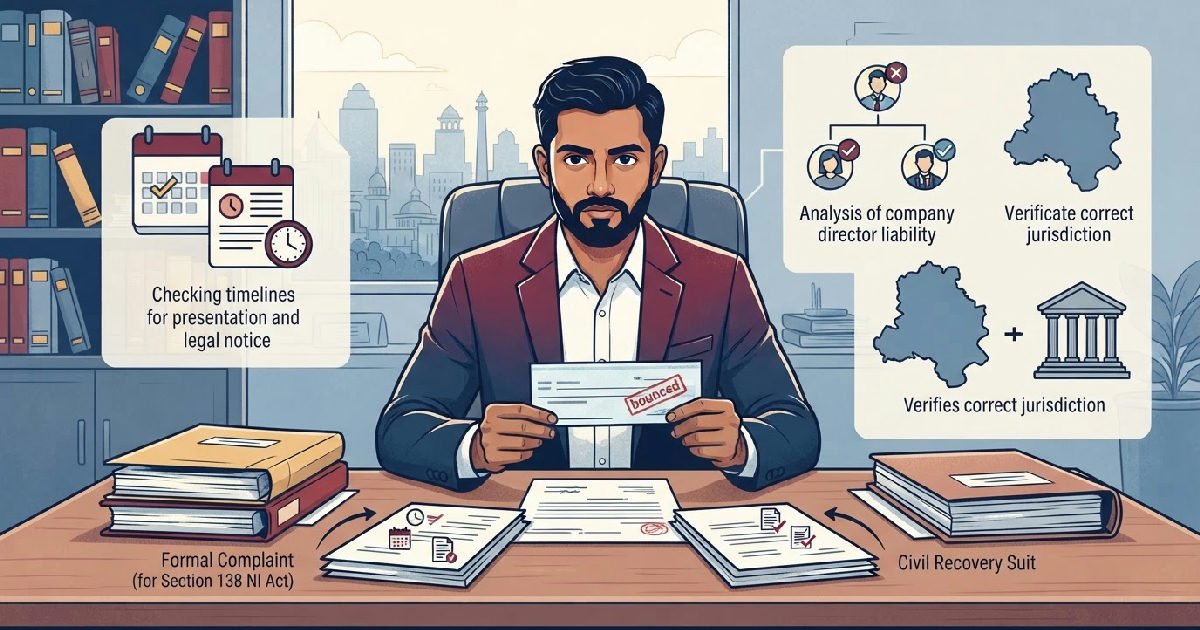
A cheque bounce lawyer in Delhi examines crucial factors to determine the viability of a Section 138 complaint under the Negotiable Instruments Act, 1881. This rigorous pre-filing scrutiny is vital to prevent procedural missteps that could lead to the case’s dismissal.
The capital faces a substantial backlog of cheque bounce cases, yet not every dishonoured instrument warrants immediate court action. Lawyers must first ascertain if the cheque represents a legally enforceable debt, if it was presented within its validity period, and if critical legal notices were issued and responded to according to strict timelines. Failing any of these points can undermine the entire legal effort.
Cheque bounce lawyer Delhi: Section 138
The success of a Section 138 complaint hinges on adhering to a series of stringent conditions outlined in the Negotiable Instruments Act. A Delhi lawyer’s initial assessment focuses keenly on these prerequisites, understanding that even minor deviations can render a case unmaintainable.
These foundational requirements include verifying that the cheque represents a genuinely enforceable debt and that it was presented to the bank within the stipulated three-month validity period. Without a legitimate underlying obligation, or if the presentation is delayed, the very basis of the complaint falters.
Such diligence is crucial, as the courts strictly interpret these initial conditions, making pre-filing scrutiny by legal experts indispensable for any successful prosecution.
Furthermore, the meticulous observance of notice periods following dishonour is equally critical. Issuing a legal demand notice to the drawer within 30 days of receiving the bank’s memo, and then allowing a 15-day window for payment before filing a complaint, are non-negotiable steps.
Any misstep in these timelines can invalidate the entire legal action, underscoring the procedural rigidity that defines Section 138 proceedings and the necessity of expert legal navigation.
Legally Enforceable Debt or Liability
A fundamental requirement is that the cheque must have been issued to discharge a “legally enforceable debt or other liability.” This isn’t just a technicality; it dictates the very essence of the complaint. Cheques issued as personal gifts, for charitable donations, or without any underlying legal obligation are generally outside the purview of Section 138, as they lack this crucial legal enforceability.
The amount specified on the cheque must correspond to a legitimate debt at the moment of its maturity or presentation. Lawyers also scrutinise any partial payments made after the cheque was drawn but before encashment.
Such payments must be formally endorsed on the cheque itself, as per Section 56 of the NI Act; without this, the conditions for Section 138 may not be met, complicating the path to legal recourse.
The Supreme Court is currently reviewing cases where cheques were issued for cash debts exceeding ₹20,000, which could violate the Income Tax Act, 1961, potentially impacting the maintainability of some complaints.
Cheque Presentation within Validity Period
Timeliness is paramount when presenting a cheque for payment. The NI Act mandates that a cheque must be presented to the bank within three months from its issuance date or within its stated period of validity, whichever comes first. This period was previously six months but has since been reduced, tightening the window for action.
Failure to present the cheque within this three-month timeframe effectively invalidates any subsequent complaint under Section 138. Lawyers are acutely aware that a lapse here can instantly derail a case, making early presentation a critical procedural step for any payee. This tight deadline highlights why a swift consultation with a legal expert is often advisable for those dealing with dishonoured payments.
Timely Legal Demand Notice after Dishonour
Upon a cheque’s dishonour, the bank issues a return memo detailing the reason for non-payment. This document triggers another critical deadline for the payee: a written legal demand notice must be dispatched to the drawer within 30 days of receiving this information from the bank. The notice must explicitly demand payment of the bounced cheque’s amount.
Missing this 30-day window for sending the legal notice can render the entire Section 138 complaint invalid, regardless of the merits of the original debt. It’s a non-negotiable step that serves as a formal intimation to the drawer, offering a final opportunity to settle the debt before criminal proceedings commence.
Lawyers often recommend using registered post or other verifiable delivery methods to establish proof of dispatch and receipt.
The 15-Day Payment Window and Complaint Filing Deadline
Once the drawer receives the legal notice, a 15-day grace period begins, during which they can make the payment. If the drawer settles the amount within these 15 days, no further legal action under Section 138 can be initiated, effectively resolving the matter.
However, if payment is not made within this stipulated period, the payee then has a subsequent 30 days (one month) from the expiry of the 15-day window to file a criminal complaint under Section 138 in a Magistrate’s court. This means the total period for filing the case, post-legal notice, is 45 days.
While courts occasionally condone delays in filing the complaint if compelling reasons are provided, the deadlines for sending the initial legal notice are almost always strictly enforced. Navigating these precise timelines is critical for the maintainability of a Section 138 complaint and often requires expert guidance.
| Procedural Step | Key Requirement | Timeline | Consequence of Non-Compliance |
|---|---|---|---|
| Cheque Validity | Legally enforceable debt/liability | At time of issuance/presentation | Section 138 not attracted |
| Cheque Presentation | Present to bank | Within 3 months of issue or validity, whichever is earlier | Cannot file Section 138 complaint |
| Legal Demand Notice | Send written notice to drawer | Within 30 days of receiving bank’s return memo | Section 138 complaint becomes invalid |
| Drawer Payment Window | Drawer to make payment | 15 days from receipt of legal notice | If paid, no Section 138 action |
| Complaint Filing | File criminal complaint in Magistrate’s court | Within 30 days of expiry of 15-day payment window | Delay may be condoned with valid reason, but strict |
Corporate Liability in Cheque Dishonour Cases
When a company issues a cheque that subsequently bounces, the question of who is liable extends beyond the signatory. Section 141 of the NI Act specifically addresses corporate responsibility, making it imperative for lawyers to correctly identify all potential accused parties.
Generally, the company itself must be named as an accused in the complaint. But the law also implicates individuals.
Section 141 states that any person who, at the time of the offence, was “in charge of, and was responsible to the company for the conduct of the business of the company,” shall also be considered guilty. This provision ensures that those with operational control are held accountable, not just the corporate entity.
Allegations Against Directors and Officers
Mere directorship is not enough to automatically impute liability in a cheque bounce case. The complaint must contain specific, concrete allegations demonstrating that the director had direct involvement in the company’s financial operations or the particular events that led to the cheque’s dishonour. This distinction is crucial; it prevents blanket prosecution of all directors simply because they hold a board position.
For instance, non-executive or independent directors typically cannot be prosecuted under Section 138 unless specific evidence links them to the decision-making process concerning the cheque. Moreover, the vicarious liability of directors only arises if the company itself is also prosecuted.
This means a complaint cannot solely target a director without also naming the company, a point that legal experts emphasize to avoid procedural defects. Can a company director go to jail for such an offence largely depends on proving this direct responsibility.
Establishing Proper Court Jurisdiction
Selecting the correct court for filing a Section 138 complaint is another pivotal decision that a cheque bounce lawyer in Delhi must get right. Filing in the wrong jurisdiction can lead to significant delays and potential dismissal, wasting valuable time and resources.
Cheque bounce cases under Section 138 are typically heard in Magistrate Courts. The primary determinant for jurisdiction is usually the location where the payee presented the cheque for collection. Specifically, this means the branch where the payee maintains their bank account, not necessarily the branch where the cheque was drawn or the drawer’s residence.
Geographical and Pecuniary Considerations
If the cheque was presented in Delhi, the case must be filed in a Delhi court that has jurisdiction over the specific area where the payee’s bank is located. Lawyers ensure this geographical alignment to streamline the legal process.
It’s also important to note that if multiple cheques from the same drawer bounce, all subsequent cases should ideally be filed in the same court for consistency and judicial efficiency.
Unlike some civil cases, Section 138 complaints in criminal law do not have pecuniary jurisdiction limitations. The amount of the cheque does not affect the Magistrate’s authority to preside over the case. While the drawer’s residence is irrelevant for determining jurisdiction, it becomes a factor solely for the purpose of serving legal notices and summons.
This focus on the payee’s bank location simplifies the jurisdictional analysis for lawyers handling these cases.
Alternative Avenues for Debt Recovery
Sometimes, the stringent conditions for a Section 138 complaint might not be met, or the evidence may appear weak. In such scenarios, an astute cheque bounce lawyer in Delhi will advise clients on alternative legal pathways to recover the outstanding debt, ensuring that justice is still pursued, albeit through a different route.
One common alternative is a civil suit for recovery. Unlike a Section 138 complaint, which carries criminal penalties, a civil suit is solely focused on recouping the cheque amount, along with any accrued interest and legal costs.
These suits are typically filed under the Code of Civil Procedure, often as a summary suit under Order XXXVII, a procedure designed for cases based on cheques or other written contracts, offering a faster resolution than ordinary civil suits.
Civil Suits vs. Criminal Complaints
Civil suits are founded on principles of breach of contract or non-payment of a legally enforceable debt, regardless of the specific payment method. Here, the plaintiff must prove their case based on a “preponderance of probabilities,” a lower evidentiary standard than the “beyond reasonable doubt” required in criminal cases.
A significant advantage is that both criminal proceedings under Section 138 and a civil money recovery suit can be pursued simultaneously. This dual strategy can exert considerable pressure on the defaulting party, potentially expediting resolution and increasing the chances of recovery.
A civil suit may also be the preferred option if the limitation period for filing a Section 138 complaint has been missed, or if the primary objective is purely financial recovery without seeking criminal punishment.
Furthermore, if the dishonoured instrument was a security cheque that doesn’t strictly meet the criteria for a Section 138 case, a civil suit provides a robust mechanism for debt enforcement. This strategic flexibility is critical for a lawyer advising on bad cheque prosecution and recovery efforts.
Strategic Considerations for Litigants
The complexities surrounding cheque bounce cases necessitate a strategic approach. Lawyers advising clients in Delhi often highlight the importance of meticulous documentation and proactive steps from the moment a cheque is received until a potential legal filing. This includes maintaining clear records of the debt, the cheque’s issuance, and all communication regarding its payment or dishonour.
Understanding the interplay between the various legal provisions is also key. For instance, while a Section 138 complaint focuses on criminal liability, the possibility of concurrently filing a civil recovery suit offers a more comprehensive approach to debt resolution. This dual pressure can often motivate debtors to settle quicker, as they face both the threat of imprisonment and the certainty of financial judgment.
Furthermore, early legal consultation can help identify potential weaknesses in a case, such as issues with the underlying debt’s enforceability or technical flaws in the notice period. Addressing these early can either strengthen the Section 138 complaint or guide the client towards more suitable civil remedies, saving time and avoiding futile litigation.
A cheque bounce lawyer in Delhi can assess these nuances to recommend the most effective legal pathway.
What is a “legally enforceable debt” in the context of Section 138?
A legally enforceable debt refers to an obligation that can be legally recovered through a court of law. This means the cheque wasn’t issued as a gift, for charity, or for any purpose that lacks a contractual or statutory basis. It must represent a genuine financial liability owed by the drawer to the payee.
What happens if I miss the 30-day deadline to send the legal notice?
Missing the 30-day deadline to send the legal demand notice after receiving the bank’s return memo is generally fatal to a Section 138 complaint. Courts are very strict about this particular timeline, and failing to adhere to it typically renders the complaint invalid, leaving other legal options like a civil suit as alternatives.
Can I pursue both a Section 138 case and a civil recovery suit simultaneously?
Yes, you can pursue both a criminal complaint under Section 138 of the Negotiable Instruments Act and a civil suit for money recovery concurrently. These are distinct legal remedies: the Section 138 case seeks to punish the drawer for the criminal offence, while the civil suit aims to recover the monetary debt.
This dual approach can often be an effective strategy to pressure the defaulting party.
Need a cheque bounce lawyer in Delhi to file or defend? WhatsApp or call.
Related Service: https://arpitmarwah.com/cheque-dishonor-lawyer/