
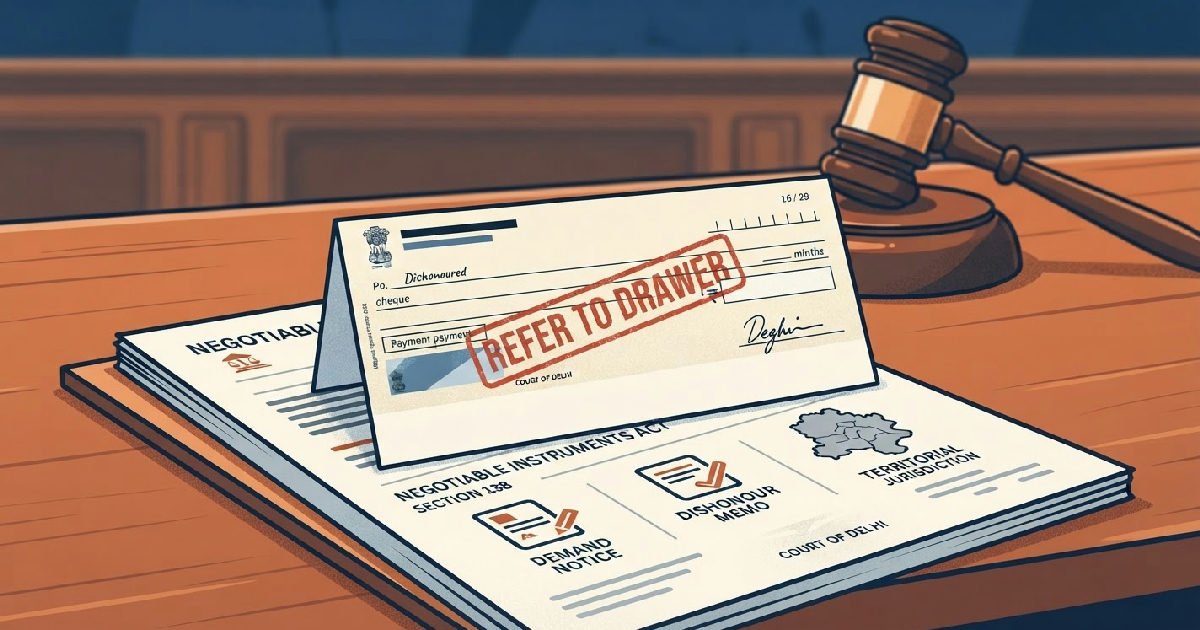
Filing a cheque bounce case in Delhi demands meticulous attention to legal procedures and strict adherence to timelines. Complainants often underestimate the complexities involved, leading to potential dismissals and prolonged litigation. The process, primarily governed by Section 138 of the Negotiable Instruments Act, 1881, hinges on several critical steps, from receiving the initial bank return memo to correctly identifying the appropriate court and parties.
Understanding these key elements can significantly improve the chances of a successful prosecution, ensuring that legal remedies are pursued effectively against those who issue dishonoured cheques. Errors at any stage can prove fatal to the complaint, underscoring the need for precision.
Understanding the Legal Framework for Cheque Dishonour in Delhi
A cheque bounce, or dishonour, occurs when a cheque issued to settle a debt or liability is returned unpaid by the bank. This isn’t merely a civil dispute; Section 138 of the Negotiable Instruments Act, 1881, classifies it as a criminal offence under specific conditions. The law aims to uphold the credibility of cheque transactions in the financial system.
Those found guilty can face severe penalties, including imprisonment for up to two years, a fine that can be double the cheque amount, or both. This legal provision was first introduced by the Banking, Public Financial Institutions and Negotiable Instruments Laws (Amendment) Act 1988, marking a significant step towards penalizing financial irresponsibility.
Key Amendments Shaping the Process
The legal landscape surrounding cheque bounce cases has evolved over the years. The Negotiable Instruments (Amendment) Act, 2015, which took retrospective effect from June 15, 2015, brought a crucial change by redefining territorial jurisdiction. This amendment clarified which courts have the authority to hear these complaints, aiming to streamline the process and prevent forum shopping.
Further strengthening the payee’s position, the 2018 Amendment introduced two significant sections. Section 143A allows courts to order interim compensation of up to 20% of the cheque amount at the very first hearing, providing immediate relief to the complainant. Section 148 mandates that the drawer deposit a certain percentage of the cheque amount when filing an appeal, reducing frivolous appeals.
The Critical First Step: Responding to a Cheque Return Memo
The journey to filing a cheque bounce case begins not with frustration, but with the bank’s official communication: the return memo. This document, detailing the reason for non-payment, is the trigger for the entire legal process. Common reasons for dishonour range from insufficient funds and signature mismatches to cheques presented past their three-month validity period or from closed accounts.
Crucially, the 30-day period for sending a legal demand notice starts from the exact date the payee receives this bank return memo. This deadline is unyielding and mandatory. Missing it means the specific dishonour cannot form the basis of a Section 138 complaint, rendering the initial attempt legally void. The 30-day notice period is a critical aspect of these proceedings.
Re-presenting a Dishonoured Cheque
Should a cheque be dishonoured, payees often have the option to re-present it for payment. If the cheque bounces again on this fresh presentation, a new 30-day notice period commences. This period is calculated from the date the payee receives the new return memo from the bank, offering a fresh window to initiate legal action.
This re-presentation strategy can be useful, but it does not negate the strict adherence to the 30-day notice period for each specific instance of dishonour. Each return memo resets the clock, requiring immediate action.
Crafting an Unassailable Demand Notice
Sending a proper written demand notice is a non-negotiable prerequisite before any complaint can be filed under Section 138. This isn’t merely a formality; it serves as a formal communication to the drawer, outlining the default and demanding rectification. The notice must be meticulously drafted to ensure its legal validity and avoid procedural objections later.
The notice must clearly articulate the original transaction, including precise cheque particulars such as the cheque number, date, amount, and bank details. It should also explicitly state the specific reason for the cheque’s dishonour, directly quoting the bank’s return memo. This clarity prevents ambiguity and strengthens the complainant’s position.
The 15-Day Payment Demand and Proof of Service
A critical component of the demand notice is the formal demand for payment. The notice must grant the drawer precisely 15 days from the date of its receipt to clear the outstanding cheque amount. This 15-day window is a statutory requirement, and any deviation can invalidate the notice.
Maintaining irrefutable proof of service is paramount. Dispatching the notice via registered post or a reliable courier service, and retaining acknowledgment receipts, is standard practice. While modern methods like email or WhatsApp can be considered valid, they require robust proof of actual delivery and viewing to stand up in court. The 15-day clock begins only when the drawer actually receives the notice.
Navigating the Strict Timelines for Complaint Filing
The legal process for cheque bounce cases is punctuated by several strict deadlines that must be observed to the letter. Failing to do so can lead to the dismissal of the complaint, regardless of the merits of the underlying debt. One of the most crucial of these is the mandatory waiting period after issuing the demand notice.
A common mistake complainants make is filing their case prematurely. The law explicitly states that the cause of action arises only after the drawer fails to make payment within the 15-day period stipulated in the demand notice. Filing a complaint before the expiry of this 15-day window is considered premature and will inevitably result in dismissal by the court.
The One-Month Filing Window: The Saketh Way
Once the 15-day notice period has expired without payment, the payee then has a subsequent 30-day window to file the criminal complaint. This one-month filing period is also rigidly enforced. The Supreme Court, in its landmark ruling in M/S Saketh India Ltd. (1999 SC), clarified the precise method for computing this period.
It established that the one-month period should be counted by excluding the day the cause of action arises and including the last day.
Strict compliance with this 30-day filing window is non-negotiable. Any delay, however minor, can be fatal. For instance, the Supreme Court in H.S. Oberoi Buildtech (2025) held that even a five-day delay is sufficient grounds for dismissal if not accompanied by a formal application for condonation of delay.
Such applications are granted only under exceptional circumstances and require compelling reasons, emphasizing the importance of adherence to the limitation period computation.
| Procedural Step | Deadline Trigger | Duration | Consequence of Missed Deadline |
|---|---|---|---|
| Send Legal Demand Notice | Receipt of Bank Return Memo | 30 days | Cannot file Section 138 complaint for that dishonour |
| Drawer’s Payment Window | Receipt of Demand Notice by Drawer | 15 days | Cause of action arises if no payment |
| File Criminal Complaint | Expiry of 15-day Payment Window | 30 days | Complaint is time-barred; requires condonation of delay |
Ensuring Correct Parties and Proper Court Jurisdiction in Delhi
Beyond timelines and notices, correctly identifying the parties involved and the appropriate court is fundamental. Errors here can lead to procedural roadblocks or outright dismissal. When a cheque is issued by a company, it’s imperative that the company itself is named as an accused in the complaint, not solely its directors.
Directors can be implicated, but the company, as the primary issuer, must always be included.
Territorial jurisdiction dictates which court has the authority to hear the case. For cheque bounce cases in Delhi, complaints are filed before the Metropolitan Magistrate or Judicial Magistrate First Class courts. The Negotiable Instruments (Amendment) Act, 2015, clarified this by stating that jurisdiction generally lies with the court where the payee’s bank branch (where the cheque was presented for payment) is located.
Jurisdictional Clarity in Delhi’s Courts
This principle was further reinforced by the Supreme Court’s ruling in Jai Balaji Industries Ltd. v. M/s HEG Limited. It cemented the place of presentation as the primary determinant for jurisdiction. However, if a cheque is presented directly at the drawer’s bank branch, bypassing the payee’s account, jurisdiction shifts to the court governing the drawer’s bank branch.
Delhi features several key judicial hubs handling these matters. For example, a bank branch situated in Connaught Place would fall under the Patiala House Courts, while one in Saket would be handled by the Saket Courts. Other prominent courts include Tis Hazari, Rohini, Dwarka, and Karkardooma.
It’s also a crucial rule that all subsequent cheque bounce cases against the same drawer must be filed in the same court where the first case was lodged, ensuring judicial efficiency and consistency. Understanding the proper court in Delhi is essential for filing these cases.
Common Pitfalls and Strategic Considerations for a Cheque Bounce Case
While the legal steps appear straightforward on paper, practical execution often presents challenges. One common pitfall is overlooking the nuance of “receipt” of the demand notice. Simply dispatching it isn’t enough; proof that the drawer actually received it, or intentionally evaded receipt, is vital for the 15-day clock to start running.
Another strategic consideration involves understanding the drawer’s potential defenses. These could range from disputing the existence of a legally enforceable debt to claiming the cheque was issued as security and not for immediate liability. A well-prepared complainant anticipates these arguments and ensures their initial notice and complaint are robust enough to counter them.
The Role of Legal Counsel
Given the strict procedural requirements and potential complexities, engaging experienced legal counsel can be invaluable. Lawyers specializing in cheque bounce cases can ensure that all notices are drafted correctly, deadlines are met, and the appropriate court is approached. They can also advise on the nuances of evidence, such as proper documentation of debt and proof of cheque issuance.
Ultimately, while the law provides a clear pathway for recourse against dishonoured cheques, the success of a Section 138 case in Delhi often hinges on rigorous adherence to procedure rather than just the underlying facts of the financial dispute. Precision and timely action remain the cornerstones of effective legal action in these matters.
What happens if I miss the 30-day deadline to send the legal notice?
If you fail to send the legal demand notice within 30 days of receiving the bank’s return memo, you generally lose the right to file a complaint under Section 138 for that specific instance of cheque dishonour. The deadline is mandatory and strictly enforced by courts.
What are the potential penalties for a dishonoured cheque?
Under Section 138 of the Negotiable Instruments Act, 1881, the offence of a dishonoured cheque is punishable with imprisonment for a term that may extend to two years, a fine which may extend to twice the amount of the cheque, or both.
Where should a cheque bounce case be filed in Delhi?
In Delhi, cheque bounce complaints are generally filed before the Metropolitan Magistrate or Judicial Magistrate First Class courts. Jurisdiction typically lies with the court where the payee’s bank branch, where the cheque was presented for payment, is located. If the cheque was presented directly at the drawer’s bank, then the court governing that branch has jurisdiction.
Dates tight on a bounced cheque? WhatsApp or call for free consultation.
Related Services: https://arpitmarwah.com/cheque-bounce-lawyers-in-delhi/