
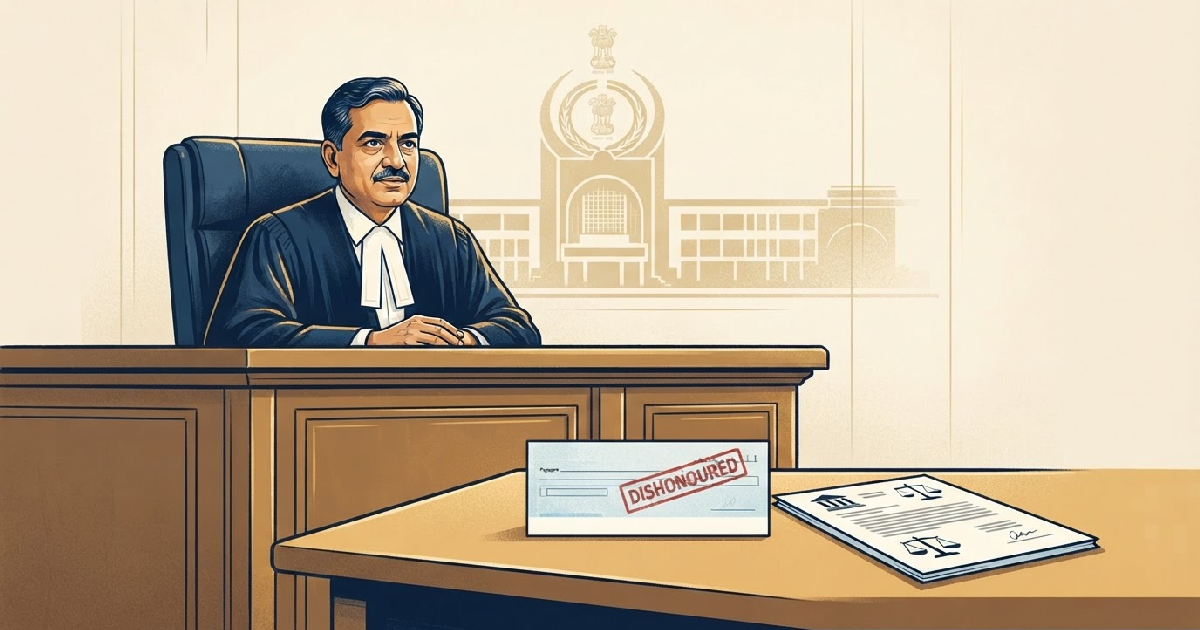
The Punjab Haryana High Court ruled that a sole proprietor cannot be sued alone for an offense under Section 138 of the Negotiable Instruments Act, 1881.
Instead, the court mandated that the sole proprietary concern itself must also be arrayed as an accused. This judgment, delivered by Justice Sureshwar Thakur, offers a specific interpretation that contrasts with some established Supreme Court precedents.
Defining Liability in Cheque Dishonour Cases
The decision underscores a nuanced approach to liability in cheque dishonour cases involving sole proprietorships, potentially altering how such cases are pursued in the states of Punjab and Haryana. It clarifies that merely prosecuting the individual proprietor isn’t sufficient under Section 141 of the NI Act.
Cheque dishonour, often referred to as a “bounced cheque,” falls under Section 138 of the Negotiable Instruments Act. This section serves as a crucial legal safeguard, ensuring that financial commitments made via cheques are honored. It aims to instill confidence in banking transactions and deter unscrupulous practices.
For a charge under Section 138 to stick, specific conditions must be met. The cheque has to be issued for a legally enforceable debt or liability and returned unpaid due to insufficient funds. Crucially, the payee must issue a legal notice to the drawer within 30 days of receiving the dishonour memo.
If the drawer fails to pay the outstanding amount within 15 days of receiving this notice, legal proceedings can commence. Penalties for cheque dishonour can be severe, including imprisonment for up to two years, a fine that could be double the cheque amount, or both.
The Role of Section 141: Offences by Companies
Section 141 of the NI Act extends liability in cases where an offense is committed by a “company.” This section is particularly important as it deals with vicarious liability, allowing for the prosecution of individuals responsible for the company’s conduct. The term “company” is broadly defined to include firms and other associations of individuals.
Traditionally, a key point of contention has been whether a sole proprietary concern, which lacks a separate legal identity from its owner, falls under this definition. The Punjab and Haryana High Court’s ruling directly addresses this long-standing ambiguity, insisting on the inclusion of the proprietary concern.
This approach highlights a legal effort to cast a wider net when dealing with financial fraud. It ensures accountability isn’t easily sidestepped by attributing blame solely to an individual, especially when business transactions involve a recognized proprietary entity.
Punjab and Haryana High Court’s Distinctive Stance
Justice Sureshwar Thakur’s pronouncement from the Punjab and Haryana High Court mandates that both the sole proprietor and the associated proprietary concern must be named as accused parties. The court emphasized that simply suing the sole proprietor is inadequate given the scope of Section 141 of the NI Act.
This ruling sets a specific precedent within the jurisdiction of Punjab and Haryana. It implies that prosecutors in these regions will now need to carefully ensure both the individual and the business entity are properly impleaded from the outset of any cheque dishonour proceedings.
For businesses operating as sole proprietorships, this means a heightened awareness of how their entity is perceived legally. It adds another layer of procedural complexity for those initiating legal action under the NI Act.
Rationale behind the new directive
The detailed reasoning behind Justice Thakur’s decision is crucial. While not fully elaborated in the initial report, the ruling likely stems from an interpretation that a proprietary concern, even without a distinct legal personality, functions as the operational arm through which the proprietor conducts business. Therefore, for effective prosecution and to fully address the offense, the concern itself must be implicated.
This move aligns with the broader objective of the NI Act to ensure accountability and maintain financial discipline. By requiring the proprietary concern to be arrayed as an accused, the court aims to reinforce the seriousness with which cheque dishonour is viewed, regardless of the business structure.
Comparing with Supreme Court Precedents on Sole Proprietorships
The Punjab and Haryana High Court’s ruling appears to chart a path distinct from some earlier interpretations by the Supreme Court of India. In a landmark decision from April 5, 2007, in the case of *Raghu Lakshminarayanan v. Fine Tubes*, the Supreme Court had clarified that a proprietary concern isn’t a “company” or “firm” under Section 141 of the NI Act.
The higher court reasoned that a sole proprietary concern holds no separate legal identity from its owner. Consequently, it stated that only the proprietor would be solely responsible for the conduct of its affairs. This divergence creates a notable point of legal debate and potential inconsistency across different jurisdictions.
In 2012, the Supreme Court, through its three-judge bench decision in Aneeta Hada v. Godfather Travels and Tours Pvt. Ltd., also firmly established the necessity of impleading the company as an accused for prosecution under Section 141.
Without the company being named, directors or other officers could not be prosecuted on grounds of vicarious liability. However, this ruling specifically addressed corporate entities, not sole proprietorships, leaving room for varying interpretations.
The Aneeta Hada impact on company impleadment
The Aneeta Hada judgment was pivotal, overruling earlier conflicting decisions that had allowed for the prosecution of individuals without naming the company. It highlighted the importance of procedural correctness and the legal distinction between an individual and a corporate entity. The ruling by Justice Sureshwar Thakur extends this principle, in a way, to sole proprietorships, albeit with a different understanding of their legal identity.
The Supreme Court in *N. Harihara Krishnan v. J. Thomas* (2017) further reinforced the need for strict adherence to timelines and the naming of the actual drawer of the cheque. When the drawer is a company, both the company and the person in charge are liable under Section 141, emphasizing the twin requirements for prosecution.
Practical Ramifications for Business Owners and Legal Practitioners
This ruling from the Punjab and Haryana High Court carries significant practical implications. For sole proprietors, it means an increased risk of dual prosecution — as an individual and as the proprietary concern. This could lead to more complex legal battles and potentially higher legal costs.
Legal practitioners, especially those dealing with cheque dishonour cases, must now adjust their strategies in Punjab and Haryana. They’ll need to ensure that complaints are drafted to include both the proprietor and the concern, preventing technical dismissals based on improper impleadment.
| Court/Ruling | Entity Type | Requirement for Prosecution | Key Principle |
|---|---|---|---|
| Punjab and Haryana High Court (2022) | Sole Proprietary Concern | Sole proprietor and proprietary concern must be arrayed as accused | Dual impleadment for comprehensive accountability |
| Supreme Court (Raghu Lakshminarayanan, 2007) | Sole Proprietary Concern | Only proprietor liable, no separate legal identity for concern | Proprietor is the sole responsible party |
| Supreme Court (Aneeta Hada, 2012) | Company/Corporate Body | Company must be arrayed as accused for vicarious liability | Company’s existence is central to vicarious liability |
Ensuring proper complaint drafting
The precision in drafting criminal complaints has become even more critical. Failure to correctly identify and implead all necessary parties could undermine the entire prosecution. This demands a thorough understanding of the business structure involved before initiating proceedings under the Negotiable Instruments Act.
Additionally, this judgment could encourage a shift towards more formal business structures to potentially mitigate some aspects of individual liability. Sole proprietors might consider incorporating their businesses to create a distinct legal entity, separating personal and business liabilities more clearly.
The Broader Legal Discourse on Vicarious Liability
The debate surrounding vicarious liability under Section 141 of the NI Act is ongoing and complex. Courts continuously grapple with how to fairly apply principles of accountability to different types of business entities. The Punjab and Haryana High Court’s decision contributes another layer to this intricate legal tapestry.
The Supreme Court has consistently held that the provisions of Section 141 are punitive and must be strictly construed. This strict interpretation means that all conditions precedent for invoking the section must be meticulously satisfied. The latest ruling from Punjab and Haryana adds another such condition for sole proprietary concerns.
Impact on financial integrity and debtor-creditor relations
While potentially increasing procedural hurdles, the ruling aims to strengthen the framework against cheque fraud. By ensuring that the business entity is also held accountable, it sends a clearer message about the collective responsibility inherent in commercial transactions. This could indirectly bolster financial integrity and help maintain trust in debtor-creditor relationships.
This particular interpretation ensures that even in structures where the business and owner are legally one, both the operational aspect (the concern) and the decision-maker (the proprietor) are explicitly recognized in the complaint. Such a comprehensive approach could make it harder for defaulters to exploit legal technicalities and escape prosecution.
Future Outlook and Potential for Supreme Court Intervention
Given the apparent divergence between the Punjab and Haryana High Court’s ruling and earlier Supreme Court pronouncements concerning the legal identity of sole proprietorships, it’s plausible that this issue could eventually reach the Supreme Court for definitive clarification. A uniform interpretation across all High Courts would provide much-needed clarity for both complainants and accused parties.
Until then, legal professionals and business owners within the jurisdiction of the Punjab and Haryana High Court must operate under this new directive. The legal landscape for cheque dishonour cases remains dynamic, continually evolving through judicial interpretations. Complainants possess statutory rights to pursue these matters, and such rulings refine the procedural path.
Adapting to evolving legal standards
The ruling underscores the importance of staying updated with judicial developments, especially in areas like commercial law that heavily impact day-to-day business operations. Adherence to these evolving standards is critical for minimizing legal risks. For example, understanding how director liability for cheque dishonour is treated can also vary.
Ultimately, the decision by Justice Sureshwar Thakur reflects an ongoing judicial effort to ensure robust enforcement of the Negotiable Instruments Act. It aims to prevent technical loopholes from being exploited, thereby strengthening the legislative intent behind penalizing cheque dishonour.
What did the Punjab and Haryana High Court rule regarding sole proprietors?
The Punjab and Haryana High Court recently held that in cases of cheque dishonour involving a sole proprietary entity, both the sole proprietor and the proprietary concern itself must be named as accused. Merely suing the individual proprietor isn’t enough under Section 141 of the Negotiable Instruments Act.
How does this ruling differ from previous Supreme Court interpretations?
The ruling appears to diverge from the Supreme Court’s 2007 decision in *Raghu Lakshminarayanan v. Fine Tubes*, which stated that a proprietary concern isn’t a “company” or “firm” under Section 141 and thus only the proprietor is responsible. The Punjab and Haryana High Court now requires dual impleadment.
What are the practical implications for sole proprietors and businesses?
For sole proprietors in Punjab and Haryana, this means facing potential prosecution as both an individual and a business entity in cheque dishonour cases. Legal practitioners will need to ensure both are impleaded in complaints to avoid procedural dismissal. It may also encourage sole proprietors to consider more formal business structures.