
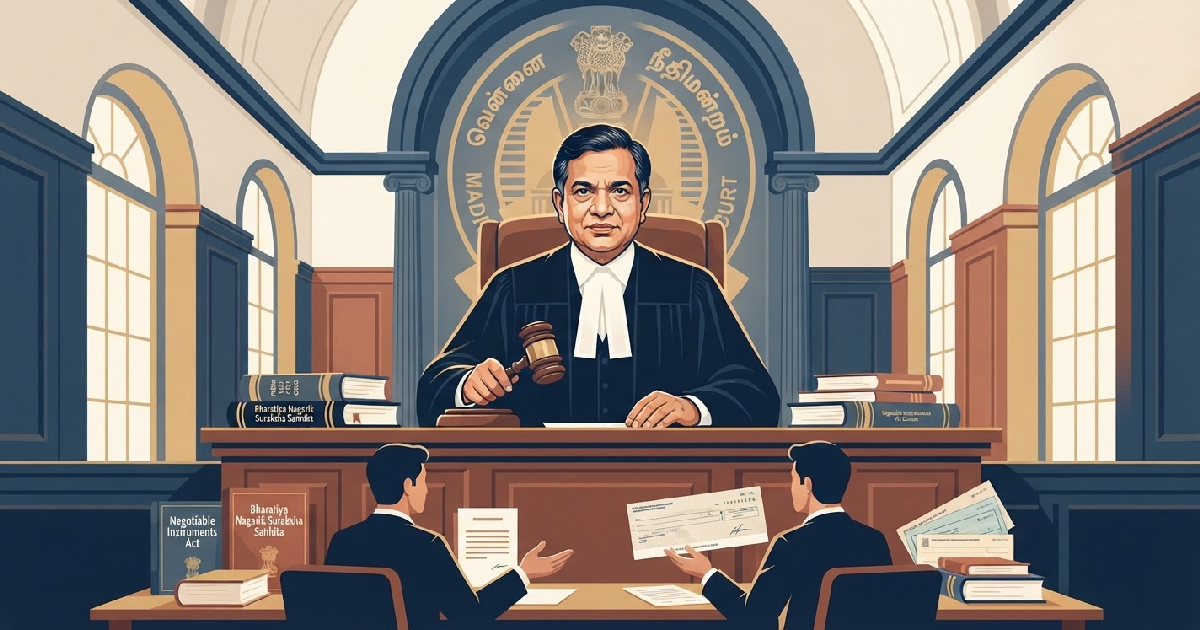
Justice Shamim Ahmed’s ruling clarifies that parties in Section 138 NI Act cases can compound offenses at any stage, even after dismissal of revision or appeal. This includes instances where a revision or appeal has already been dismissed, marking a crucial step towards prioritizing restitution over punitive measures in cheque dishonour cases.
Justice Shamim Ahmed, presiding at the Madurai Bench of the Madras High Court, delivered the judgment on September 19, 2025. The court emphasized that the provisions of the NI Act, being a special law, would override those of the Bharatiya Nagarik Suraksha Sanhita (BNSS), 2023, concerning the compoundability of such offenses.
Understanding cheque dishonour under the NI Act
Section 138 of the Negotiable Instruments Act was introduced to bolster confidence in cheque transactions by making their dishonour a criminal offense. Before its enactment, bouncing cheques primarily resulted in civil disputes, which often led to prolonged legal battles.
This provision, part of Chapter XVII of the NI Act (Sections 138-142), aims to ensure financial discipline. It imposes penalties including imprisonment for up to two years and fines that can be double the cheque amount.
The quasi-criminal nature of section 138 offenses
While Section 138 cases are classified as criminal offenses, they possess a unique “quasi-criminal” character. Their primary objective isn’t to punish the offender severely but to ensure that the aggrieved party receives the payment owed. This focus on restitution distinguishes them from traditional criminal offenses.
The law largely views these cases as civil in nature, with criminal sanctions acting as a deterrent to prevent financial misconduct. It’s a system designed to encourage prompt repayment rather than incarceration, wherever possible. The gravity of complaint under the Negotiable Instruments Act, therefore, often centers on securing the financial due.
Madras High Court reaffirms flexible compounding
The recent Madras High Court decision firmly reinforces that settling disputes, known as compounding an offense, is permissible at virtually any point. This means parties can reach an amicable resolution even after a lower court conviction has been upheld on appeal.
Justice Shamim Ahmed explicitly stated that offenses under Section 138 read with Section 147 of the NI Act remain compoundable at any stage. This includes situations where the case has progressed through various appellate levels and even after a revision petition has been dismissed.
The definitive ruling in K. Balachenniappan v. Jeyakrishnan
The judgment in *K. Balachenniappan v. Jeyakrishnan* (Crl.R.C.(MD) No. 875 of 2025) serves as a cornerstone for this clarification. Here, K. Balachenniappan had been convicted by the District Munsif-cum-Judicial Magistrate, Peraiyur, on April 20, 2022, facing one year of simple imprisonment and a fine.
His conviction and sentence were confirmed by the IV Additional District and Sessions Judge, Madurai, on April 5, 2025. However, during the criminal revision petition, both parties reached a settlement. The petitioner fully discharged his liability, leading the court to permit compounding, setting aside the earlier judgments.
Overriding effect of the NI Act over new criminal procedure code
A crucial aspect of Justice Ahmed’s ruling is its declaration that the Negotiable Instruments Act takes precedence over the newly introduced Bharatiya Nagarik Suraksha Sanhita (BNSS), 2023. Specifically, Section 147 of the NI Act, which deals with compounding, overrides Section 359 of the BNSS.
This means that despite general provisions in the new procedural code, the special nature of the NI Act ensures that compounding offenses under Section 138 remains straightforward. The legislature intended for cheque dishonour cases to be resolved through settlement, acknowledging their commercial roots.
Supreme Court precedents on compounding
The Madras High Court’s ruling aligns with established principles laid down by the Supreme Court of India. Several landmark judgments have consistently emphasized the importance and permissibility of compounding Section 138 offenses at advanced stages of litigation.
This judicial stance aims to reduce the burden on the court system and facilitate quicker justice for financial disputes. The highest court in the land has recognized the practical benefits of encouraging settlements in these matters.
Damodar S. Prabhu v. Sayed Babalal H.
One of the most cited precedents is *Damodar S. Prabhu v. Sayed Babalal H.* from May 3, 2010. In this case, a two-judge Supreme Court bench explicitly affirmed that Section 147 of the NI Act allows for compounding at any stage, whether before a Magistrate, Sessions Court, High Court, or the Supreme Court itself.
The court even introduced a graded cost scheme to incentivize early settlement. Parties settling during the first hearing incurred no penalty, while those settling later faced escalating costs, such as 10% of the cheque amount before a Magistrate, and up to 20% before the Supreme Court. These costs are then directed to the Legal Services Authority.
Reinforcing the compensatory nature of the offense
Other Supreme Court decisions, like *Vinay Devanna Nayak v. Ryot Seva Sahakari Bank Limited*, have further reinforced this outlook. They consistently highlight that the offense under Section 138 is primarily compensatory rather than purely punitive.
The consistent judicial view across various courts emphasizes that the ultimate goal is to ensure the complainant receives their due. This approach streamlines justice and supports commercial efficacy, which is critical for India’s financial ecosystem. India’s Section 138 NI Act provides a robust framework for managing these financial obligations.
Case study: Arthi Kamlesh Purohit’s acquittal
A recent instance vividly illustrates the practical application of this principle. The case of Arthi Kamlesh Purohit concluded with her acquittal on July 24, 2026, after a successful compounding of the offense. Her journey through the legal system highlights the flexibility the courts are now offering.
Arthi Kamlesh Purohit had been convicted by the Fast Track Court No.II (Magisterial Level), Erode, in S.T.C. No. 695 of 2018 for a Section 138 NI Act offense. She received a sentence of six months simple imprisonment and was directed to pay M/s. Sri Vimala Nehru Exports Private Ltd. Rs. 8,01,990/- as compensation.
From conviction to compromise
The conviction was later upheld by the II Additional District and Sessions Judge, Erode, on February 2, 2026, in C.A. No. 157 of 2021. Undeterred, Arthi Kamlesh Purohit filed a criminal revision petition before the Madras High Court under Section 438 read with Section 442 of the Bharatiya Nagarik Suraksha Sanhita, 2023.
During the revision proceedings, both parties, Arthi Kamlesh Purohit and the complainant M/s. Sri Vimala Nehru Exports Private Ltd., represented by its Director Rishabh Parakh, reached an amicable settlement. They formally submitted a Memo of Compromise dated March 18, 2026, with the complainant affirming the agreement via video conferencing.
The High Court’s decision
The Madras High Court, noting the genuine settlement and full discharge of monetary liability, permitted the compounding of the offense. Consequently, it allowed the Criminal Revision Case, set aside the judgments of both the appellate and trial courts, and acquitted Arthi Kamlesh Purohit of all charges.
The court also ensured the refund of any fine paid and the discharge of bail bonds, bringing a complete end to the prolonged litigation.
Broader implications for litigation and financial disputes
This ruling by the Madras High Court is expected to have far-reaching implications for the management of cheque dishonour cases. It provides a clear legal pathway for parties to resolve disputes amicably, even at highly advanced stages of judicial proceedings, thereby reducing the burden on an already stretched legal system.
It also sends a strong message to both drawers and payees that settlement remains a preferred avenue for resolution. The emphasis is firmly on securing the payment and providing restitution to the complainant, rather than pursuing lengthy and often unproductive criminal trials.
Encouraging out-of-court settlements
The judiciary has consistently pushed for alternative dispute resolution mechanisms to alleviate court backlogs. This latest decision from the Madras High Court further strengthens the incentive for out-of-court settlements in Section 138 cases. It offers a lifeline to individuals facing prolonged legal battles, allowing them to find closure and move forward.
Such judicial clarity promotes a more pragmatic approach to these commercial disputes. It ensures that the technicalities of criminal procedure do not inadvertently hinder genuine efforts at reconciliation and payment fulfillment.
Impact on commercial confidence
The ability to compound offenses at any stage ultimately reinforces commercial confidence. Businesses and individuals can enter into transactions involving cheques with greater assurance, knowing that legal recourse is effective and geared towards financial recovery. This stability is vital for economic activity.
The ruling implicitly acknowledges that most cheque dishonour cases stem from financial difficulties or disputes rather than malicious criminal intent. Therefore, a framework that prioritizes payment over punishment serves the commercial community best. Supreme Court confirms signed blank cheques also contributes to the clarity in these financial dealings.
Comparative outcomes in cheque dishonour cases
The following table illustrates the differing stages and outcomes of the two notable cases discussed, highlighting the court’s consistent application of the compounding principle.
| Case Name | Initial Conviction Date | Appeal Confirmation Date | Settlement Date | Final Court Decision |
|---|---|---|---|---|
| K. Balachenniappan v. Jeyakrishnan | April 20, 2022 | April 5, 2025 | During Revision Petition | Compounding Permitted, Acquitted (Sept 19, 2025) |
| Arthi Kamlesh Purohit Case | (Not Specified) | February 2, 2026 | March 18, 2026 | Compounding Permitted, Acquitted (July 24, 2026) |
Future outlook for NI Act cases
The Madras High Court’s definitive stance on the compoundability of Section 138 offenses will likely shape how such cases are handled moving forward. Legal practitioners will now have clearer guidelines, potentially leading to more structured settlement efforts at every stage of litigation.
This judicial clarity is particularly beneficial for the large volume of cheque dishonour cases that clog lower courts. Encouraging settlements reduces the caseload and allows judicial resources to be reallocated to more serious criminal matters. It’s a pragmatic step towards judicial efficiency.
Streamlining the justice delivery system
The decision reinforces the idea that the legal system is not merely about punishment but also about providing effective remedies and resolution. By allowing compounding even after multiple appeals, the court opens a window for genuine reconciliation, even for parties who have been through a protracted legal battle.
This approach promotes a more rehabilitative and restorative justice model for financial disputes. It focuses on healing the financial harm rather than solely imposing penalties, aligning with the core intent behind the NI Act.
What does compounding an offense mean in legal terms?
Compounding an offense means that the complainant and the accused agree to settle the matter outside of court, usually with the accused compensating the complainant. Once compounded, the charges are dropped, and the accused is acquitted, effectively ending the criminal proceedings.
Can a cheque dishonour case be compounded after conviction?
Yes, according to the Madras High Court’s recent ruling and Supreme Court precedents, an offense under Section 138 of the NI Act can be compounded even after conviction. This includes cases where the conviction has been upheld in appeal or during the pendency of a revision petition.
Why does the Negotiable Instruments Act override the Bharatiya Nagarik Suraksha Sanhita?
The Negotiable Instruments Act is considered a “special law” because it deals with a specific type of transaction (negotiable instruments like cheques). Special laws generally override general laws, like the Bharatiya Nagarik Suraksha Sanhita, when there is a conflict. This ensures the specialized intent of the NI Act regarding compounding is maintained.