
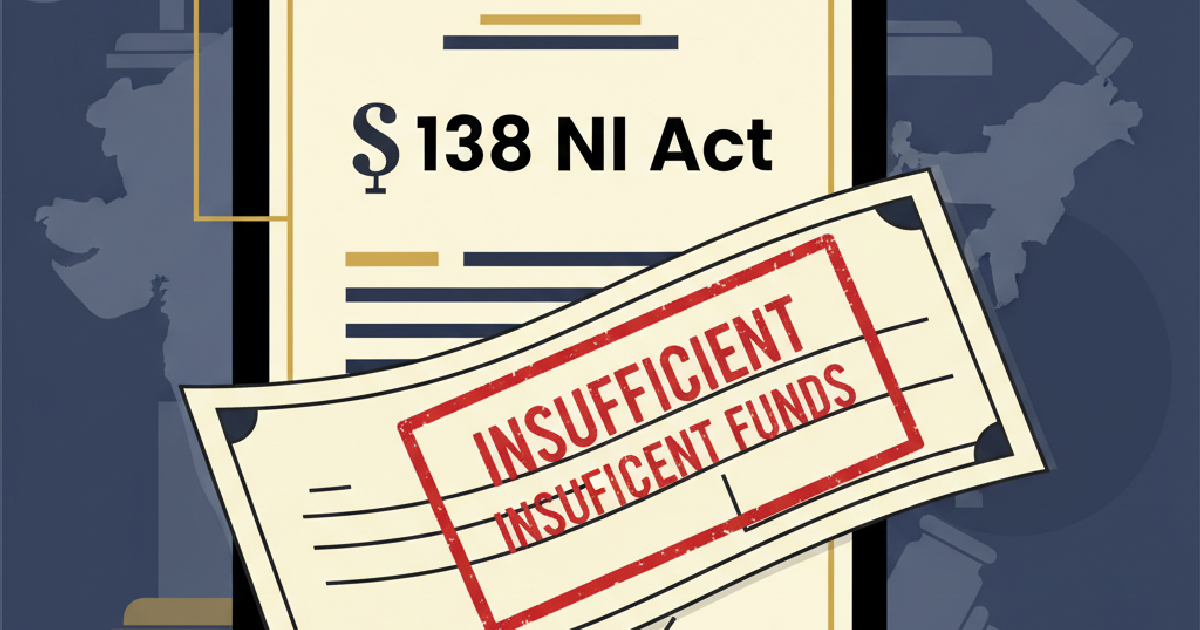
Section 138 of India’s Negotiable Instruments Act, 1881, stands as a critical provision ensuring the sanctity of cheque transactions. It specifically criminalises the dishonour of cheques under defined circumstances, holding the issuer responsible for non-payment.
This law provides a crucial safeguard for payees, helping enforce financial obligations and establishing a clear legal framework when cheques bounce due to various reasons, such as insufficient funds or a signature mismatch. Its provisions aim to foster trust in commercial dealings across the country.
Understanding India’s cheque dishonour law
The Negotiable Instruments Act, 1881 (NI Act), provides the overarching legal framework for various financial instruments in India, including promissory notes, bills of exchange, and cheques. Section 138 within this Act specifically addresses instances where a cheque issued for a legally enforceable debt is dishonoured by the bank. This makes the act of writing a bad cheque a criminal offense, rather than merely a civil one.
The core objective of Section 138 is to instill confidence in cheque as a mode of payment. It essentially transforms a financial default into a criminal liability under specific conditions. This mechanism holds drawers accountable for their financial commitments, protecting the interests of payees.
Key definitions in cheque transactions
Understanding the precise terminology within the NI Act is essential for grasping the implications of cheque dishonour. A negotiable instrument is a transferable document that promises payment to a specified person or assignee, either on demand or at a set time. Cheques are prime examples, acting as a substitute for actual currency.
Cheque dishonour, often termed a “cheque bounce,” occurs when a bank refuses to process a cheque presented for payment. Common reasons include insufficient funds, an account closure, or a signature mismatch. The bank then issues a “Cheque Return Memo” detailing the reason for non-payment to the payee.
The drawer is the individual or entity that issues the cheque, while the payee is the person or entity designated to receive the payment. For Section 138 to be applicable, the cheque must have been issued to discharge a legally enforceable debt or liability, meaning an obligation that can be pursued through legal channels. Without this underlying debt, the provision doesn’t apply.
Interestingly, while criminal law typically requires mens rea, or a “guilty mind,” Section 138 operates on a principle of strict liability. This means the prosecution generally doesn’t need to prove the drawer’s specific intent to defraud. The act of dishonouring the cheque for an existing debt is usually sufficient for the offense to be established.
Navigating the stringent legal process of Section 138
Initiating legal action under Section 138 is a multi-step process with very strict timelines. It begins with the drawer issuing a cheque to the payee for a legitimate debt. The payee then presents this cheque to their bank within its validity period, which typically spans three months from the issue date.
Should the cheque bounce, the payee’s bank provides a Cheque Return Memo. Following this, the payee must issue a written demand notice to the drawer within 30 days of receiving the memo. This notice formally requests payment of the dishonoured cheque’s amount.
The drawer then has a 15-day window from receiving this notice to make the payment. If the payment is completed within this period, no offense under Section 138 is considered to have occurred. However, failure to pay within these 15 days allows the payee to proceed with a formal complaint.
Crucial timelines for legal action
The next critical step involves filing a criminal complaint. If the drawer fails to make payment, the payee must file a complaint before a Judicial Magistrate First Class (JMFC) or Metropolitan Magistrate within 30 days after the 15-day notice period expires. Missing these deadlines can invalidate the complaint.
The courts have emphasised the importance of these timeframes. For instance, the Supreme Court of India has ruled that courts cannot hear premature cheque bounce complaints. Similarly, the Delhi High Court, in a ruling by Justice Girish Kathpalia, confirmed that complaints are valid after 15 days, rejecting any notion of a longer 45-day wait.
Once a complaint is filed, the Magistrate examines the complainant and the presented evidence. Summons are then issued to the accused drawer. The accused can seek bail, as it’s a bailable offense, and enter a plea. Courts often facilitate settlement or mediation during proceedings to encourage an amicable resolution between the parties involved.
Landmark judgments clarify key legal ambiguities
Over the years, the Supreme Court of India and various High Courts have significantly shaped the interpretation and enforcement of Section 138 through landmark rulings. These judgments provide clarity on procedural aspects and substantive requirements, making the law more robust and predictable.
One of the most significant clarifications came from the Supreme Court regarding territorial jurisdiction. Previously, there was considerable ambiguity about where a complaint under Section 138 should be filed. Different courts held varying views, leading to confusion and potential forum shopping.
Navigating territorial jurisdiction disputes
The Supreme Court, in the pivotal case of Dashrath Rupsingh Rathore v. State of Maharashtra (2014), addressed this jurisdictional confusion head-on. The ruling clarified that the appropriate court for filing a complaint lies with the court where the offence is committed. This brought much-needed certainty to the legal process, ensuring that cases are heard in the correct forum.
This decision streamlines the process for both complainants and the judiciary, reducing delays and ensuring fair trials. It also has implications for cases involving individuals residing abroad, as Indian courts can hear foreign cheque complaints, provided the jurisdictional requirements are met.
Other rulings have further refined the application of Section 138. For example, the Supreme Court has clarified that signed blank cheques imply debt under the Negotiable Instruments Act. This strengthens the payee’s position by establishing a presumption of liability, even when the cheque details are filled in later.
Strict liability and the drawer’s responsibility
The principle of strict liability under Section 138 is a cornerstone of its effectiveness. Unlike many other criminal offenses where proving malicious intent (mens rea) is paramount, the law here focuses on the act itself. The mere dishonour of a cheque, given for a legally enforceable debt, triggers the penal provisions once procedural requirements are met.
This approach significantly eases the burden of proof for the complainant. It places a greater responsibility on the drawer to ensure sufficient funds are available and that all cheque details are accurate. This legal stance underscores the importance of exercising due diligence when issuing cheques for financial obligations.
The rationale behind strict liability is to maintain the reliability of commercial transactions facilitated by cheques. If every dishonoured cheque required proof of fraudulent intent, the process would be far more arduous. This could undermine public trust in cheques as a reliable payment method and make recovery for payees exceedingly difficult.
Penalties and their deterrent effect
The penalties prescribed under Section 138 are substantial, designed to act as a strong deterrent against cheque dishonour. A conviction can lead to imprisonment for a term of up to two years, or a fine which may extend to twice the amount of the cheque, or both.
This dual approach of imprisonment and hefty fines ensures that defaulting drawers face serious consequences. The possibility of a two-year prison sentence, alongside a potentially significant financial penalty, strongly motivates individuals to honor their commitments and maintain adequate balances in their accounts.
The Indian government has also moved to strengthen these laws further, particularly concerning non-resident Indians (NRIs). India has tightened cheque dishonour laws for NRIs, with the provision of a two-year prison term, reflecting a broader commitment to ensuring financial accountability across all sectors.
Preventing cheque dishonour: A practical guide
For individuals and businesses, understanding Section 138 isn’t just about legal recourse; it’s also about prevention. The most straightforward way to avoid falling afoul of this law is to always maintain sufficient funds in the account from which cheques are issued. Regularly reconciling bank statements helps in tracking balances effectively.
Accuracy is another critical factor. Always ensure the date, payee name, amount in figures and words, and signature precisely match bank records. Discrepancies, even minor ones like a signature mismatch, can lead to dishonour and subsequent legal complications, even if funds are available.
If there’s an unavoidable situation leading to cheque dishonour, it’s crucial to act swiftly upon receiving a demand notice. Settling the outstanding amount within the 15-day statutory period can avert criminal proceedings entirely. Proactive communication with the payee can also help manage expectations and explore alternative payment arrangements.
| Action/Requirement | Timeline | Purpose/Consequence |
|---|---|---|
| Cheque Validity Period | 3 months from issue date | Payee must present cheque within this window. |
| Demand Notice to Drawer | Within 30 days of Cheque Return Memo | Formal notification requesting payment of dishonoured cheque. |
| Drawer’s Payment Window | 15 days from receiving Demand Notice | Payment within this period prevents Section 138 offense. |
| Filing of Criminal Complaint | Within 30 days after expiry of 15-day notice period | Initiation of legal proceedings if payment is not made. |
| Maximum Imprisonment | Up to 2 years | Punishment for convicted drawer. |
| Maximum Fine | Up to twice the cheque amount | Financial penalty for convicted drawer. |
Frequently Asked Questions
What makes a cheque dishonour a criminal offense in India?
A cheque dishonour becomes a criminal offense under Section 138 of the Negotiable Instruments Act, 1881, when it is issued for a legally enforceable debt or liability and bounces due to insufficient funds or other specified reasons. Crucially, the drawer must fail to make payment within 15 days of receiving a formal demand notice from the payee.
What is the difference between a civil and criminal case for cheque dishonour?
A civil case for cheque dishonour primarily aims at recovering the outstanding debt amount, often involving a summary suit for recovery. In contrast, a criminal case under Section 138 of the NI Act seeks to punish the drawer for the offense of dishonouring the cheque, which can result in imprisonment, a fine, or both, in addition to recovering the cheque amount.
Can I file a Section 138 complaint if the cheque was issued as a gift?
No, a Section 138 complaint typically cannot be filed if the cheque was issued purely as a gift or for any purpose not related to a “legally enforceable debt or liability.” The law specifically requires the cheque to be issued in discharge of an existing and valid financial obligation. Cheques for gifts generally fall outside this purview.