
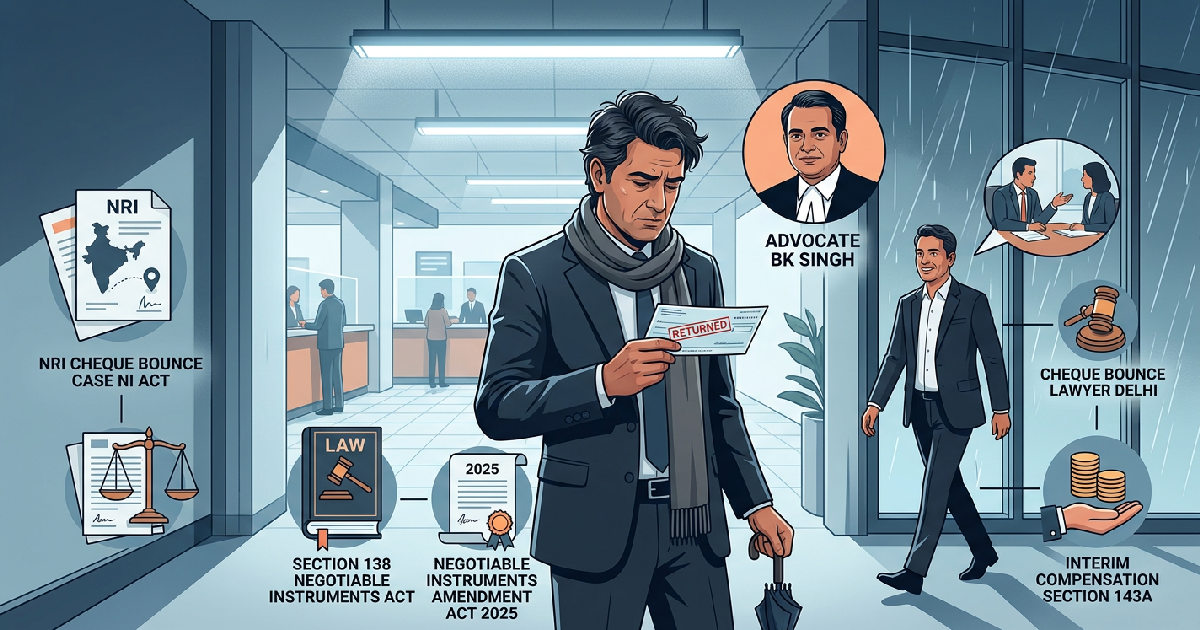
Non-resident Indians (NRIs) and overseas citizens facing the dishonor of a cheque in India must navigate a complex criminal framework under Section 138 of the Negotiable Instruments Act, 1881. Advocate Arpit Marwah notes that while geography provides a physical distance, it offers no legal protection from prosecution in Indian courts.
The adjustment recognizes the logistical hurdles faced by international parties while simultaneously increasing the potential for more rigorous litigation. However, the rules for delay condonation remain a factor if these new, extended deadlines are missed by the payee.
The severity of penalties has also shifted under the new guidelines. Imprisonment for cheque dishonor has been set to a maximum of two years. Additionally, courts can impose a fine of up to twice the amount of the cheque.
For NRIs, these proceedings are particularly high-stakes as they can lead to the issuance of non-bailable warrants or the attachment of Indian property if court orders are ignored. For those acting on behalf of businesses, the Statutory timelines and procedural requirements for NRI cases
The Negotiable Instruments Act operates on strict timelines that begin the moment a cheque is presented. The instrument must be presented to the bank within three months of its issue date or within its period of validity. If the cheque bounces, the payee has exactly 30 days from receiving the “Cheque Return Memo” to send a formal written demand notice to the drawer. This notice serves as a final opportunity for the drawer to settle the liability within a 15-day grace period. Failure to pay within those 15 days allows the complainant to file a criminal case before a Metropolitan Magistrate or Judicial Magistrate First Class. The mandate that these cases follow a summary trial process with a strict six-month deadline for disposal. To deter delay tactics, Section 143A allows courts to order the accused to pay up to 20% of the cheque amount as interim compensation within 60 days of the plea. A similar requirement exists under Section 148, where a 20% deposit is required if a convict chooses to appeal the verdict.
| Legal Step | Confirmed Timeline | Maximum Penalty/Requirement |
|---|---|---|
| Cheque Presentation | Within 3 months of issue | Invalidation of instrument if missed |
| Legal Demand Notice | 30 days from Return Memo | Mandatory prerequisite for criminal suit |
| Filing Criminal Complaint | 3 months (2025 Amendment) | Up to 2 years imprisonment |
| Interim Compensation | Within 60 days of plea | Up to 20% of the cheque amount |
Managing representation and evidence from abroad
Advocate Arpit Marwah advises NRIs to maintain a robust “evidence file,” as the communication trail is often the strongest link in an international dispute. This file should include the original cheque, the bank return memo, proof of delivery of the legal notice, and evidence of the transaction, such as bank statements or loan agreements.
Because NRIs often cannot attend every hearing, the competence of a Power of Attorney holder is vital for representing the NRI’s interests without requiring frequent travel.
Indian courts have become increasingly accommodating regarding personal appearances for overseas residents. Exemptions are frequently granted for initial stages, provided the NRI is represented by competent counsel. In many jurisdictions, including Delhi’s specialized courts like NI Courts, personal appearance for evidence or settlement discussions can now be facilitated via video conferencing.
This approach ensures the trial moves forward effectively without causing undue disruption to the NRI’s foreign employment or residence.
Mediation and alternative dispute resolution
The legal landscape is shifting toward mandatory pre-litigation mediation, supported by the Mediation Act 2023 and Supreme Court guidelines from 2025. In the case of *Sanjabij Tari v. Kishore S. Borcar*, the court emphasized streamlining these matters through mediation to reduce the burden on the judiciary.
For an NRI, a settlement reached through mediation is often the most efficient path, as it allows for the “compounding” of the offense under Section 147 of the NI Act, legally closing the criminal case upon payment.
Frequently Asked Questions (FAQ)
Can an NRI file a cheque bounce case without being in India?
Yes. An NRI can authorize a legal representative or a Power of Attorney (PoA) holder to file the case and represent them in court. While personal presence is generally required for cross-examination or specific evidence steps, courts often allow these appearances through video conferencing to accommodate overseas residents.
What is the new time limit for filing a complaint in 2026?
As per the Negotiable Instruments (Amendment) Act, 2025, the time limit for filing a criminal complaint has been extended to three months after the bank returns the cheque unpaid. This is an increase from the previous one-month limitation period, provided the mandatory 15-day payment grace period after the legal notice has expired.
What are the financial penalties for a bounced cheque for an NRI?
The drawer of a bounced cheque can be sentenced to imprisonment for up to two years and a fine of up to twice the amount of the cheque. Furthermore, under Section 143A, the court can order the drawer to pay interim compensation of up to 20% of the cheque amount while the trial is still pending.