
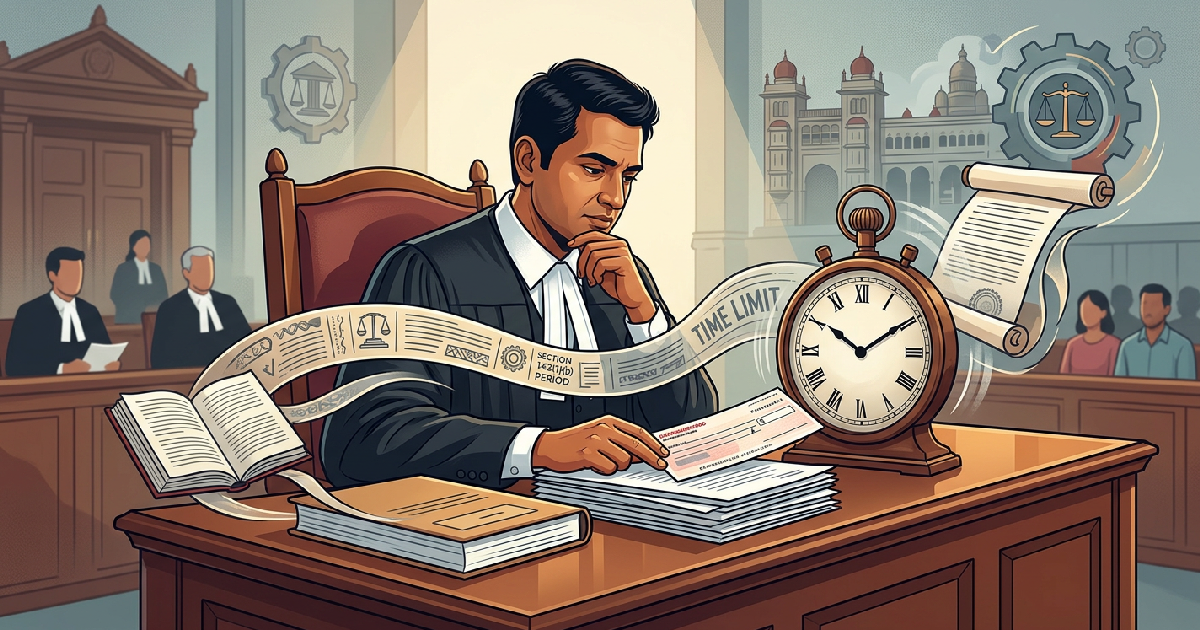
The Supreme Court of India ruled on January 6, 2026, that a Magistrate lacks the jurisdiction to take cognizance of a time-barred cheque dishonour complaint under Section 138 of the Negotiable Instruments Act, 1881, without first formally condoning the delay. Justices Sanjay Kumar and Alok Aradhe held that the satisfaction of the court regarding “sufficient cause” for a late filing must strictly precede the official act of starting criminal proceedings. The bench set aside a Karnataka High Court decision, quashing a complaint pending before the judicial authorities in Mysore that had proceeded despite a procedural lapse.
The case, S. Nagesh v. Shobha S. Aradhya, involved a claim that the appellant borrowed ₹5,40,000 for a house purchase in 2010. A cheque issued in July 2013 was dishonoured due to insufficient funds, leading the complainant to file a legal challenge. However, the filing occurred two days beyond the 30-day limitation period prescribed under Section 142(1)(b) of the NI Act. The Supreme Court found that taking cognizance before addressing this delay vitiated the entire proceedings, as condonation is a mandatory jurisdictional requirement.
Writing for the bench, Justice Sanjay Kumar emphasized that the power to hear a belated complaint depends entirely on the complainant first satisfying the court of their reasons for the delay. The court noted that these steps are not interchangeable. Because the original Magistrate took cognizance of the offence before the delay was formally excused, the subsequent years of litigation were built on a flawed legal foundation. This ruling serves as a reminder of the strict procedural standards also seen when the Supreme Court issues guidelines for summary judgment in other commercial contexts.
Analysis of the 30-day limitation period
The Negotiable Instruments Act, 1881, provides a narrow window for seeking justice in cheque bounce cases. Under Section 142(1)(b), a complainant must file their grievance within thirty days of the date the cause of action arises. While a proviso allows courts to accept filings after this window, it is not an automatic right. The complainant must demonstrate “sufficient cause” to the court’s satisfaction, making this a condition precedent to the court taking any further criminal notice of the matter.
In this specific litigation, the complainant, Shobha S. Aradhya, originally stated in her complaint that the paperwork was filed within the prescribed time. This led the Magistrate to take cognizance on October 9, 2013. It was only later that a successor Magistrate noticed the two-day delay. Rather than pausing to address the jurisdictional flaw immediately, the successor judge granted the accused liberty to contest the delay during the trial, eventually condoning it in 2016 based on a medical certificate for viral fever.
The Supreme Court rejected the Karnataka High Court’s view that this was a “curable irregularity.” The bench argued that because the initial cognizance was taken without jurisdiction, everything that followed was invalid. Such strict adherence to timelines mirrors other high court rulings, such as when the Telangana High Court clarified the 120-day limit for commercial filings, reinforcing that statutory deadlines are a matter of law, not judicial discretion.
Chronology of the S. Nagesh vs Shobha S. Aradhya dispute
The legal battle spanned over a decade, originating from a 2010 loan agreement. The Supreme Court highlighted that even though the delay was only two days and the case had been pending for 11 years, the procedural error could not be overlooked. The records show the cheque was dishonoured on July 17, 2013, and the subsequent “unclaimed” legal notice was returned on August 22, 2013.
| Legal Milestone | Date of Record | Details of Event |
|---|---|---|
| Cheque Dishonour | July 17, 2013 | Returned for “Insufficient Funds” |
| Complaint Filed | October 9, 2013 | Filed with a two-day delay |
| Cognizance Taken | October 9, 2013 | Magistrate accepted case without condoning delay |
| Delay Condoned | Year 2016 | Successor Magistrate attempted retrospective fix |
| Final Judgment | January 6, 2026 | Supreme Court quashed the complaint |
Implications for cheque dishonour litigation
This judgment reinforces the necessity for complainants to be transparent about filing delays from the very first day. The Supreme Court noted that because the respondent erroneously claimed her filing was on time, the court was misled into taking cognizance prematurely. This ruling aligns with established precedents like Dashrath Rupsingh Rathod v. State of Maharashtra, which also stressed the importance of timely filing in financial disputes.
Legal experts suggest this will lead to a more rigorous screening of Section 138 complaints at the filing stage. Courts must now ensure that any delay, no matter how brief, is resolved through a formal application before the trial begins. This standard of liability remains high in the Indian legal system, much like how directors remain liable for cheque bounce issues even when their companies undergo insolvency resolution.
Frequently Asked Questions
Must a delay be condoned before a trial starts?
Yes. The Supreme Court ruled that a Magistrate must first be satisfied that there was “sufficient cause” for a delay and formally condone it before taking cognizance of the offence. Taking cognizance before condoning the delay is considered an act without jurisdiction.
What is the limitation period for filing under Section 138?
According to Section 142(1)(b) of the NI Act, there is a thirty-day limitation period for filing a complaint. If a complaint is filed after this 30-day window, the complainant must file a separate application to explain the delay and seek the court’s forgiveness.
Can a two-day delay result in a case being quashed?
Yes. The Supreme Court emphasized that procedural compliance is mandatory. In the Nagesh v. Aradhya case, the court quashed the complaint specifically because the two-day delay was not condoned before the Magistrate officially took cognizance of the matter.