
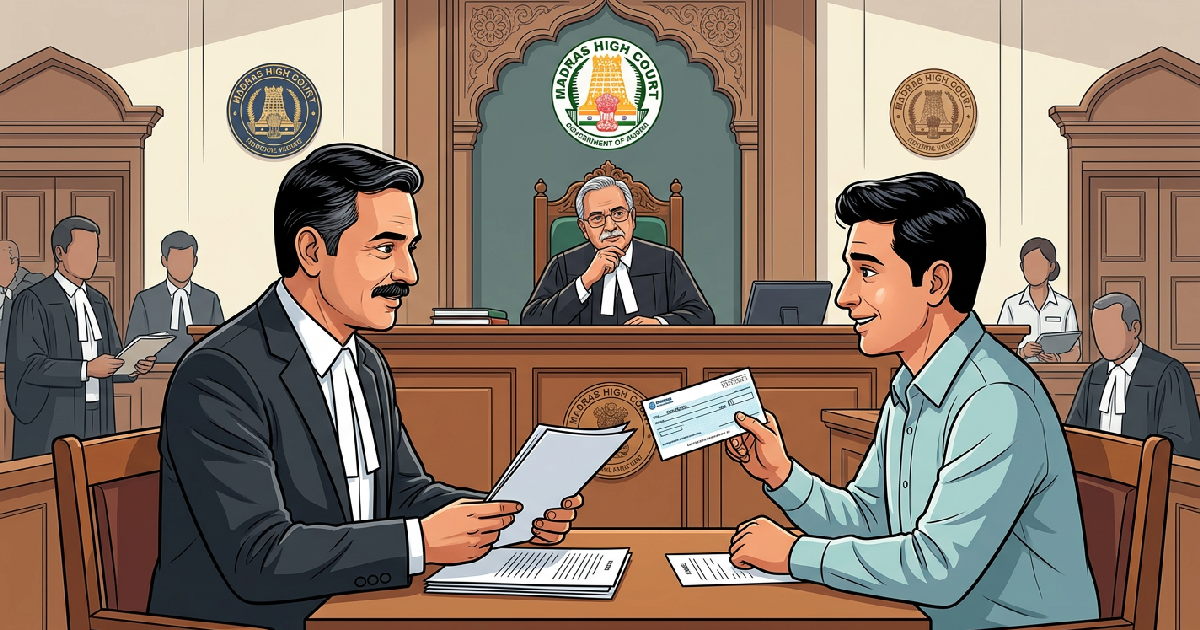
Justice Shamim Ahmed of the Madras High Court has ruled that a photocopy of a misplaced cheque is admissible as secondary evidence in cheque bounce cases, provided the original was previously produced and verified by the trial court. The judgment, delivered on September 16, 2025, in the case of Mohammed Iqbal v. S. Manonmanian (Crl.RC(MD) No. 662 of 2025), sets aside an order by the Judicial Magistrate I, Pudukottai. The High Court found that the lower court erred by dismissing the petitioner’s plea simply because he lacked independent evidence to prove his advocate lost the original document.
The case originated from a 2014 transaction where S. Manonmanian borrowed ₹5,50,000 from Mohammed Iqbal. A cheque for the amount, drawn on ICICI Bank’s Virachilai Branch, was returned with a “Funds Insufficient” endorsement on May 30, 2014. During the initial trial proceedings, the original cheque was presented to the court when the petitioner’s sworn statement was recorded on July 15, 2014. The court verified the instrument at that time, retained a copy, and returned the original to the petitioner. However, the original was subsequently lost while in the custody of the petitioner’s former legal counsel.
The ruling clarifies that procedural hurdles should not defeat substantive justice when court records already confirm the existence of a document. This perspective is vital in financial litigation, where the legal landscape remains complex; for instance, the Supreme Court confirms directors remain liable for cheque bounce cases even during insolvency resolutions. Justice Ahmed noted that the trial court’s rigid demand for proof of loss was unnecessary given the court’s own prior endorsement of the original document.
Legal provisions for secondary evidence in cheque dishonour cases
The High Court’s reasoning relied on Sections 63 and 65 of the Indian Evidence Act, 1872, which govern the admissibility of secondary evidence. Section 65(c) specifically permits such evidence when the original document is lost. Justice Ahmed emphasized that the trial court ignored the administrative fact that it had already verified the original cheque a decade earlier. By recording the sworn statement and making an endorsement on July 15, 2014, the trial court had officially acknowledged the document’s validity.
The transition to the Bharatiya Sakshya Adhiniyam (BSA), 2023, which became effective on July 1, 2024, does not change these core principles. Sections 58(ii) and 60(c) of the BSA are analogous to the older Evidence Act provisions. These laws allow for mechanical copies as evidence because the process of photocopying ensures the accuracy of the duplicate. However, the court did clarify that while the photocopy is now admissible, its “probative value” remains a matter for the trial, as the Kerala High Court clarified rules on partial payments regarding how specific claims must be tested during cross-examination.
Chronology of the Mohammed Iqbal vs S. Manonmanian dispute
The following table details the key dates and legal developments in this decade-long litigation over the lost ICICI Bank cheque.
| Date | Event Description | Outcome/Status |
|---|---|---|
| February 1, 2014 | Respondent borrows ₹5,50,000 from petitioner | Debt established |
| May 30, 2014 | Cheque No. 009790 returned by bank | Dishonoured for “Funds Insufficient” |
| July 15, 2014 | Petitioner records sworn statement in trial court | Original cheque verified by Magistrate |
| April 15, 2025 | Judicial Magistrate I, Pudukottai dismisses application | Refused Xerox due to lack of proof of loss |
| September 16, 2025 | Madras High Court sets aside dismissal | Photocopy admitted as secondary evidence |
Correcting errors in proving the loss of original documents
The primary reason for the trial court’s dismissal on April 15, 2025, was the petitioner’s failure to produce “independent evidence” to prove the advocate had lost the cheque. Justice Ahmed found this requirement served no purpose other than to delay the case. Since the court itself had returned the original with an endorsement in 2014, the existence of the instrument was already a matter of judicial record. Requiring a separate trial just to prove how an advocate misplaced a file was deemed unnecessary.
This decision addresses a significant bottleneck in the Indian judiciary. In many jurisdictions, such as in the north, the Supreme Court requires prior delay condonation for time-barred complaints to prevent old cases from lingering indefinitely. By removing the need for redundant “proof of loss,” the Madras High Court is attempting to streamline the process for thousands of pending Section 138 cases that constitute roughly 8.81% of the total criminal case backlog.
Justice Ahmed has now directed the Judicial Magistrate I, Pudukottai, to admit the Xerox copy as secondary evidence and move forward. The court emphasized that while the respondent still has the right to challenge the accuracy of the copy through cross-examination, the trial itself must now be expedited. This ensures that the accidental loss of physical paper does not stop a creditor from pursuing a legitimate claim for unpaid debts.
Frequently Asked Questions (FAQ)
Why was the trial court’s initial decision overturned?
The Judicial Magistrate I, Pudukottai, had dismissed the request to use a photocopy because the petitioner did not provide independent proof that his lawyer lost the original cheque. The High Court ruled this was an error, stating that because the court had already verified and endorsed the original in 2014, further proof of its loss was not required.
What specific laws allow a photocopy to be used in court?
The decision relied on Sections 63 and 65 of the Indian Evidence Act, 1872 (now replaced by Sections 58 and 60 of the Bharatiya Sakshya Adhiniyam, 2023). These sections allow secondary evidence, like a Xerox copy, to be admitted if the original document is lost or destroyed through no fault of the party presenting it.
Does this mean a photocopy is as strong as an original cheque?
Not necessarily. While the Madras High Court ruled that the photocopy is “admissible” as evidence, its weight or “probative value” is still decided by the trial judge. The respondent can still cross-examine witnesses and challenge the authenticity of the copy or the underlying debt during the remainder of the trial.