
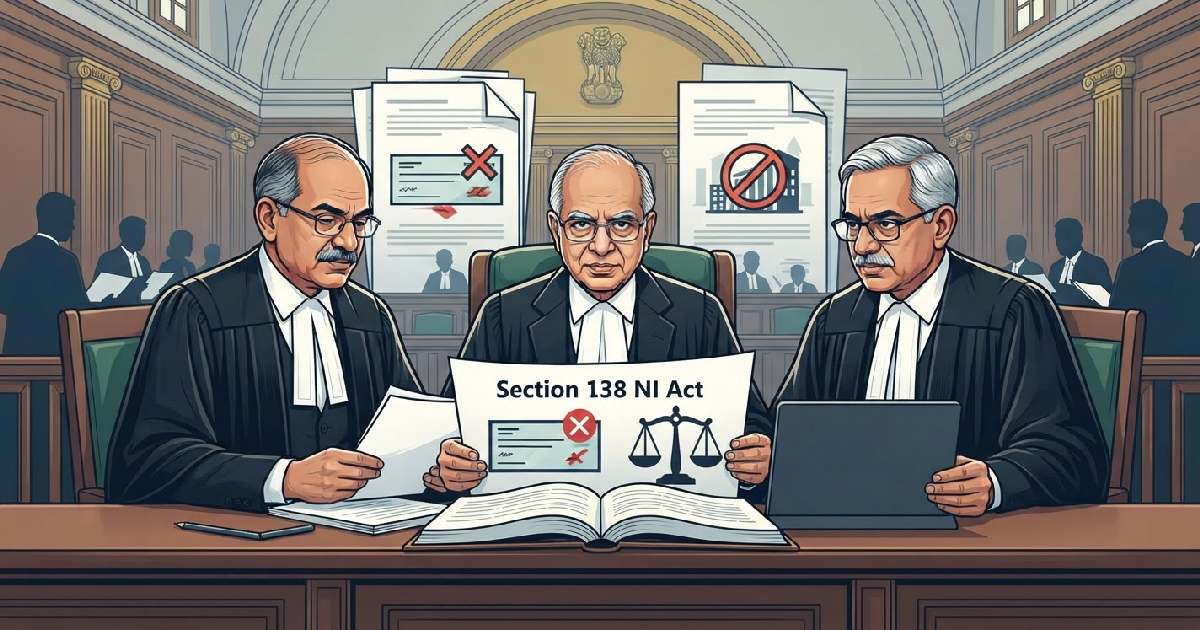
In a pivotal decision delivered around March 1-3, 2021, India’s Supreme Court delivered a nuanced interpretation of criminal proceedings concerning cheque dishonour under Section 138 of the Negotiable Instruments Act, 1881. A three-judge bench, comprising Justices R.F. Nariman, Navin Sinha, and K.M. Joseph, famously described these proceedings as “quasi-criminal” in nature.
They coined the striking phrase “a civil sheep in a criminal wolf’s clothing” to encapsulate the provision’s dual character.
Defining Section 138 NI Act: Civil Liability with Criminal Teeth
This significant observation came during the case of P Mohanraj and others v M/s Shah Brothers Ispat Ltd and connected cases. The Court was grappling with the complex question of whether a moratorium declared under Section 14 of the Insolvency and Bankruptcy Code (IBC) would shield a corporate debtor from such proceedings.
Its ruling has substantial implications for commercial disputes, corporate insolvency, and the already overburdened judicial system.
The Supreme Court’s characterization underscores the inherent tension within Section 138. While it imposes criminal penalties, the underlying objective is primarily to ensure payment and compensate the victim. Justice K.M. Joseph, speaking for the bench, explicitly stated the rationale behind the memorable metaphor.
He observed, “Section 138 proceeding can be said to be a ‘civil sheep’ in a ‘criminal wolf’s’ clothing, as it is the interest of the victim that is sought to be protected, the larger interest of the state being subsumed in the victim alone moving a court in cheque bouncing cases.”
This highlights that while the process might feel criminal, its ultimate goal aligns with civil restitution.
The Court acknowledged that Section 138 contains the ingredients of an offense, making what would otherwise be a civil liability into a punishable offense. This blend makes it a “hybrid provision,” designed to enforce bounced cheque payments if they are legally valid. The fine can extend up to twice the cheque amount, which covers principal, interest, and legal costs.
Impact on Corporate Debtors: IBC Moratorium and Cheque Cases
A crucial aspect of the Supreme Court’s 2021 ruling involved the interplay between the Negotiable Instruments Act and the Insolvency and Bankruptcy Code. The bench affirmed that proceedings under Section 138 of the NI Act against a corporate debtor are indeed covered by Section 14(1)(a) of the IBC moratorium.
This means that once a Corporate Insolvency Resolution Process (CIRP) is initiated, criminal actions for cheque dishonour against the company are stayed.
However, the Court clarified a critical distinction. While proceedings against the corporate debtor are halted, actions can still be pursued against individuals. These include directors or other responsible persons mentioned in Section 141(1) and (2) of the Negotiable Instruments Act. This ensures accountability for individuals while the corporate entity undergoes resolution.
The case involved Diamond Engineering Chennai Limited, against which the National Company Law Tribunal (NCLT), Chennai, had initiated CIRP in June 2017. The NCLT had directed Shah Brothers Ispat Private Limited to withdraw its Section 138 complaint. The Supreme Court noted that the moratorium period in this specific case had ended, allowing proceedings to continue against both the company and its directors.
The Negotiable Instruments Act: A Historical Perspective
The Negotiable Instruments Act, 1881, stands as one of India’s oldest commercial statutes. Enacted during British colonial rule, it established the legal framework for promissory notes, bills of exchange, and cheques. Its initial purpose was to provide legal sanctity to these instruments, which were vital for fostering trade and credit transactions across the subcontinent.
However, the original Act primarily addressed civil liabilities. This proved inadequate in deterring cheque misuse and ensuring financial discipline in a rapidly growing economy. Recognising this gap, Chapter XVII, encompassing Sections 138 to 142, was inserted into the NI Act in 1988.
This amendment, which took effect on April 1, 1989, criminalised the dishonour of cheques under specific conditions. Its introduction aimed to bolster the credibility of cheque transactions, promote commercial morality, and offer an effective remedy to aggrieved payees by imposing penal liability on defaulting drawers.
Addressing India’s Judicial Backlog: The Cheque Bounce Crisis
Despite its compensatory aims, the criminalisation of cheque dishonour has led to a significant judicial burden. Cases under Section 138 of the NI Act now constitute a staggering proportion of India’s legal backlog. Estimates from December 2024 suggest there were 4.3 million cheque bounce cases pending in courts nationwide, with some reports indicating this figure could reach 8.2 million by March 2026.
This sheer volume has prompted the Supreme Court to take serious notice of the issue. On March 7, 2020, a Constitution Bench, led by then Chief Justice S.A. Bobde and Justice L. Nageswara Rao, initiated a *suo motu* case titled “In Re: Expeditious Trial of Cases Under Section 138 of N.I. Act 1881.” This unprecedented move highlighted the urgency of finding solutions.
The geographical distribution of these cases further illustrates the widespread problem. Rajasthan leads with over 640,000 pending cases, followed by major economic hubs like Maharashtra, Gujarat, Delhi, Uttar Pradesh, and West Bengal. In Delhi alone, cheque bounce cases represented approximately 36% of the total pendency in trial courts as of October 2025, significantly straining judicial resources.
Reforms and Expedited Trial Initiatives
Recognising the immense pressure on the judiciary, a 10-member committee was constituted by the Supreme Court on March 10, 2021. Chaired by former Bombay High Court judge Justice R.C. Chavan, this committee was tasked with proposing measures for the faster disposal of cheque dishonour cases. Its members included officials from key government departments and distinguished legal professionals who served as *amicus curiae*.
Legislative amendments have also sought to streamline the process and alleviate some of the burdens. The 2002 amendment extended the maximum imprisonment under Section 138 from one year to two years. It also introduced Section 147, making the offense compoundable, which allows for out-of-court settlements and reduces trial time. These changes aimed to offer more robust deterrence and flexibility.
Further reforms came with the 2015 amendment, which inserted Section 142(2) to clarify territorial jurisdiction. This allowed complaints to be filed where the cheque was presented for payment, addressing confusion arising from previous rulings. This amendment aimed to simplify the procedural aspects of filing cases and ensure easier access to justice for complainants.
Enhancing Recovery and Deterrence: 2018 Amendments
The most impactful procedural changes arrived with the Negotiable Instruments (Amendment) Act, 2018, effective September 1, 2018. This amendment introduced two critical provisions designed to empower complainants and deter frivolous appeals. Section 143A now allows courts to direct the drawer to pay interim compensation to the complainant during the trial stage.
This interim compensation can be up to 20% of the cheque amount and must be paid within 60 days, with a possible 30-day extension.
Additionally, Section 148 mandates that when an accused appeals a conviction before the Sessions Court, they must deposit a minimum of 20% of the fine or compensation awarded by the trial court.
This provision acts as a strong disincentive for baseless appeals, ensuring that victims receive at least a portion of their due without prolonged litigation.
Prior judicial interpretations also paved the way for a more compensatory approach. In Meters and Instruments Pvt. Ltd. & Anr. vs. Kanchan Mehta (2018), the Supreme Court emphasised the restitutionary nature of Section 138 offenses.
It held that trial courts could use their discretion to compound the offense and close proceedings, even without the complainant’s explicit consent, if adequate compensation had been paid. This ruling prioritised the victim’s recovery over punitive measures.
Key Statistics on Cheque Dishonour Cases (All-India)
| Metric | Approximate Numbers (as of latest data) | Source Year |
|---|---|---|
| Total Pending Cases (minimum) | 4.3 million | December 2024 |
| Total Pending Cases (highest estimate) | 8.2 million | March 2026 |
| Cases in Delhi Trial Courts (proportion) | ~36% of total pendency | October 2025 |
This table highlights the sheer scale of the challenge faced by the Indian judiciary in handling cheque bounce cases. The ongoing efforts by the Supreme Court and legislative bodies aim to reduce this backlog and ensure quicker justice for those affected. The focus remains on balancing punitive action with efficient compensation.
These numbers reinforce why dedicated judicial resources and procedural innovations are critical to managing this volume.
The Way Forward: Streamlining Justice for Cheque Dishonour
The Supreme Court has continued to issue comprehensive guidelines to expedite Section 138 cases. On September 26, 2025, new directives were rolled out to further streamline the process. These included mandating “dasti” service of summons, where the complainant directly serves the accused, in addition to conventional methods. Encouraging electronic service via email, mobile number, and WhatsApp aims to speed up notification and reduce delays.
Principal District and Sessions Judges have also been directed to establish dedicated online payment facilities specifically for Section 138 cases. This initiative simplifies the compensation process and promotes faster resolution. The guidelines also advocate for voluntary compromises, graded penalties, and the application of probation benefits to ease judicial strain, encouraging out-of-court settlements.
The Court has also emphasised that exemptions from personal appearance in court should only be granted when absolutely necessary. It suggested that, prior to issuing summons, matters could be listed before digital courts to handle preliminary procedures more efficiently.
Furthermore, High Courts were urged to ensure realistic pecuniary limits for cheque amounts handled in evening courts, noting that Delhi’s existing limit of ₹25,000 is too low to be effective.
These ongoing efforts reflect a persistent judicial commitment to refine the application of Section 138. The goal is to make it a more effective tool for commercial enforcement without unnecessarily burdening the criminal justice system. The Supreme Court’s insights into the quasi-criminal nature of the law continue to guide these crucial reforms.
These measures promise to transform how cheque dishonour trials are conducted across India, offering hope for a more efficient and responsive system.
What makes Section 138 proceedings ‘quasi-criminal’?
Section 138 proceedings are considered ‘quasi-criminal’ because, while they involve elements of criminal law like potential imprisonment, their primary goal is to enforce a civil debt and compensate the victim. It uses the threat of criminal prosecution to ensure commercial obligations are met, blurring the lines between civil and criminal jurisprudence.
Can a company undergoing insolvency be prosecuted under Section 138?
No, a company (corporate debtor) undergoing an Insolvency and Bankruptcy Code (IBC) moratorium cannot be prosecuted under Section 138 during the moratorium period. However, individuals responsible within the company, such as directors, can still face proceedings under the NI Act.
What is the maximum penalty for cheque dishonour under Section 138 NI Act?
The maximum penalty for cheque dishonour under Section 138 of the Negotiable Instruments Act, 1881, includes imprisonment for up to two years, a fine which can extend to twice the amount of the cheque, or both. This penalty aims to compensate the victim and deter further offenses.