
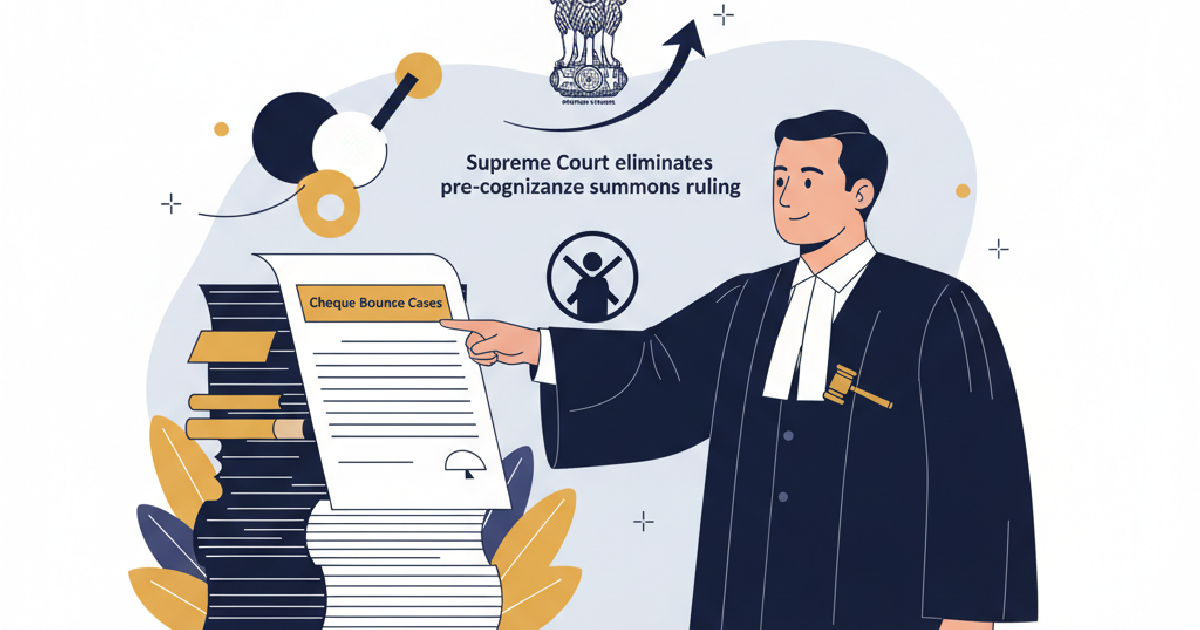
The Supreme Court of India has issued a comprehensive set of directions to streamline the trial of cheque bounce cases under Section 138 of the Negotiable Instruments Act, 1881, ruling that magistrates are not required to hear the accused at the pre-cognizance stage.
In the case of Sanjabij Tari v. Kishore S. Borcar & Anr., decided on September 25, 2025, the court emphasized that because the Negotiable Instruments Act is a special law, it takes precedence over general procedural requirements that might otherwise mandate preliminary summons. These new directives, effective from November 1, 2025, aim to significantly reduce the staggering backlog of cheque dishonour cases across all Indian trial courts and ensure quicker justice.
Streamlining cheque bounce proceedings: A judicial imperative
The Supreme Court’s decision marks a pivotal moment in addressing the persistent challenge of cheque bounce cases in India. With millions of such cases currently burdening the judicial system, the court acted decisively to introduce changes that will hasten justice delivery.
The bench, comprising Justice Manmohan and Justice N.V. Anjaria, made it clear that procedural delays have undermined the very purpose of Section 138. This section was initially designed to bolster the credibility of cheques as reliable financial instruments.
No pre-cognizance summons: A shift in procedure
One of the most consequential directives from the Supreme Court is the elimination of pre-cognizance summons for the accused in Section 138 NI Act cases. This means a Magistrate can now proceed directly to take cognizance of a complaint without needing to issue prior notice to the accused.
This ruling aligns with the view previously held by the Karnataka High Court in Ashok v. Fayaz Aahmad. It also underscores the Supreme Court’s intent to remove unnecessary procedural hurdles that have historically contributed to delays in criminal proceedings.
Digital solutions for efficient service and settlement
The court has embraced technology to modernize the process of serving summons and facilitating settlements. Hybrid service of summons is now mandated, allowing electronic means such as email, mobile numbers, and WhatsApp to be used alongside traditional methods.
Complainants must provide accurate electronic contact details, verified by an affidavit, at the time of filing their complaint. False affidavits will lead to strict action against the complainant.
Online payment facilities for expeditious resolution
In a significant move to encourage early resolution, Principal District and Sessions Judges are directed to establish online payment facilities. These will include secure QR codes and UPI links, allowing accused individuals to pay the cheque amount directly at the initial stages of the legal process.
Summons issued to the accused will explicitly mention this online payment option. If payment is confirmed, the court can then pass appropriate orders for the release of funds and the closure or compounding of proceedings under the relevant sections of the NI Act or the Bharatiya Nagarik Suraksha Sanhita (BNSS), 2023.
Mandatory synopsis for easier navigation
To further streamline the judicial process, all complaints filed under Section 138 of the NI Act must now include a synopsis in a prescribed format. This synopsis must be placed immediately after the index and before the formal complaint document.
This requirement aims to provide courts with a quick and concise overview of each case. It helps judges to grasp the essential facts more rapidly, saving valuable time during initial reviews and subsequent hearings, which can significantly aid in quicker disposals.
Recalibrated compounding guidelines
The Supreme Court has also updated the guidelines for compounding offences under Section 138, linking penalties to the stage of the proceedings. This structured approach incentivizes earlier settlements and helps to decongest the court system.
| Stage of Compounding | Additional Costs Payable |
|---|---|
| Before defence evidence | No additional costs |
| After defence evidence, before judgment | 5% of cheque amount to Legal Services Authority |
| Before Sessions/High Court (appeal/revision) | 7.5% of cheque amount by way of costs |
| Before Supreme Court | 10% of cheque amount |
Summary trials and preliminary questioning
Magistrates are encouraged to conduct summary trials for cheque bounce cases, recording clear reasons if they choose to convert to a summons trial. This guideline reaffirms previous directions aimed at expediting these proceedings.
At the initial post-cognizance stage, the trial court can now pose specific questions to the accused to ascertain their defence. These questions include whether the cheque belongs to their account, if the signature is theirs, if they issued the cheque, and if they admit liability. Their responses will be recorded and help determine the further course of action.
Tackling the backlog: A systemic issue
The sheer volume of pending cheque bounce cases has long been a critical concern for India’s judiciary. As of December 31, 2019, approximately 35.16 lakh cases were pending under Section 138 of the NI Act. These cases constitute a significant portion of both High Court and trial court dockets, with nearly 50% of the backlog in Delhi courts attributed to them.
The Supreme Court highlighted that despite the legislative intent behind Section 138, the procedural bottlenecks have diluted its effectiveness. The new directions represent a concerted effort to restore the provision’s efficacy and ensure timely justice for creditors.
Impact on metropolitan courts
Metropolitan cities, in particular, bear a disproportionate share of the cheque bounce case burden. Delhi alone reported over 6.5 lakh pending cases, while Mumbai recorded 1.17 lakh cases. The new directives, especially those concerning electronic service and online payments, are expected to have a substantial impact on these high-volume jurisdictions, reducing the administrative load and speeding up resolutions.
The directive for High Courts to reassess the pecuniary limits for cases heard in evening courts is also designed to alleviate pressure. The current limit in Delhi, not exceeding ₹25,000, is considered too low, suggesting a need for more realistic benchmarks to enable evening courts to handle a broader range of disputes. This adjustment could unlock considerable judicial capacity.
In a related development, the Supreme Court has previously confirmed that signed blank cheques imply debt under the Negotiable Instruments Act, reinforcing the legal weight of such instruments.
Future outlook and broader implications
The Supreme Court’s proactive stance in issuing these directions reflects a broader judicial commitment to procedural reform and efficient dispute resolution. By leveraging technology and streamlining procedural requirements, the court aims to create a more responsive and effective legal framework for commercial transactions.
But the success of these measures will ultimately depend on their consistent implementation across all trial courts. The shift towards hybrid service, online payments, and structured preliminary questioning represents a fundamental change in how these cases will be handled.
Encouraging mediation and settlement
The Supreme Court has reiterated the importance of alternative dispute resolution mechanisms. Courts are now explicitly tasked with actively encouraging parties to explore mediation and compromise, especially at the pre-trial stage. This approach can lead to quicker, mutually agreeable solutions, further reducing the strain on the formal judicial system.
The option to club hearings for multiple dishonoured cheques from a single transaction is another practical measure. This prevents repetitive trials and allows for a more consolidated approach to complex cases, saving time for both litigants and the courts.
Moreover, similar efforts to expedite justice have been seen, for instance, in rulings concerning forensic checks for disputed cheque signatures, ensuring thorough verification and fair proceedings.
Frequently Asked Questions
What was the primary objective of the Supreme Court’s new directions?
The primary objective was to ensure the speedy trial and disposal of cheque bounce cases under Section 138 of the Negotiable Instruments Act. The Supreme Court aims to reduce the large backlog of these cases and restore the credibility of cheques as financial instruments.
When will these new directions come into effect?
The Supreme Court’s directions were rendered on September 25, 2025, and will become effective from November 1, 2025. They apply to all trial courts across India.
Can an accused still challenge the validity of a complaint in Section 138 cases?
Yes, while pre-cognizance summons are no longer required, the accused can still raise their defence and challenge the complaint at the post-cognizance stage during preliminary questioning. The new questioning format allows for clear articulation of their defence.