
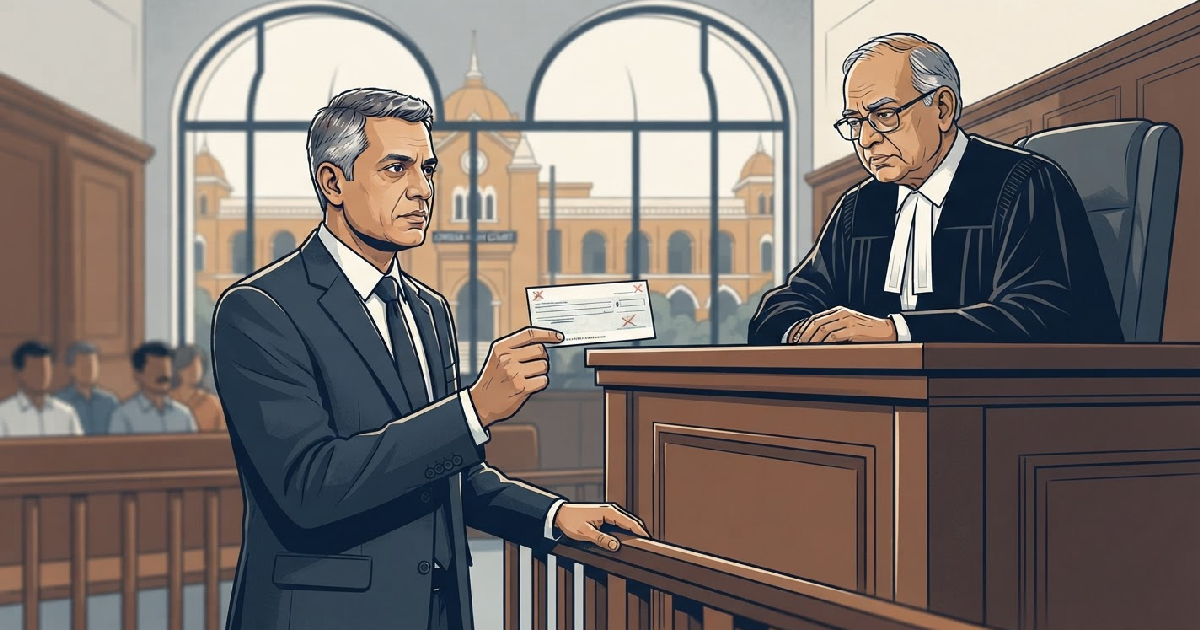
Orissa High Court ruled on October 13, 2025, that directors face personal liability for cheque dishonour under Section 138 of the NI Act, even if their company is insolvent.
This significant pronouncement came from a Single Judge Bench of Justice Chittaranjan Dash in Cuttack, dismissing the plea of Syed Najam Ahmed, the Managing Director of an insolvent firm.
Director Liability for Cheque Dishonour Upheld
The ruling in Syed Najam Ahmed v. State of Odisha & Anr., specifically criminal revision petition CRLMP No. 837 of 2025, reinforces the distinction between corporate insolvency proceedings and individual criminal culpability. It confirms that the protections afforded to a corporate entity during insolvency do not automatically extend to its directors for penal offenses.
Justice Chittaranjan Dash delivered a clear message to corporate leadership: insolvency doesn’t equate to immunity from criminal charges. Directors, as natural persons actively involved in a company’s financial decisions, retain their individual accountability. This interpretation aligns with the overarching intent of the NI Act to ensure the sanctity of financial instruments and deter fraudulent practices.
The court’s decision will likely influence how directors approach financial transactions, especially in companies facing fiscal challenges. It underscores the critical need for due diligence and ethical conduct in corporate dealings. But it also raises questions about the practical implications for directors attempting to navigate a struggling business environment.
The Case: Syed Najam Ahmed v. State of Odisha & Anr.
The case stemmed from a complaint lodged by Dewy Developers (P) Ltd. against Zenith Mining (P) Ltd. and its Managing Director, Syed Najam Ahmed. Dewy Developers had extended a friendly loan of ₹1 crore to Zenith Mining (P) Ltd., expecting timely repayment.
As part of the repayment arrangement, Syed Najam Ahmed issued a cheque for ₹1 crore, dated June 25, 2021, drawn on IndusInd Bank. This cheque, however, was subsequently dishonoured twice with the clear endorsement “refer to drawer,” signaling insufficient funds or issues with the account.
From Dishonour to Insolvency Proceedings
Following the cheque’s dishonour and the failure of a statutory notice demanding payment, Dewy Developers (P) Ltd. initiated criminal proceedings. They filed a case under Section 138 of the NI Act before the Judicial Magistrate First Class (LR), Bhubaneswar, seeking redress for the bounced cheque. This is a standard procedure when a cheque fails to clear.
However, the situation took a complex turn when Zenith Mining (P) Ltd. was declared insolvent by the National Company Law Tribunal (NCLT), Cuttack, on January 8, 2024. A Resolution Professional (RP) was appointed on November 8, 2024, to manage the company’s affairs under the Insolvency and Bankruptcy Code, 2016 (IBC).
Syed Najam Ahmed then sought to be discharged from the cheque bounce case, arguing that with the company in insolvency and an RP in place, he should no longer be personally liable.
Legal Reasoning: Why Insolvency Doesn’t Shield Directors
The Orissa High Court firmly rejected Syed Najam Ahmed’s argument. It emphasized that proceedings under Section 138 of the NI Act are inherently penal. These are distinct from the civil nature of insolvency proceedings under the IBC, which primarily deal with the financial restructuring and recovery of a corporate debtor.
The court highlighted that the moratorium imposed under Section 14 of the IBC applies specifically to the corporate debtor, protecting it from certain legal actions during the insolvency process.
However, this moratorium does not extend to natural persons, such as directors or other signatories, who are prosecuted in their individual capacity under Section 141 of the NI Act. This provision assigns liability to those responsible for the company’s conduct.
Supreme Court Precedents Reinforce Stance
The High Court’s decision was not made in a vacuum; it drew heavily on established principles set by the Supreme Court of India. Notably, the court cited Ajay Kumar Radheshyam Goenka v. Tourism Finance Corporation of India Ltd. (2023) and P. Mohanraj v. Shah Brothers Ispat Pvt. Ltd. (2021).
These landmark judgments have consistently upheld the idea that while a corporate debtor may receive protection during insolvency, its directors remain accountable for their criminal actions.
In P. Mohanraj v. Shah Brothers Ispat Pvt. Ltd., the Supreme Court clarified that while proceedings under Section 138 against the corporate debtor are subject to the IBC moratorium, those against individual directors can continue.
This distinction is crucial for maintaining the integrity of financial transactions and ensuring that individuals cannot use corporate structures to evade personal criminal liability for actions like cheque dishonour laws.
Implications for Corporate Governance and Financial Responsibility
This ruling carries significant weight for corporate governance in India. It serves as a stark reminder that directorship comes with considerable personal responsibility, especially concerning financial integrity. Boards will need to be even more vigilant about their financial management and adherence to statutory obligations.
Companies, particularly those teetering on the brink of insolvency, must ensure that their directors understand the personal risks involved in issuing cheques. The decision reinforces the idea that an individual’s culpability is separate from the corporate entity’s financial distress. This could lead to more cautious financial practices and increased scrutiny over cheque issuance and management.
Here’s a look at key dates and events in the *Syed Najam Ahmed* case:
| Event | Date | Entity Involved | Outcome |
|---|---|---|---|
| Cheque Issue Date | June 25, 2021 | Zenith Mining (P) Ltd. | ₹1 crore cheque issued by MD |
| Company Declared Insolvent | January 8, 2024 | Zenith Mining (P) Ltd. | NCLT Cuttack order |
| Resolution Professional Order | November 8, 2024 | Zenith Mining (P) Ltd. | RP appointed under IBC |
| Orissa High Court Judgment | October 13, 2025 | Syed Najam Ahmed | Director liability upheld |
Navigating Cheque Dishonour Cases: A Broader Perspective
The NI Act provides a legal framework to address instances where cheques are dishonoured, a common occurrence in commercial transactions. Section 138 of the Act aims to instill confidence in the banking system by imposing penalties on those who issue cheques without sufficient funds or intention to pay. This includes imprisonment or fines, or both.
The legal landscape surrounding cheque dishonour has evolved considerably, with courts consistently seeking to balance protection for creditors with fair treatment for debtors. This ruling is another step in clarifying the boundaries of corporate and individual responsibility. It ensures that legal entities cannot be used as shields for individual wrongdoing.
The Role of Legal Representation in Cheque Dishonour Cases
In the *Syed Najam Ahmed* case, Advocate Sidhartha Mishra represented the petitioner, while Additional Public Prosecutor A. K. Apat represented the respondent, the State of Odisha and Dewy Developers (P) Ltd. The robust legal arguments presented by both sides underscore the complexities inherent in these cases. Expert legal counsel is often critical for businesses and individuals facing such charges.
Given the severe penalties, including potential imprisonment, it’s imperative for directors to seek informed legal advice promptly if they are facing allegations of cheque dishonour. Understanding the nuances of the underlying financial deal validity and procedural requirements is key to a strong defense.
The Path Forward for Directors and Businesses
This ruling reinforces the need for directors to exercise extreme caution and due diligence when signing financial instruments on behalf of their companies. It highlights that the declaration of insolvency is not a blanket waiver of criminal liability. Directors must be acutely aware of their personal exposure to prosecution under the NI Act.
For creditors, this judgment offers continued reassurance that their interests are protected, even when a debtor company faces financial collapse. The ability to pursue individual directors provides an additional avenue for justice and deterrence against malfeasance. It adds another layer of security to commercial transactions.
Businesses operating in India should review their internal financial control mechanisms and risk management strategies. They must educate their directors on the personal implications of cheque dishonour. Proactive measures can prevent future legal entanglements and ensure compliance with both the NI Act and the IBC.
What is Section 138 of the Negotiable Instruments Act?
Section 138 of the Negotiable Instruments Act, 1881, deals with the dishonour of cheques. It makes the drawer of a cheque liable for criminal penalties, including imprisonment and fines, if the cheque bounces due to insufficient funds or if it exceeds the amount arranged to be paid from the account.
How does insolvency typically affect legal proceedings against a company?
When a company is declared insolvent under the Insolvency and Bankruptcy Code (IBC), a moratorium is typically imposed under Section 14. This temporarily halts all legal proceedings, including debt recovery actions, against the corporate debtor to facilitate its resolution or liquidation process without external interference.
Why does the moratorium under IBC not protect directors from Section 138 liability?
The moratorium under Section 14 of the IBC is intended to protect the corporate debtor as an entity, not the individuals associated with it. Proceedings under Section 138 of the NI Act are penal in nature and target the individuals responsible for the offense, such as directors or signatories, in their personal capacity, thus falling outside the scope of the corporate moratorium.