
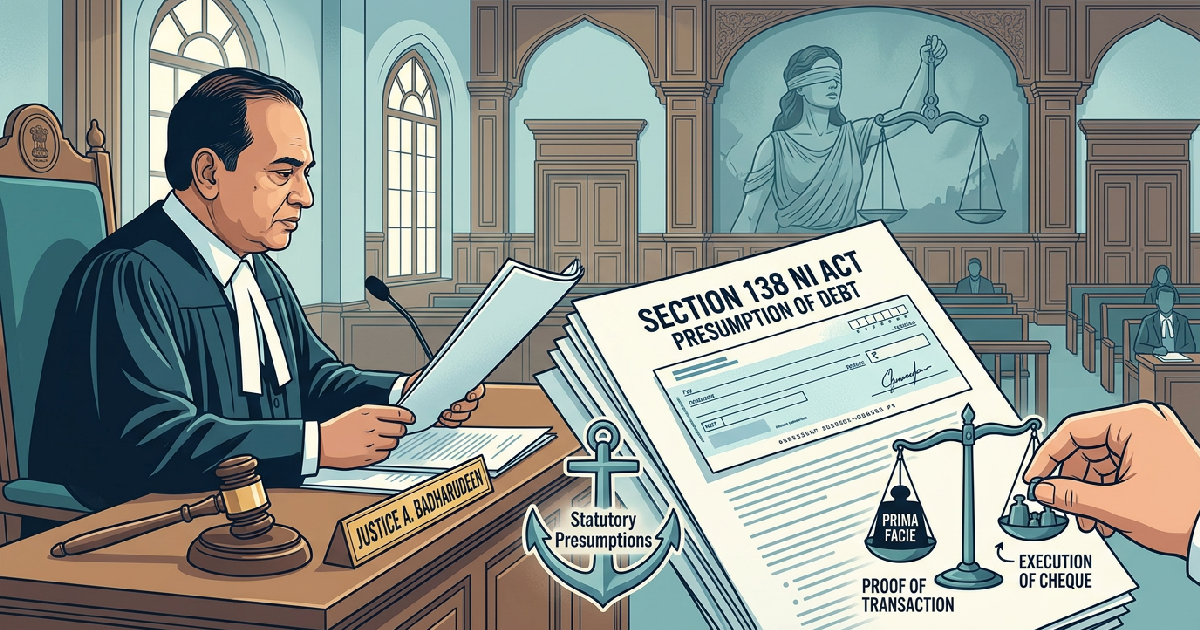
The Kerala High Court on June 12, 2026, ruled that a complainant in a cheque bounce case cannot rely on legislative shortcuts without first demonstrating the validity of the underlying financial transaction. Justice A. Badharudeen held in Shijosh v The State of Kerala and Anr.
that statutory presumptions regarding debt liability only apply after the execution of the cheque is proved in a convincing manner. This trial ended in the dismissal of an appeal against the acquittal of an accused individual who had been charged under Section 138 of the Negotiable Instruments Act, 1881 (NI Act).
The decision underscores that the initial burden of proof rests firmly on the person filing the complaint. While Sections 118 and 139 of the NI Act typically assume a cheque was issued for a valid debt, the court clarified that these are not automatic protections.
Instead, they require the complainant to establish that consideration actually passed between the parties. In this specific case, the court found the complainant lacked the necessary personal knowledge to verify how and when the alleged loan was disbursed.
This ruling provides a significant shield for defendants against unsubstantiated claims. It mirrors broader judicial scrutiny of financial disputes, such as when the Supreme Court rules NGO signatory with plenary control is criminally liable based on specific evidence of authority and debt.
By demanding concrete proof of the original transaction, the Kerala High Court ensures that the NI Act remains a tool for justice rather than a mechanism for recovery based on hearsay.
High Court emphasizes the need for direct knowledge
The legal dispute, identified as Crl.A 1403/2008, involved a cheque for ₹4,50,000 dated March 9, 2004. The appellant, Shijosh, alleged that the cheque was meant to repay a loan. However, cross-examination revealed that the money was actually advanced by the complainant’s father in five separate installments.
Despite the father being the primary actor in the exchange, he was never presented as a witness to corroborate the claim.
Furthermore, the complainant failed to produce a notebook that allegedly recorded the loan payments. Justice A. Badharudeen noted that the complainant admitted to being unaware of several material aspects of the deal. The court stressed that evidence must come from a person with direct knowledge of the transaction.
Without the father’s testimony or the ledger, the court found the evidence insufficient to trigger legal presumptions in favor of the appellant.
The strict adherence to evidentiary standards is a recurring theme in the region’s judiciary. For example, Justice A. Badharudeen rules demand notice invalid without specific amount in cases where procedural errors undermine the prosecution. In the Shijosh case, the lack of primary evidence regarding the “passing of consideration” meant the prosecution could not move past the initial hurdle of proof.
Clarification of statutory presumptions under the NI Act
The judgment clarifies that the “twin presumptions” under Sections 118 and 139 are rebuttable and conditional. Section 118 presumes that every negotiable instrument was made for consideration, while Section 139 presumes the holder received the cheque for the discharge of a debt. But the court held that the pre-condition for invoking these sections is proof of the transaction in a convincing manner.
| NI Act Section | Specific Statutory Presumption | Requirement to Invoke |
|---|---|---|
| Section 118 | Instrument was drawn for consideration | Proof of underlying transaction |
| Section 139 | Cheque was received for debt discharge | Proof of cheque execution |
| Section 138 | Criminal liability for cheque bounce | Established legally enforceable debt |
Because the transaction was not proved, the court upheld the trial court’s decision to acquit the accused. This ruling aligns with other high-level precedents where the Supreme Court: Dishonour of Post-Dated Cheque Not Enough to Presume Cheating Intent without further evidence. The Kerala High Court’s stance reinforces that the “legally enforceable debt” requirement must be supported by competent, first-hand testimony and documentation.
Future implications for cheque bounce litigation
This ruling serves as a warning to litigants who attempt to file Section 138 cases through family members or proxies who were not present during the original transaction. Justice A. Badharudeen’s judgment makes it clear that if the individual who advanced the money does not testify, the case is likely to fail.
This protects the integrity of the judicial process by preventing the recovery of undocumented or fictitious loans.
The decision also places a higher premium on maintaining financial records like ledgers or notebooks. Complainants cannot expect the court to fill in the blanks where evidence is missing. By dismissing the appeal, the High Court reaffirmed that criminal liability in financial matters must be based on a solid foundation of proven facts rather than legal assumptions that lack a factual starting point.
Frequently Asked Questions
What is the primary burden of proof for a complainant under Section 138?
The complainant must convincingly prove the execution of the cheque and the specific underlying transaction, including the passing of consideration. Only after this initial burden is met can the complainant claim the benefit of statutory presumptions under the NI Act.
Can a case succeed if the person with direct knowledge does not testify?
According to the Kerala High Court, evidence from a person who lacks direct knowledge of the transaction is insufficient. If the individual who actually advanced the funds is not examined, the court may find the evidence inadequate to prove the execution of the cheque.
Are the presumptions under Sections 118 and 139 of the NI Act absolute?
No, these are rebuttable presumptions. Furthermore, the court has ruled that they cannot be invoked at all until the complainant first establishes the underlying transaction through competent evidence, such as testimony from someone with personal knowledge of the business deal.