
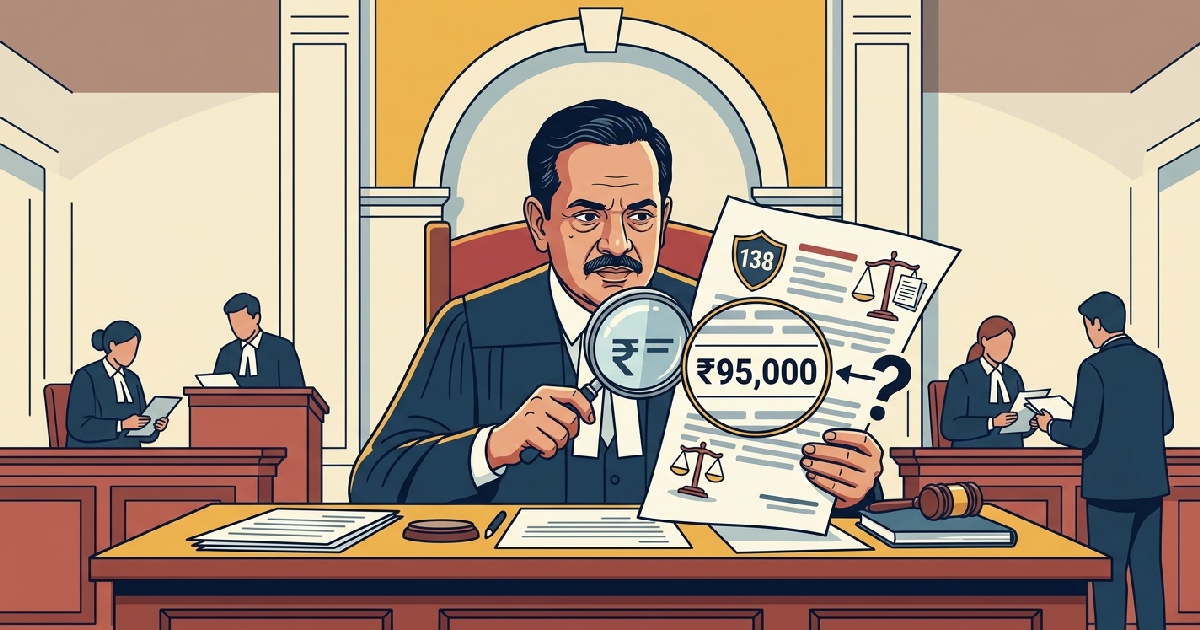
Justice A. Badharudeen of the Kerala High Court has ruled that a statutory demand notice for cheque dishonour is legally invalid if it fails to explicitly state the specific amount demanded.
The judgment, delivered on May 26, 2026, and reported on June 3, 2026, clarifies that the absence of a clear monetary demand prevents a recipient from settling the debt to avoid criminal prosecution. Consequently, the High Court dismissed an appeal filed by Rajesh K. against the acquittal of Asokan P.K.
in a case involving a dishonoured cheque worth ₹95,000.
Kerala High Court clarifies Section 138 demand notice requirements
The ruling emphasizes that for an offence under Section 138 of the Negotiable Instruments Act (NI Act) to be established, the complainant must strictly adhere to procedural formalities. Proviso (b) to Section 138 explicitly requires a written demand for the “said amount of money” within 30 days of receiving notice of dishonour.
Without a specific figure, the court held that the notice is “incomplete” and effectively non-existent in the eyes of the law. This ensures the drawer has a fair opportunity to pay within the 15-day window provided by the statute.
Justice A. Badharudeen noted that while additional claims like interest or legal costs do not inherently ruin a notice, the principal cheque amount must be clearly identifiable. This approach aligns with broader judicial trends where dishonour of post-dated cheques requires precise legal compliance to establish criminal intent.
In this specific case, Criminal Appeal No. 212 of 2013, the omission of the ₹95,000 figure in the notice led to the dismissal of the appeal, confirming a 2012 magistrate court decision.
Specific demand necessary to avoid penal consequences
The court’s reasoning centers on the practical ability of a debtor to resolve the dispute before it reaches the criminal courts. “Only when the notice is specific about the amount, it is possible for the recipient to pay the amount which was specifically asked for to avoid penal consequences,” Justice A. Badharudeen stated.
He further explained that if a complainant fails to mention the actual amount due, it becomes impossible for the drawer to fulfill the demand, thus vitiating the entire legal proceeding.
This decision reinforces the principle that criminal liability in commercial transactions is not automatic but contingent on technical accuracy. For instance, even the NG0 signatory with plenary control can face liability, but only if the procedural foundations of the notice are sound.
The Kerala High Court stressed that the statutory presumption of debt only applies once the complainant has established a valid underlying transaction and followed all notice protocols.
Key statutory timelines and limits in NI Act cases
The legal framework for cheque dishonour in India operates on strict deadlines. Understanding these timelines is critical for both complainants and accused parties to maintain their standing in court. A failure at any stage of the timeline below can lead to the dismissal of the case, regardless of whether the money is actually owed.
| Action Required | Statutory Timeline | Legal Reference |
|---|---|---|
| Notice issuance after dishonour | Within 30 days | Section 138, Proviso (b) |
| Payment window for the drawer | 15 days from receipt | Section 138, Proviso (c) |
| Filing of criminal complaint | Within 30 days of 15-day expiry | Section 142(1)(b) |
| Maximum financial penalty | Twice the cheque amount | Section 138 |
Broader implications for commercial litigation
Legal experts suggest this ruling serves as a warning to creditors to avoid vague or overly complicated demand notices. While it is common to demand interest and damages in the same letter, the primary cheque amount must be distinct and separate.
If the “said amount” is buried under other claims or omitted entirely, the prosecution loses its standing. This provides a necessary safeguard against the potential misuse of the NI Act as a tool for harassment rather than debt recovery.
The court also touched upon the burden of proof, noting that statutory presumptions under Sections 118 and 139 of the NI Act do not fill the gaps of a faulty notice. A complainant must first prove they issued a valid demand. For those facing such litigation, it remains crucial to com/kerala-high-court-pre-arrest-bail-accused-abroad-disclosure-rule/”>disclose personal circumstances in bail pleas if they are traveling, as procedural accuracy is expected from both sides in the Kerala court system.
Frequently Asked Questions
Can a notice be valid if it includes interest along with the cheque amount?
Yes, a demand notice remains valid even if it includes additional claims like interest or legal costs. However, the specific amount of the dishonoured cheque must be clearly and separately demanded so the recipient knows exactly what must be paid to avoid criminal prosecution.
What happens if the demand notice completely omits the cheque amount?
If the statutory notice fails to mention the specific amount of the cheque, it is considered legally invalid. The Kerala High Court held that such an omission makes it impossible for the drawer to pay the due amount, meaning no criminal offence is completed under Section 138 of the NI Act.
How long does a person have to pay after receiving a valid notice?
Under the Negotiable Instruments Act, a person has exactly 15 days from the date they receive the statutory demand notice to pay the specified amount. If they fail to pay within this period, the complainant has another 30 days to file a formal criminal complaint in court.