
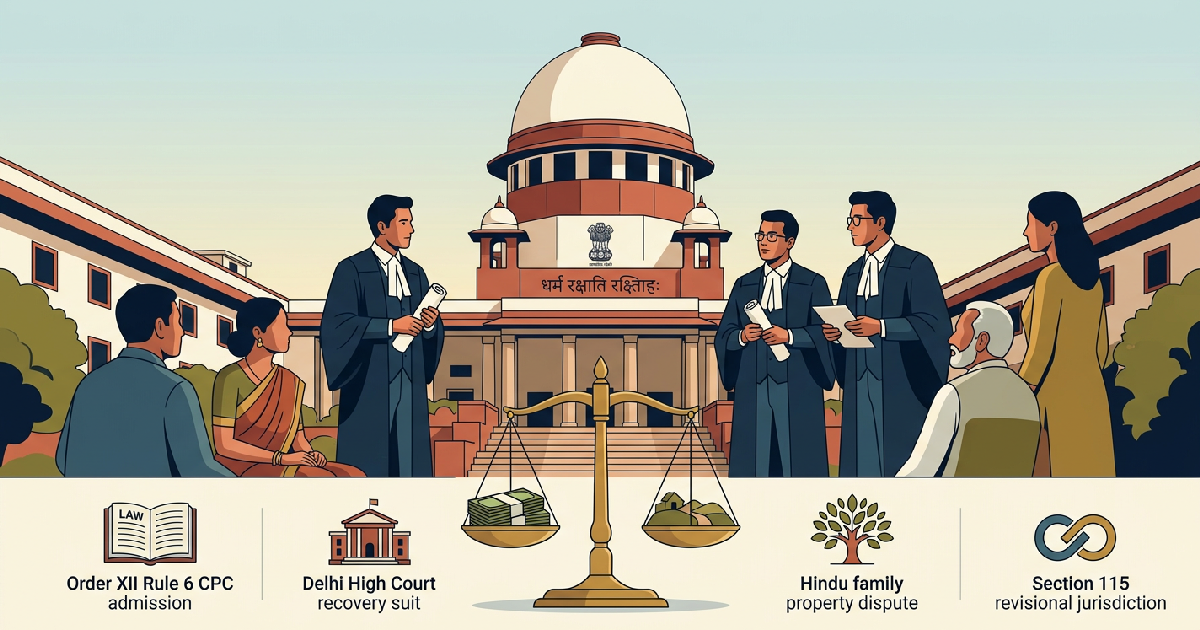
The Supreme Court of India has granted leave to appeal in a long-standing family property dispute, questioning whether a lower court can issue a recovery decree based solely on a written statement without a full trial. In a reportable judgment delivered on June 9, 2026, Justice Vipul M.
Pancholi addressed the appeal filed by Pushpa and others against Dayawati and other family members. The legal battle centers on the distribution of over ₹15.31 crore received from the sale of 31 bighas of agricultural land in August 2007.
The dispute began in 2009 when Dayawati, the plaintiff, filed a suit for recovery and partition against her parents, Shis Ram and Chameli, and her siblings. She sought ₹45 lakh, alleging she was entitled to her share of the ancestral land proceeds. While NRIs can demand property partition in India under the Hindu Succession Act, this domestic case turned on whether an admission made in 2010 by the late Daya Ram, the brother of the plaintiff, was unequivocal enough to bypass a regular trial.
Initially, a preliminary decree in 2011 granted each of the seven family members a 1/7th share. However, in 2013, the High Court modified this to a 1/6th share after Respondent No. 6 relinquished her portion.
Following this adjustment, Dayawati argued that because her brother Daya Ram had claimed in a written statement that each member received ₹3 crore, he had actually received ₹44,79,167 more than his legal 1/6th share of ₹2,55,20,833.
Legal debate over Order XII Rule 6: Admission on Judgment
The High Court of Delhi had reversed a trial court’s decision, choosing to decree the suit against Daya Ram’s heirs. The High Court relied on Order XII Rule 6 of the Code of Civil Procedure (CPC), which permits a court to pass a judgment based on admissions made in pleadings.
However, the appellants argue that the High Court exceeded its revisional jurisdiction under Section 115 of the CPC by reversing a finding of fact. This is a critical distinction, as the Supreme Court orders that Order VII Rule 11 CPC rejection and similar procedural shortcuts require a very high threshold of legal clarity.
Mr. Rakesh Kumar, counsel for the appellants, argued that there was no “clear, unambiguous or unequivocal” admission that would entitle the plaintiff to a recovery decree without a trial. He pointed out that the trial court—the Additional District Judge at Dwarka Courts—had originally dismissed the application for a decree on admission.
The trial judge felt the controversy required the appreciation of evidence to determine if the money was actually received as alleged.
Chronology of the family property litigation
The timeline of this case spans nearly two decades, moving from the High Court to the District Court and eventually to the Supreme Court.
The legal focus shifted when the pecuniary jurisdiction of the High Court of Delhi was increased, leading to the transfer of the suit to the District Court level before it was brought back to the High Court through a revision petition. A summary of the key financial and legal milestones is provided below.
| Date | Legal Event / Financial Detail | Outcome or Value |
|---|---|---|
| August 2007 | Sale of 31 bighas 9 biswas land | ₹15,31,25,000 total consideration |
| 25.03.2010 | Written Statement by Daya Ram | Stated members received ₹3 crore each |
| 15.03.2013 | Division Bench Modification | Shares adjusted to 1/6th per person |
| 16.04.2019 | High Court Revision Order | Decreed recovery of ₹44,79,167 |
| 09.06.2026 | Supreme Court Judgment | Leave to appeal granted |
Questioning the liability of defendant heirs
The appellants, who are the daughters and legal heirs of the now-deceased Daya Ram, contend that their father never received funds directly from the land purchaser. According to their records, the entire sale consideration was received by Shis Ram, the father, in his personal account.
They argue that any recovery suit should have been directed at the recipient of the funds rather than their father’s estate. This distinction is vital in restoring a recovery suit to the proper trial stage where bank statements and oral evidence can be scrutinized.
Furthermore, the appellants highlighted that the plaint is silent on why Dayawati did not claim the undistributed balance of over ₹12.31 crore from her father, Shis Ram. They maintain that the High Court’s decision to grant a judgment on admission was premature.
The Supreme Court’s decision to grant leave suggests a need to clarify whether the brother’s 2010 statement truly constituted an admission of liability or was merely a description of a family settlement that still required factual proof.
Frequently Asked Questions
What is the significance of the 1/6th share adjustment in this case?
Originally, the family intended to split the proceeds into seven shares. However, because Respondent No. 6 relinquished her share, the High Court modified the preliminary decree in 2013 to grant each of the remaining six family members an equal 1/6th share of the property and proceeds.
Why did the High Court set aside the Trial Court’s order?
The High Court exercised its revisional jurisdiction, concluding that the written statement filed by Daya Ram in 2010 was a sufficient admission of receiving ₹3 crore. Based on this, it calculated he had received a surplus and issued a decree for recovery without requiring a full trial.
What are the heirs of Daya Ram arguing in the Supreme Court?
The heirs argue that the High Court exceeded its revisional power by reversing a finding of fact. They claim there was no unequivocal admission of liability and that the complex nature of the family’s financial transactions necessitates a full trial with witness evidence and documentation.
Call or Whatsapp for free consultation.
Related Service: https://arpitmarwah.com/civil-law/