
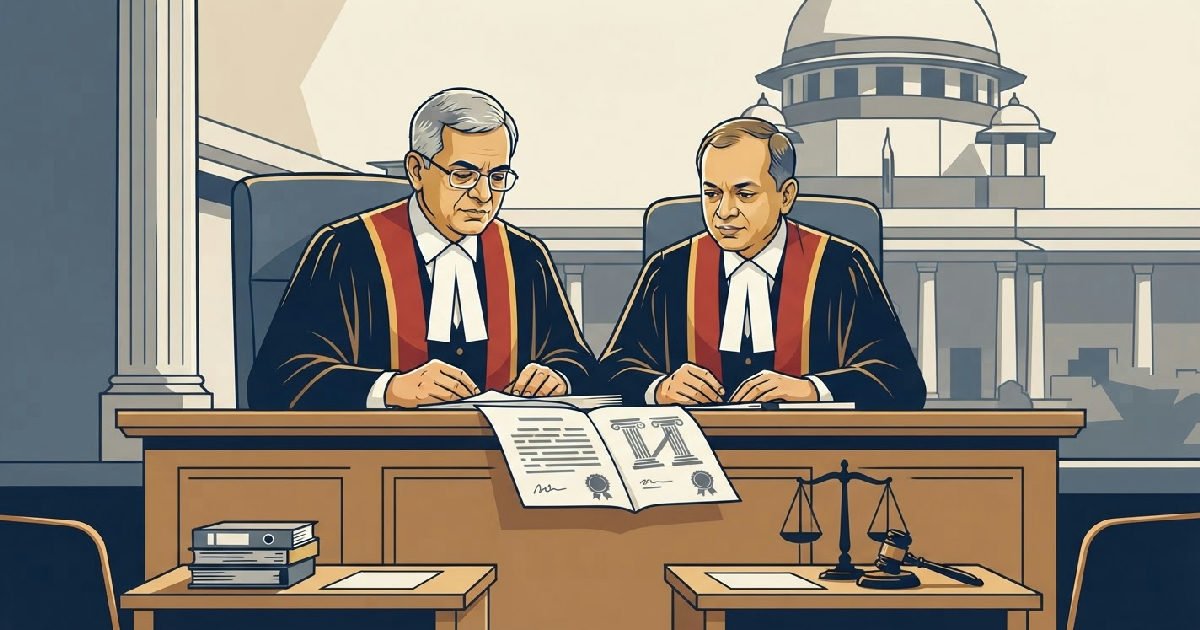
India’s Supreme Court has delivered a landmark ruling, significantly shaping the landscape for summary judgment in commercial disputes across the nation, particularly within Delhi’s bustling commercial courts. In the 2026 case of Reliance Eminent Trading and Commercial Private Limited v. Delhi Development Authority, Justices J.K. Maheshwari and Atul S. Chandurkar established comprehensive guidelines for applying Order XIII-A of the Code of Civil Procedure (CPC).
This pivotal decision aims to accelerate the resolution of commercial claims by providing a clearer framework for courts to dismiss or decide cases without the need for prolonged oral evidence. The ruling underscores a judicial push to ensure that only genuinely triable issues proceed to a full trial, thereby curbing delays endemic to the Indian legal system.
Supreme Court Sets New Standards for Summary Judgment In Commercial Courts In Delhi & All of India
The Supreme Court’s 2026 judgment in Reliance Eminent Trading and Commercial Private Limited v. Delhi Development Authority represents the first detailed judicial framework for summary judgments under Order XIII-A. This ruling provides nine non-exhaustive guidelines for courts to follow, explicitly advocating for a more assertive approach to disposing of claims summarily when the evidence allows it.
Notably, the Supreme Court itself granted summary judgment against the Delhi Development Authority (DDA) in this case, ordering a substantial refund of ₹164.91 crore along with 7.5% interest. This outcome exemplifies the provision’s potential to deliver swift and enforceable remedies, cutting through bureaucratic delays and protracted legal battles.
The guidelines emphasize that courts should conduct a “disciplined, reasoned assessment” of the available evidence. They must consider not only the immediate documentary record but also what evidence could reasonably be expected at trial. This raises the bar for respondents, who must now present a substantively genuine defense, rather than one that is “technically articulated but substantively fanciful.”
Order XIII-A: India’s Drive for Expedited Commercial Justice
India’s pursuit of an efficient commercial justice system has been a long-standing objective, driven by the need to foster economic growth and attract investment. The introduction of Order XIII-A was a crucial legislative step in this direction, aiming to overcome the historical challenges of protracted litigation that often hampered business operations and deterred timely dispute resolution. This procedural innovation reflects a commitment to judicial reform.
By empowering courts to adjudicate certain disputes summarily, Order XIII-A seeks to instill greater predictability and speed into commercial proceedings. It represents a shift from purely adversarial, evidence-heavy trials towards a more pragmatic assessment of claims where a genuine defense or triable issue is lacking. This move is vital for clearing backlogs and enhancing the overall climate for commercial dealings in the country.
Historical Challenges in Indian Commercial Litigation
Before the introduction of Order XIII-A, civil suits, especially commercial ones, often faced significant delays. The traditional process of leading oral evidence, coupled with extensive examination and cross-examination of witnesses, frequently prolonged adjudication for years. This procedural bottleneck stifled commercial efficiency and undermined the enforceability of contracts.
The protracted nature of these disputes made India an unattractive prospect for certain investors and businesses seeking timely dispute resolution. It highlighted a critical need for procedural reforms that could offer faster, more decisive outcomes in commercial matters. The legal community widely acknowledged that the system required an overhaul to keep pace with modern commerce.
Genesis of the Commercial Courts Act, 2015
The Commercial Courts Act, 2015, which enacted on October 23, 2015, was a legislative response to these challenges. It sought to create a specialized judicial infrastructure for commercial disputes. Central to this reform was the introduction of Order XIII-A into the Code of Civil Procedure (CPC), specifically for Commercial Courts, Commercial Divisions of High Courts, and Commercial Appellate Divisions across India.
The 20th Law Commission, in its 253rd Report, had strongly recommended this summary judgment procedure. It drew inspiration from successful models in other jurisdictions, particularly courts in Singapore and the UK’s Civil Procedure Rules Part 24. This demonstrated an international perspective on streamlining commercial justice and adopting best practices.
Order XIII-A marked a significant expansion beyond summary suits under Order XXXVII of the CPC. While Order XXXVII focused on liquidated demands or fixed sums of debt, Order XIII-A broadened the scope considerably. It now encompasses any relief sought in a commercial dispute, provided it meets specific criteria for a “clean paper claim.”
Understanding the Scope and Application of Order XIII-A
Order XIII-A’s effectiveness hinges on a clear understanding of its boundaries and how it is to be applied within the specific context of commercial disputes. Its provisions are meticulously crafted to ensure that while the process is expedited, fairness and due process are not compromised. This requires careful consideration of what constitutes a “commercial dispute” and the financial thresholds involved.
The Supreme Court’s guidelines serve to clarify these nuances, providing much-needed interpretative clarity on the scope of claims that can be subjected to summary judgment. This includes not just entire cases, but also specific parts or questions within a dispute, allowing for a targeted and efficient resolution of discrete legal points. This flexibility is key to its utility in complex commercial litigation.
Defining “Commercial Dispute” and Pecuniary Limits
Order XIII-A applies exclusively to suits classified as “commercial disputes” under the Commercial Courts Act, 2015. These disputes must also meet a specified pecuniary value, currently set at ₹3 lakh and above. This threshold ensures that the expedited procedure is reserved for commercial matters of a certain financial significance.
The term “claim” under Order XIII-A is broad. It can refer to an entire claim, a specific part of a claim, any particular question upon which the claim’s outcome depends, or even a counterclaim. This flexibility allows courts to address discrete, resolvable aspects of a dispute summarily, even if the entire case cannot be disposed of at that stage.
Critical Timing for Summary Judgment Applications
The timing for filing a summary judgment application is crucial and strictly regulated. Either the plaintiff or the defendant can make the application, but it must be submitted at any point after the summons has been served on the defendant. Crucially, this must occur before the issues have been formally framed by the court.
The Supreme Court’s 2026 guidelines emphatically reinforced that this specific window must be “strictly observed.” This strictness aims to prevent tactical delays or the use of summary judgment applications as a last-ditch effort once a case has progressed significantly. Proper strategic planning is therefore essential for parties considering this option.
Procedural Framework and Judicial Discretion
The successful implementation of Order XIII-A relies heavily on a robust procedural framework and the judicious exercise of judicial discretion. While the goal is expedition, courts must meticulously adhere to prescribed steps, ensuring that both parties have ample opportunity to present their positions. This balance is critical to maintaining the integrity and legitimacy of summary dispositions.
Judges are tasked with a crucial role: discerning between a truly unmeritorious claim or defense and one that, despite initial appearances, warrants a full trial. This calls for a “disciplined, reasoned assessment” of the evidence, demanding a higher standard from respondents to demonstrate a “real prospect of success” rather than relying on mere technical denials or speculative arguments.
Filing Requirements and Evidentiary Standards
An application for summary judgment under Order XIII-A must be meticulously prepared. It needs to explicitly state that it is being filed under this specific Order of the CPC. The application must clearly outline the grounds for seeking summary judgment, identify all evidence relied upon, and include a confirmation that the applicant genuinely believes the respondent has no real prospect of success.
A supporting affidavit from an individual with direct knowledge of the facts is also mandatory. Typically, the respondent receives 30 days’ notice to prepare and submit their response to the application. This period allows them adequate time to demonstrate a genuine defense, if one exists, ensuring fairness in the expedited process.
Court’s Assessment and Potential Orders
The court’s role during a summary judgment application is not to conduct a mini-trial, but rather to assess the documentary record. It seeks to determine if the defense presented is “fanciful, speculative, or without substance.” This means courts are looking for tangible evidence of a genuinely triable issue, not just a technically phrased denial.
If the court concludes that a party has no real prospect of successfully defending or prosecuting a claim, and there’s no other compelling reason for a full trial, it can issue various orders. These include granting judgment on the claim, dismissing the claim entirely, or dismissing the summary judgment application itself.
The court also holds the power to make conditional orders, such as requiring security for restitution of costs.
If summary judgment is granted, the outcome is a dismissal of the suit on its merits. This prevents the same claim from being re-filed later, providing a definitive and efficient resolution. This finality is a key benefit, especially compared to the often drawn-out nature of traditional litigation. Here’s a brief comparison:
| Feature | Order XIII-A (Summary Judgment) | Order XXXVII (Summary Suits) |
|---|---|---|
| Scope | Any commercial dispute, including specific questions or counterclaims | Limited to liquidated demand or fixed sum of debt |
| Pecuniary Value | ₹3 lakh and above | Not specified in research context |
| Timing of Application | After summons, before issues framed | Not specified in research context |
| Nature of Defense | Must demonstrate “real prospect” of success, not “fanciful” | Not specified in research context |
| Outcome if Granted | Dismissal of suit on merit | Not specified in research context |
Strategic Implications for Businesses and Legal Counsel
For businesses engaged in commercial disputes in Delhi, the Supreme Court’s reinforced stance on Order XIII-A offers both opportunities and warnings. If a claim is genuinely a “clean paper claim” with clear, undisputed evidence, seeking summary judgment can provide a significantly faster route to resolution and recovery.
This is especially true for cases involving straightforward contractual obligations or outstanding payments where the defense is largely designed for delay.
However, legal practitioners must exercise caution. As the initial guidance suggests, summary judgment will not work if the opposing side has a genuine defense related to quality of goods, a valid jurisdiction challenge, or any other substantively arguable point. It’s not a tool to be filed “as a habit on every messy account,” where disputes are fact-heavy or involve complex interpretations.
The emphasis on a “real prospect” of success demands thorough preparation. Parties need to meticulously scrutinize their claims and defenses, ensuring they possess solid documentary evidence to support their positions. How to file a commercial suit effectively now includes a strong consideration of this expedited pathway, especially for claims that are ripe for early adjudication.
Future of Commercial Dispute Resolution in India
The Supreme Court’s comprehensive guidelines are set to have a profound impact on the efficiency of commercial dispute resolution across India. By providing clarity and encouraging a proactive judicial approach, they aim to reduce the substantial backlog of commercial cases.
This move aligns with the broader goal of making India a more attractive destination for business and investment, where legal recourse is both fair and swift.
While the initial application of these refined rules will undoubtedly require adaptation from both courts and litigants, the direction is clear: move away from unnecessary trials. The legal community anticipates a shift towards more summary dispositions, compelling parties to present their strongest cases earlier. This could significantly cut down on the time and cost associated with commercial litigation, fostering a more predictable legal environment.
It’s important to remember that even with these streamlined procedures, the foundation of a strong commercial claim still relies on meticulous documentation and legal strategy. Knowing when and how to leverage tools like summary judgment is critical for any entity involved in significant commercial dealings. Do not file a commercial suit in Delhi without understanding these crucial nuances.
What is summary judgment in commercial courts?
Summary judgment in commercial courts, governed by Order XIII-A of the CPC, allows a court to decide a claim or issue without a full trial if one party has no real prospect of success. It is designed for clear-cut cases where oral evidence isn’t needed.
When was Order XIII-A introduced into the CPC?
Order XIII-A was introduced into the Code of Civil Procedure (CPC) by the Commercial Courts Act, 2015, which was enacted on October 23, 2015.
Can summary judgment be applied to all commercial disputes?
No, Order XIII-A applies only to “commercial disputes” as defined by the Commercial Courts Act, 2015, with a specified value of ₹3 lakh and above. It’s intended for cases with clear documentary evidence, not for complex factual disputes.
Clean invoices and a blank defence? Call or Whatsapp for Free Consultation.
Related Service: https://arpitmarwah.com/commercial-lawyers-in-delhi/