
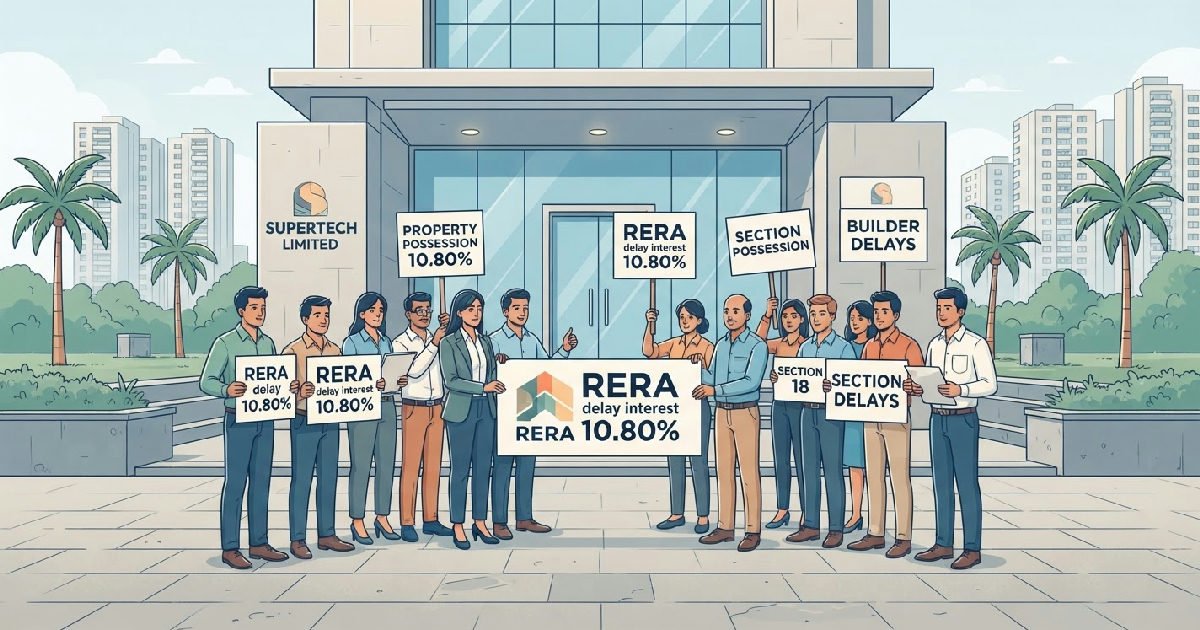
Homebuyers across Delhi-NCR are increasingly asserting their statutory rights under the Real Estate (Regulation and Development) Act, 2016 (RERA), demanding compensation for delayed property possession. This critical legislation empowers allottees to claim RERA delay interest at a current annual rate of 10.80% when builders fail to deliver projects on time, or to seek a full refund with interest if they choose to withdraw.
The right to this compensation is enshrined in Section 18 of the RERA Act. It provides a clear mechanism for buyers to be remunerated for the financial burden and inconvenience caused by construction delays, ensuring accountability from property developers.
Understanding RERA Delay Interest Provisions
The core purpose of RERA delay interest is to compensate buyers for a builder’s failure to hand over possession by the agreed-upon date. It also applies if a buyer opts to terminate their agreement and seeks a refund, with the interest calculated on the amount paid to the builder.
Critically, the delay period begins from the possession date explicitly stated in the registered agreement for sale. Oral assurances or informal promises from sales managers hold no legal weight in this calculation. Builders often include a grace period of three to six months in their agreements, which is generally considered enforceable.
Calculating Homebuyer Compensation
The interest rate payable by the promoter is fixed by RERA regulations. It is typically set at the State Bank of India’s (SBI) highest Marginal Cost of Funds Based Lending Rate (MCLR) plus two percent (SBI MCLR + 2%).
As of August 15, 2026, SBI’s highest MCLR for a three-year tenor stands at 8.80%. This calculates to a verified annual interest rate of 10.80% (8.80% MCLR + 2%), which builders must pay.
This interest is applied per annum on the total amount the buyer has already paid to the builder, not on the total flat price. It covers all amounts paid, including booking amounts, instalments, parking charges, and club fees, but excludes stamp duty and registration fees.
For more comprehensive insights into legal options, many homebuyers often engage RERA lawyers in Delhi to navigate these complex cases effectively.
A significant aspect of RERA is its symmetrical application of interest. If a builder levies charges on a buyer for late payments, they must also compensate the buyer at the same rate for any project delays. The calculation formula for RERA possession delay interest is straightforward.
It’s the Total Amount Paid multiplied by (SBI MCLR + 2%) multiplied by the Number of Delayed Months, then divided by 12. For example, a ₹50 Lakh payment with an 11% annual interest rate for a 12-month delay would yield ₹5,50,000 in annual interest.
Addressing Builder ‘Force Majeure’ Claims
Builders frequently cite force majeure events, such as natural calamities, government orders, or pandemics, to justify construction delays. They hope these exemptions will shield them from liability for late delivery.
However, RERA authorities rigorously examine these claims. Delays stemming from poor planning, mismanagement, or insufficient funding typically do not qualify as force majeure. Courts have consistently ruled that while force majeure may exempt promoters from certain legal penalties, it does not absolve them of paying compensatory interest to buyers.
Homebuyer Options Under RERA Section 18
When a builder fails to deliver possession by the agreed-upon date, Section 18 of RERA provides homebuyers with two distinct and equally powerful options. These choices empower buyers to decide the best course of action based on their individual circumstances.
Firstly, the buyer can choose to withdraw from the project entirely. This allows them to terminate the agreement and demand a full refund of all amounts paid. The builder is then obligated to return the entire sum, complete with the prescribed RERA interest and additional compensation.
The Supreme Court, in its landmark 2020 ruling in Imperia Structures Ltd versus Anil Patni, affirmed this right. It clarified that a refund is an absolute entitlement under Section 18, even if construction is complete or an occupancy certificate has already been issued for the property. This ruling significantly bolstered buyer protections.
Alternatively, if the homebuyer still wishes to proceed with the purchase, they can choose to continue with the project. In this scenario, the builder must pay interest for every month of delay until the actual possession of the property is handed over. This ensures ongoing compensation for the continued inconvenience.
Deciding between these two options requires careful consideration of the project’s status and the buyer’s long-term goals. Understanding the pros and cons of each path is crucial for making an informed decision. Sometimes, whether to accept possession or seek a refund is a significant dilemma. Homebuyers often weigh whether to pursue possession or a refund, a choice dependent on several factors.
Navigating the Claims Process
Initiating a RERA claim for delay interest requires adherence to specific eligibility criteria and a structured process. This ensures that only legitimate grievances are addressed and that all necessary documentation is in order.
To be eligible, the claimant must be an “allottee” as defined under Section 2(d) of the RERA Act. There must also be a registered agreement for sale that clearly specifies a possession date. The builder must have missed this stipulated date without a valid, acceptable reason, such as genuine force majeure.
Furthermore, the real estate project itself must be registered with the respective state RERA authority. This registration is fundamental, as it brings the project under the regulatory oversight of RERA, enabling buyers to file complaints through the official channels.
Essential Documentation for Claims
Gathering the right documents is paramount for a successful RERA claim. Homebuyers need to present a comprehensive set of records to substantiate their case.
Key documents include the Registered Agreement for Sale or the original Booking Letter. All payment receipts and corresponding bank statements are essential to prove payments made to the builder. The Allotment Letter also forms a crucial part of the submission.
Additionally, the RERA registration certificate for the project can be downloaded from the relevant state RERA portal. Any written communication with the builder, including emails, WhatsApp messages, or formal letters, demonstrating delay or demands for possession, should be compiled. This includes all builder responses, or lack thereof.
Evidence of delay, such as site photographs or project progress updates, can further strengthen a complaint. If claiming additional compensation for financial loss, proof like rent receipts or EMI statements should also be included. A copy of any legal notice previously sent to the builder is also highly recommended.
Online Complaint Submission Procedure
The process of filing a RERA complaint is streamlined through online portals, making it accessible for homebuyers. Each state has its own RERA website where complaints are lodged electronically.
First, identify the appropriate state RERA authority based on the project’s location. Confirm that the project is indeed registered with that authority. Then, register as a complainant on the state RERA portal, which usually requires an email address, mobile number, PAN card details, and sometimes residential address and a photograph.
Once registered, fill out the complaint form accurately, clearly specifying the grievance and the relief sought. This could be a refund, possession with interest, or additional compensation. Finally, upload all the meticulously gathered supporting documents to complete the submission process.
Importance of Timely Action for Homebuyers
Homebuyers in Delhi-NCR facing delayed projects must act promptly to protect their interests. Delaying the complaint process can complicate matters, as builders may use a buyer’s inaction against them during proceedings.
The provided research does not contain specific guidance on the implications of continuing to pay instalments after the agreed possession date. This specific aspect is not detailed within the provided context regarding RERA claims.
Furthermore, the research also does not detail specific provisions or procedures for Non-Resident Indians (NRIs) regarding RERA complaints. Information on filing mechanisms for NRIs, such as the use of a Power of Attorney (POA), is not present in this context.
Seeking timely legal counsel from specialists in real estate law can make a significant difference. These professionals can help assess the situation, prepare the necessary documentation, and guide the homebuyer through the intricate process of filing a complaint. This proactive approach helps secure rightful compensation.
RERA’s Impact on Real Estate Accountability
The implementation of RERA has profoundly reshaped the real estate landscape, particularly in regions like Delhi-NCR. It has shifted the balance of power, granting homebuyers unprecedented protection and recourse against errant developers.
Before RERA, buyers often found themselves at the mercy of builders, with little legal framework to ensure timely delivery or fair compensation for delays. The act introduced much-needed transparency and accountability, making project registration mandatory and clearly defining promoter obligations.
This increased oversight means that developers can no longer unilaterally alter project specifications or delay delivery without consequence. The clear provisions for delay interest and refunds serve as a powerful deterrent against arbitrary practices, fostering a more regulated and consumer-friendly market environment. Many legal experts believe that RERA has significantly enhanced homebuyers’ ability to counter builder non-compliance.
The impact extends beyond individual cases, contributing to a more mature and predictable real estate sector. With buyers more aware of their rights and the legal avenues available, builders are compelled to adhere to timelines and commitments, ultimately benefiting the entire ecosystem.
Key Financial Responsibilities of Builders Under RERA
| Aspect | Builder’s Obligation Under RERA | Details |
|---|---|---|
| Delay Interest Rate | SBI MCLR + 2% per annum | Currently 10.80% (as of Aug 15, 2026) |
| Interest Basis | Amount paid by buyer | Not total flat price; includes booking, installments, etc. |
| Symmetry Clause | Must pay buyer at same rate if charging late fees | Ensures fairness in financial penalties |
| Refund Obligation | Full refund with interest & compensation | If buyer withdraws due to delay; absolute right |
| Grace Period Impact | Delay calculation starts after grace period ends | Typically 3-6 months, if specified in agreement |
What is RERA delay interest?
RERA delay interest is a compensation mechanism under the Real Estate (Regulation and Development) Act, 2016. It allows homebuyers to receive financial remuneration from builders for delayed possession of their property, or to get interest on their refund if they choose to exit the project.
How is the RERA delay interest rate calculated?
The interest rate is determined by adding two percent to the State Bank of India’s (SBI) highest Marginal Cost of Funds Based Lending Rate (MCLR). As of August 15, 2026, with SBI’s MCLR at 8.80%, the applicable RERA delay interest rate is 10.80% per annum.
What documents are essential to claim RERA delay interest?
Key documents include the registered Agreement for Sale, all payment receipts and bank statements proving payments, the Allotment Letter, and the project’s RERA registration certificate. Any written communication with the builder and proof of delay or loss also strengthen the claim.
Delayed possession and want RERA delay interest calculated properly? WhatsApp or call.
Related Service: https://arpitmarwah.com/real-estate-lawyer/