
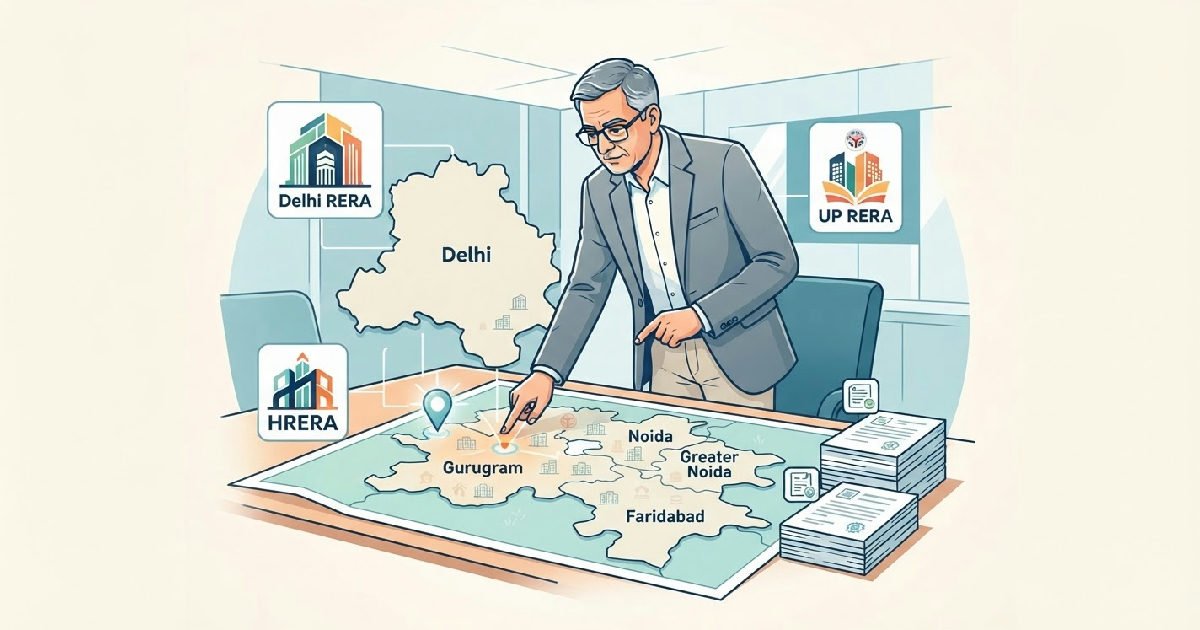
RERA confirms project location is the key factor for homebuyers to file a RERA complaint in Delhi NCR, as per the Real Estate (Regulation and Development) Act, 2016.
This landmark legislation, which became fully effective on May 1, 2017, was designed to protect consumer interests and bring much-needed regulation to India’s real estate sector. It mandates the creation of state-level Real Estate Regulatory Authorities (RERAs) for oversight and swift dispute resolution, streamlining a process once fraught with challenges.
How File RERA: jurisdiction matters
Understanding where to file your RERA complaint is the crucial first step. The jurisdiction is determined exclusively by the physical location of the real estate project, not by where the homebuyer resides. This means a buyer living in Dwarka, Delhi, who purchased a property in Greater Noida, will need to approach a different authority than one who bought within Delhi.
For projects situated within the territorial boundaries of Delhi, the Delhi Real Estate Regulatory Authority (Delhi RERA) is the correct forum. Similarly, if your property is in Noida or Greater Noida, the Uttar Pradesh Real Estate Regulatory Authority (UP RERA) holds jurisdiction. Homebuyers with projects in Gurugram, on the other hand, must file their complaints with the Haryana Real Estate Regulatory Authority (HRERA Gurugram).
This clear jurisdictional division prevents confusion and ensures that complaints are heard by the authority best positioned to investigate and resolve local issues. It also underscores RERA’s intent to decentralize and localize regulatory power, making it more accessible and efficient for consumers. Establishing eligibility to file the complaint properly is essential for timely resolution.
Streamlining the RERA Complaint Process Online
The general procedure for filing a RERA complaint across Delhi, UP, and HRERA largely follows a standardized online model. This digital approach aims to simplify access and expedite the initial stages of dispute resolution, offering a systematic pathway for homebuyers to seek redress.
This digital transformation begins with the creation of a secure online profile on the respective state RERA portal. Complainants register by providing essential personal details, authenticated through an OTP verification, which then grants them access to a personalized dashboard.
This initial step is critical for establishing a secure and trackable interaction channel with the regulatory authority, replacing cumbersome manual procedures with a streamlined, accessible online system.
Once logged in, the process guides users through selecting the appropriate complaint form, typically Form M for general RERA violations or Form N for claims involving financial loss or damage. Beyond form selection, the success of a complaint heavily relies on comprehensive documentation.
This includes gathering crucial evidence such as the Builder-Buyer Agreement, payment proofs, and any correspondence, all meticulously prepared to substantiate the claim effectively.
Initial Registration and Login Steps
The first step involves visiting the official RERA website for the relevant state: rera.delhi.gov.in for Delhi, up-rera.in for Uttar Pradesh, or haryanarera.gov.in for Haryana. Prospective complainants must create a login ID, typically registering as a “Complainant” by providing personal details like their name, father’s name, email address, and mobile number.
An OTP verification process usually secures this registration, after which users can log in using their newly established credentials.
This initial online setup is designed to be user-friendly, ensuring that homebuyers can easily initiate their complaint from anywhere. It digitizes what was once a paperwork-heavy process, making it more efficient and less time-consuming for all parties involved. Once logged in, the complainant gains access to the specific forms required for their grievance.
Selecting the Correct Complaint Form
After logging in, complainants must select the appropriate type of complaint form. Two primary forms are generally available: Form M and Form N. Form M is designated for complaints concerning violations of the RERA Act and its associated Rules. This form is used for broad regulatory infringements committed by developers.
Conversely, Form N is utilized for grievances related to loss or damage. This often includes issues arising from incorrect or false information provided by the builder, structural defects in the property, deficiencies in services, or significant delays in project completion. Filling out these forms accurately requires careful attention to detail, including the complainant’s full particulars, the project’s address, and its registration number if applicable.
Crucially, homebuyers must detail the specific facts and statements pertaining to the delay or other issues, along with any responses received from the project developer. The form also requires a clear statement of the specific relief sought, which is a critical point that requires careful consideration to avoid complications.
Compiling Essential Documents for Submission
A successful RERA complaint hinges on a well-documented case, meaning meticulous preparation of supporting paperwork is non-negotiable. The required documents serve as evidence to substantiate the homebuyer’s claims, providing the regulatory authority with a comprehensive understanding of the dispute.
Key documents include the Builder-Buyer Agreement (BBA), the Allotment Letter, or the Sale Agreement – these foundational contracts outline the terms of the purchase. All payment receipts and definitive proof of payments made to the builder are also essential, confirming the financial transactions involved. Any email, letter, or WhatsApp correspondence exchanged with the builder regarding delays, issues, or promises can also be vital evidence.
Furthermore, the project brochure or marketing material is important, particularly if it highlights promised amenities or specifications that were not delivered. Proof of the promised possession date is critical for claims related to delays. Identity and address proofs, such as an Aadhaar Card or PAN card, verify the complainant’s details.
Photographs or videos can serve as powerful visual evidence of poor construction quality or incomplete work. Finally, the RERA registration number of the project, if registered, must be provided, and if legal representation is involved, a Vakalatnama or Memorandum of Authorization will be necessary.
Understanding Fees and Financial Aspects
Filing a RERA complaint incurs specific fees that vary by state authority, a detail every homebuyer must consider before initiating the process. These fees cover the administrative costs associated with processing the complaint and hearing the case. Understanding these financial commitments beforehand helps in planning and ensures a smooth filing experience.
In Delhi, for instance, a RERA complaint filed directly with the regulatory authority (Form M) costs ₹1,000. However, if the complaint is directed to an Adjudicating Officer (Form N), the fee increases to ₹5,000.
For homebuyers approaching the Uttar Pradesh Real Estate Regulatory Authority (UP RERA), a uniform fee of ₹1,000 applies for both Form M and Form N. The Haryana Real Estate Regulatory Authority (HRERA), serving both Gurugram and Panchkula benches, charges ₹1,000 per complaint, with an additional ₹10 fee for every annexure attached to the complaint.
Payments can typically be made online or through a Demand Draft, offering flexibility to complainants.
| RERA Authority | Complaint Type / Fee | Amount | Notes |
|---|---|---|---|
| Delhi RERA | General Complaint (Form M) | ₹1,000 | For RERA Act/Rules violations |
| Delhi RERA | Adjudicating Officer (Form N) | ₹5,000 | For loss/damage claims |
| UP RERA | General & Adjudicating Officer | ₹1,000 | Uniform fee for both Form M & N |
| HRERA (Gurugram/Panchkula) | General Complaint | ₹1,000 | Plus ₹10 per annexure attached |
Key Strategic Considerations for Homebuyers
Navigating the RERA complaint process effectively requires more than just filling out forms; it demands strategic decision-making, particularly regarding the relief sought and understanding specific eligibility criteria. These considerations can significantly impact the outcome and efficiency of the resolution process.
A pivotal decision lies in clearly articulating the desired relief: either possession of the property with accrued delay interest or a complete refund with interest. Homebuyers must make a singular, unambiguous choice, as selecting both options can complicate and prolong the resolution process.
This strategic clarity is essential for the RERA authorities to understand and act upon the complaint efficiently, aligning the legal remedy with the homebuyer’s ultimate objective.
Furthermore, understanding specific eligibility parameters is crucial, especially for non-resident Indian (NRI) buyers who can file complaints through a Power of Attorney, and for allottees who must file directly. Even in cases involving projects that failed to register under RERA, the Act often still provides recourse, demonstrating its comprehensive protective umbrella.
These nuances are vital for ensuring the complaint is properly structured and valid from the outset.
Clarity in Seeking Relief
One of the most critical decisions a homebuyer must make is clearly stating the specific relief they seek. The RERA framework typically allows for two primary outcomes: possession of the property with delay interest, or a full refund with interest. It is imperative not to select both options simultaneously.
The system requires a distinct choice, and attempting to tick both boxes can complicate the complaint and potentially delay its resolution.
Homebuyers should carefully evaluate their circumstances, financial position, and the project’s status before deciding. If the project is nearing completion and the buyer still intends to occupy the property, pursuing claim delay interest might be the suitable path.
However, if trust in the developer is lost or the delays are substantial, a refund with interest could be the more appropriate course of action. This clarity ensures the RERA authority can process the request efficiently.
Special Cases: NRIs and Allottee Eligibility
The RERA Act extends its protection to non-resident Indian (NRI) homebuyers as well. NRIs can file complaints, often by utilizing a Power of Attorney granted to a trusted individual in India. This provision ensures that geographical distance doesn’t prevent them from addressing grievances with their Indian properties, facilitating access to justice for NRI homebuyers.
A crucial point of eligibility dictates that the complaint must be filed by the allottee themselves. Relatives or other individuals cannot file a complaint in their own name if they are not the official allottee of the property. This rule reinforces the direct contractual relationship between the developer and the original buyer, ensuring that only those with a direct stake can initiate proceedings.
Addressing Unregistered Projects
Even if a real estate project is not registered under RERA, homebuyers may still have grounds to file a complaint. This applies to projects that fall under RERA’s mandatory registration criteria but have failed to comply. The Act aims to regulate the entire sector, and developers cannot evade accountability simply by sidestepping registration.
The authorities often review such cases to determine if the project should have been registered in the first place, and if so, they can compel the developer to comply. This provision offers a safety net for buyers who might have invested in projects unaware of their unregistered status, broadening RERA’s protective scope.
Submission, Tracking, and Resolution Outlook
Once all the necessary forms are filled and documents uploaded, the final step in the process is to formally submit the complaint online. Upon successful submission, complainants will receive a unique complaint reference number. This number is vital for all future correspondence and tracking the status of their grievance.
Regularly checking the status of the complaint on the respective RERA website is highly recommended. These platforms are designed to provide updates on hearings, orders, and the overall progression of the case, ensuring transparency for the homebuyer. RERA complaints are intended for speedy resolution, with a targeted timeframe of 60 days. While this is an ambitious goal, it highlights the Act’s commitment to prompt justice.
The system also allows for multiple complaints to be filed through the same user profile after the initial registration, which is convenient for buyers with grievances against different projects or developers. In Uttar Pradesh, UP RERA further offers a conciliation forum. This additional mechanism aims to facilitate an amicable settlement between homebuyers and developers, potentially avoiding lengthy litigation and fostering a more cooperative resolution.
RERA’s Enduring Impact on Real Estate Trust
The Real Estate (Regulation and Development) Act, 2016, has fundamentally reshaped the landscape of India’s property sector, particularly in key regions like Delhi NCR. By standardizing processes, demanding transparency, and establishing clear mechanisms for grievance redressal, RERA has moved towards creating a more equitable playing field for homebuyers.
Before RERA, homebuyers often found themselves at a significant disadvantage against developers, with little recourse for project delays, fraudulent claims, or substandard construction. The Act has not only empowered consumers but has also instilled a greater sense of accountability among builders. This regulatory overhaul fosters an environment where trust can flourish, crucial for the long-term health and credibility of the real estate market.
Looking ahead, RERA’s continued enforcement and evolving interpretations will further define buyer-developer relationships. The Act remains a dynamic instrument, constantly adapting to new challenges in the market and reinforcing its role as a bulwark for residential property investments. Its presence ensures that the interests of the ordinary homebuyer are consistently prioritized, transforming a complex sector into one that is more reliable and transparent.
Frequently Asked Questions
This section addresses common queries homebuyers often have regarding the RERA complaint process, offering clarity on critical aspects from jurisdiction to eligibility and available remedies. Navigating the legal landscape of real estate can be complex, and these frequently asked questions aim to demystify key procedural and strategic considerations for those seeking redress under RERA.
Understanding these fundamental points can significantly streamline the complaint filing process and improve the likelihood of a successful resolution. From pinpointing the correct regulatory authority based on property location to grasping the implications of different relief options, this guide provides essential insights derived directly from the RERA Act’s provisions.
Q: What determines the RERA jurisdiction for my complaint?
A: The jurisdiction for filing a RERA complaint is determined by the physical location of the real estate project, not by the buyer’s residence. For example, a project in Gurugram falls under HRERA Gurugram, while one in Noida is handled by UP RERA, regardless of where the buyer lives.
Q: Can I seek both possession with delay interest and a refund with interest?
A: No, you cannot typically seek both possession with delay interest and a full refund with interest simultaneously. You must clearly state one specific relief option in your RERA complaint. Choosing both can complicate the process and delay resolution.
Q: What if I’m an NRI or not the direct allottee?
A: Non-Resident Indians (NRIs) can file a RERA complaint, often by appointing a Power of Attorney in India to act on their behalf. However, the complaint must always be filed by the actual allottee of the property, not by relatives or other individuals in their own name if they are not the official buyer.
Need this filed in the correct NCR authority? WhatsApp or call for free consultation.
Related Service: https://arpitmarwah.com/rera-lawyers-in-delhi/