
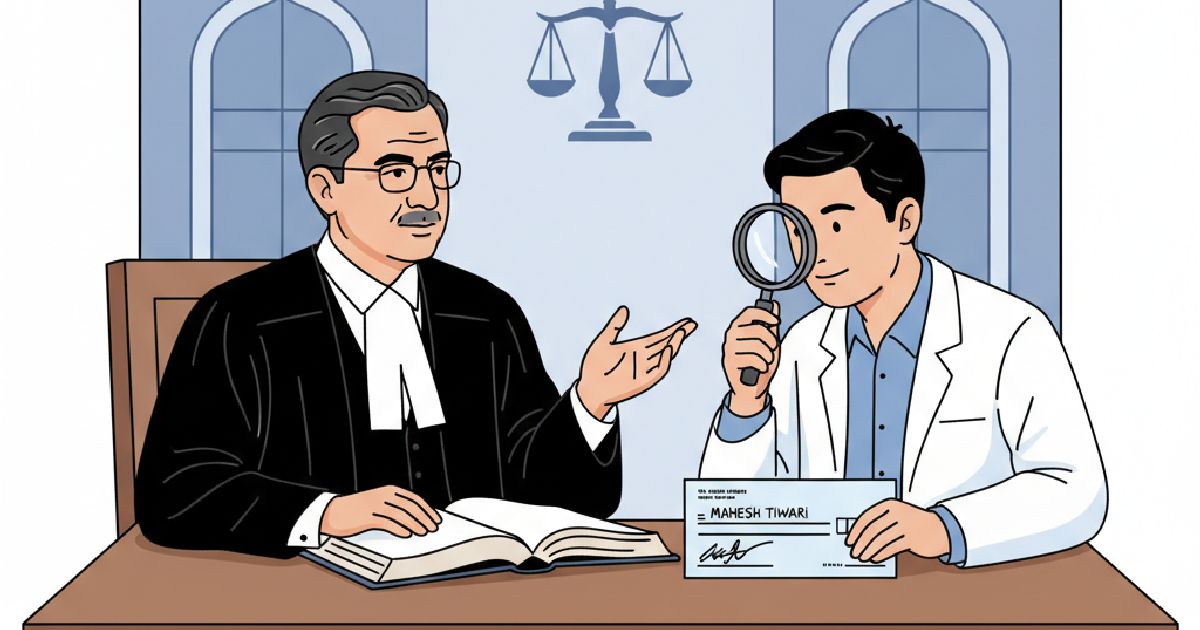
Justice Anoop Kumar Dhand of the Rajasthan High Court, Bench at Jaipur, has ruled that an accused facing trial for cheque dishonor cannot be denied the opportunity to have disputed signatures scientifically examined.
The order, issued on April 13, 2026, sets aside a decade-old decision by a lower court that had previously blocked Mahesh Tiwari from seeking a handwriting expert’s opinion.
Ensuring fair trial rights in cheque dishonour cases
The High Court emphasized that the right to a fair trial, enshrined in Article 21 of the Constitution of India, demands that defendants be granted proper legal mechanisms to prove their innocence. This pivotal right ensures that every individual has an equitable chance to present their defence.
The petitioner, Mahesh Tiwari, a resident of Gangapur City, has been embroiled in legal proceedings for 14 years, stemming from a complaint filed by Kailash in 2012. The dispute centered on cheque No. 106880, dated March 31, 2011, which was presented by Kailash and subsequently returned by the bank for “insufficient funds.”
Tiwari consistently maintained that he never issued or signed the document in question. His defence has remained unchanged since he received the initial legal notice following the cheque’s dishonour.
Despite this consistent defence, the Judicial Magistrate (First Class) in Gangapur City, Sawai Madhopur, rejected his application for forensic analysis in 2015. The lower court suggested instead that the petitioner could examine a bank officer in order to support his claims regarding the disputed signature.
This rejection led Tiwari to file a criminal miscellaneous petition, S.B. Criminal Miscellaneous (Petition) No. 1175/2015, before the High Court of Judicature for Rajasthan, Bench at Jaipur. He sought to challenge the lower court’s decision and secure the forensic examination.
The legal framework: Section 45 of the Indian Evidence Act
In his reportable order, Justice Anoop Kumar Dhand clarified that the timing of a forensic application should not automatically disqualify it if the defence is central to the case. The lower court had initially dismissed Tiwari’s request under Section 45 of the Indian Evidence Act, 1872, arguing it was filed at the “fag end” of the trial.
However, the High Court noted that the right to adduce evidence in support of one’s defence is a valuable fundamental right, recognized by Section 243(2) of the Code of Criminal Procedure, 1973. This right remains active throughout the defence stage of a trial.
Section 45 of the Indian Evidence Act plays a crucial role by allowing courts to consider expert opinions on matters such as handwriting identification. Experts, individuals specially skilled in these areas, provide opinions that assist the court in forming its judgment.
These opinions, while relevant, are not conclusive and must be presented through oral testimony, allowing for cross-examination. This ensures that the scientific evidence provided by the Forensic Science Laboratory (FSL) is thoroughly scrutinised.
Rebuttable presumptions and the Negotiable Instruments Act
Tiwari is facing trial for an offence under Section 138 of the Negotiable Instruments Act, 1881. This section makes the dishonour of a cheque a criminal offence under specific circumstances, aiming to enhance the acceptability of cheques in financial transactions.
The court highlighted that Section 139 of the Act of 1881 creates a presumption in favour of the cheque holder. This presumption states that, unless proven otherwise, the holder received the cheque for the discharge of a debt or other liability.
But this particular presumption, the court emphasized, is a rebuttable one, not absolute. While statutes like the Negotiable Instruments Act often place heavy burdens on the accused, the complainant must still face the accused’s right to robustly rebut these legal presumptions. The burden of proof shifts to the accused to disprove their guilt.
In such scenarios, where the common law presumption of innocence is reversed, the right to a fair trial becomes even more critical. It deserves stronger and more emphatic protection than it might receive in ordinary criminal offences under the Penal Code, 1860.
Kalyani Baskar precedent: a cornerstone for fair trial
Justice Anoop Kumar Dhand drew extensively from the Supreme Court’s ruling in Kalyani Baskar (Mrs.) Vs. M.S. Sampoornam (Mrs.), reported in (2007) 2 SCC 258. This landmark judgment clearly supports an accused person’s right to present evidence to counter charges.
The Supreme Court in Kalyani Baskar held that a Magistrate does not exceed their powers by directing a document to be sent to a handwriting expert for comparison, particularly when it serves the interest of justice. The purpose of such an examination is to assist the Magistrate in comparing disputed signatures and reaching a conclusion.
Crucially, the Supreme Court stated that denying a handwriting expert’s examination effectively deprives the appellant of an opportunity to rebut the case against them. This is a denial of fair trial, which includes proper opportunities to prove innocence.
The inadequacy of alternative evidence
Justice Dhand observed that a bank officer’s administrative check is no substitute for the scientific opinion of an FSL handwriting expert. Expert analysis of strokes and signatures provides the “good material” necessary for an accused to potentially disprove their guilt. This scientific evidence can offer decisive clarity where visual comparison alone might fall short.
The court highlighted that rejecting such an application, particularly when the accused has disputed the signature from the outset, amounts to denying a “fair and proper opportunity” to defend oneself. The fundamental right to defend oneself is secured under Article 21 of the Constitution of India.
High Court directs expedited forensic examination
Considering the legal propositions and the specific circumstances of Mahesh Tiwari’s case, the High Court concluded that the application under Section 45 of the Act of 1872 deserved acceptance. Consequently, the impugned order dated March 2, 2015, passed by the Judicial Magistrate (First Class), Gangapur City, Sawai Madhopur, was quashed and set aside.
The High Court has now directed the Trial Court to send the cheque in question to the FSL for analysis of the disputed signatures. Furthermore, the Trial Court must obtain specimen signatures from Mahesh Tiwari in court and forward them alongside the cheque to the FSL.
Given that the matter dates back to 2012, spanning over 14 years, Justice Dhand instructed the Trial Court to send a D.O. letter to the FSL requesting an expeditious report. Such proactive measures are necessary to avoid further undue delays in the prolonged legal battle.
Implications for criminal proceedings and fairness
This ruling reinforces the critical importance of a fair trial, particularly in cases involving financial instruments where authenticity is disputed. It underscores that procedural rules are designed to ensure justice, not to create barriers to an accused person’s defence. The order serves as a reminder that courts must meticulously adhere to these principles, safeguarding the fundamental rights of individuals. Premature complaints or technicalities should not overshadow the core principles of justice.
| Aspect | Judicial Magistrate (First Class) Decision | High Court Decision |
|---|---|---|
| Date of Order | March 2, 2015 | April 13, 2026 |
| Application for FSL Analysis | Rejected | Allowed |
| Grounds for Rejection/Acceptance | “Fag end of trial”; bank officer examination alternative | Right to fair trial (Article 21); expert opinion necessity; Kalyani Baskar precedent |
| Status of Impugned Order | Upheld | Quashed and Set Aside |
| Directions to Trial Court | N/A | Send cheque to FSL; obtain specimen signatures; expedite report |
The Trial Court is further directed to make every possible endeavor to conclude the trial expeditiously immediately following the receipt of the FSL report. It must also refrain from entertaining any unnecessary requests for adjournment from either side, ensuring the complaint is decided without further delay.
This decision by Justice Dhand is a significant affirmation of an accused person’s right to present expert evidence crucial to their defence. It clarifies that such rights cannot be curtailed merely due to the advanced stage of a trial. Cheque dishonour incidents are a common legal challenge, and fair process is paramount.
Frequently Asked Questions
What is the primary issue in Mahesh Tiwari’s case?
Mahesh Tiwari is accused of cheque dishonour under Section 138 of the Negotiable Instruments Act, 1881. His primary defence is that he did not issue or sign the cheque in question, and he sought forensic analysis of the signature.
What is Section 45 of the Indian Evidence Act, 1872?
Section 45 of the Indian Evidence Act, 1872, allows courts to accept opinions from experts, such as handwriting experts from a Forensic Science Laboratory (FSL), on technical matters to help them reach a judgment.
Why is the Kalyani Baskar case important here?
The Supreme Court’s decision in Kalyani Baskar (Mrs.) Vs. M.S. Sampoornam (Mrs.) reinforced the accused’s right to a fair trial, affirming that denying a request for expert handwriting analysis on disputed documents can be a denial of the fundamental right to prove innocence.