
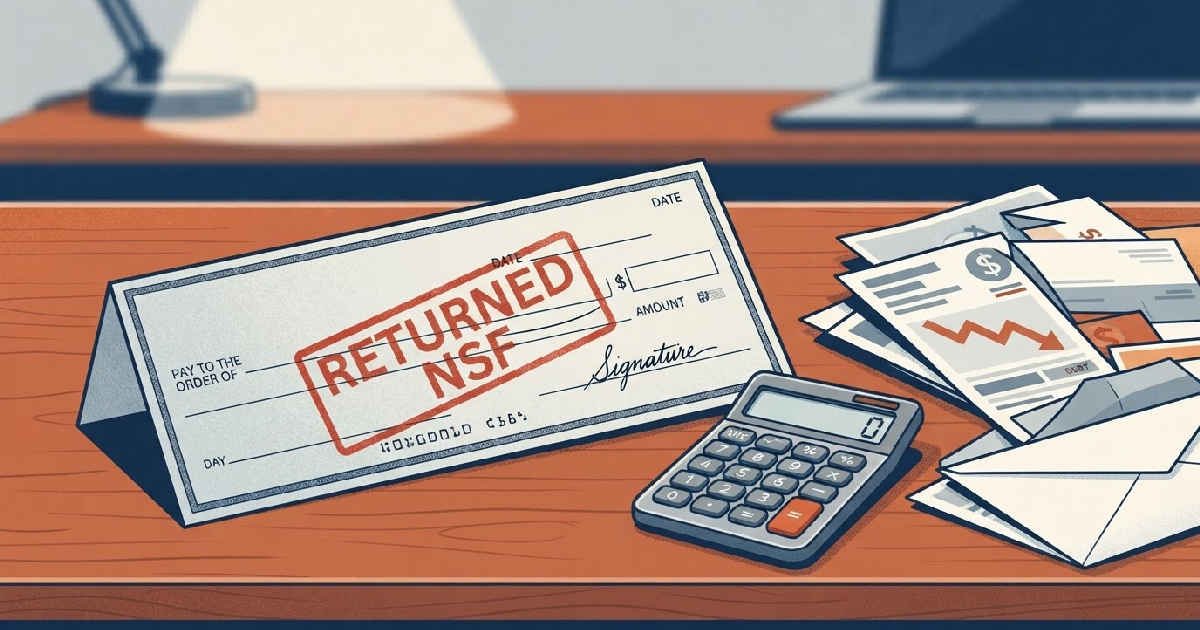
NSF check consequences, or check bounce case punishment, occur when a financial institution declines to process a payment due to insufficient funds. Understanding the full scope of NSF check consequences is crucial for anyone handling financial transactions, whether as a payer or a payee.
This situation can arise with traditional paper checks, automated clearing house (ACH) transfers, or even debit card transactions. The core issue remains that the payer attempted a transaction exceeding their available balance at that precise moment, leading to various financial and legal repercussions.
The mechanics of an NSF check refusal
When a check is presented for payment, the issuing bank first verifies if the check writer’s account holds adequate funds. If those funds are insufficient, the bank returns the check unpaid and marks it as “NSF.”
This process fundamentally differs from an overdraft, where a bank might opt to cover the payment, thereby pushing the account into a negative balance, typically in exchange for a fee.
Several factors can lead to an account lacking the necessary funds. The most common reason is simply an insufficient account balance, where the check writer issues a check for more than they have. But other situations, like holds or restrictions on the account, or delayed deposits of expected funds, can also create a temporary shortfall.
Unanticipated withdrawals, such as automatic payments or unexpected charges, can similarly drain an account before a check clears. In rare instances, bank errors or even a stop payment order can result in an NSF designation. Additionally, banks may refuse checks that are stale-dated, meaning they are older than six months.
Financial penalties for the check writer
Issuing an NSF check triggers a series of financial penalties for the individual or entity responsible. These aren’t just minor inconveniences; they can add up quickly and affect one’s banking standing. The primary penalty comes directly from the check writer’s own bank.
Banks typically levy an NSF fee for returning a check unpaid, with these charges often ranging from $10 to $35 or more per transaction, depending on the institution’s policies. It’s worth noting that some banks have recently eliminated NSF fees for consumer accounts, but they remain prevalent. In 2026, the average NSF fee stood at approximately $17.
Beyond the bank, the recipient of the check, whether a merchant or another individual, can also impose a penalty. These merchant penalties, often called “returned check fees,” cover their inconvenience and any bank charges they incurred. These fees commonly fall between $25 and $40, adhering to state-allowed limits. For example, North Carolina law permits a processing fee not exceeding $25 for returned checks.
Repeatedly issuing NSF checks can have even more severe banking ramifications. Financial institutions may decide to close accounts belonging to serial offenders, making it significantly harder to open new accounts elsewhere. This action reflects the bank’s assessment of risk and reliability.
Banks report negative banking history, including bounced checks and unpaid fees, to ChexSystems. This consumer reporting agency serves the banking industry, and information can stay on a ChexSystems report for up to five years.
Its presence can severely hinder one’s ability to open new checking or savings accounts at over 80% of banks and credit unions. While an NSF check doesn’t directly impact a credit score, if the underlying debt remains unpaid and gets sent to collections, it will negatively affect credit scores.
Impact on recipients: the payee’s perspective
Receiving an NSF check is not just an inconvenience for the payee; it brings its own set of financial and administrative burdens. The most immediate problem is the disruption of cash flow, as the expected funds simply don’t arrive. This can delay the payee’s ability to meet their own financial obligations or invest as planned.
Payees also face potential bank fees. Their bank may charge a “Returned Deposited Item Fee,” a “Returned Check Fee,” or a “Return Item Chargeback” for handling the rejected item. These fees typically range from $10 to $20 for domestic checks, adding an unexpected cost to the payee. Beyond fees, dealing with an NSF check requires additional administrative work.
This includes contacting the check issuer, attempting to secure alternative payment arrangements, and updating financial records. Such administrative hassles can consume valuable time and resources, especially for businesses. And on a less tangible but equally important note, receiving a bounced check can strain business or personal relationships due to the inconvenience and perceived lack of trust it implies.
Navigating the repercussions of bounced checks often involves understanding these multifaceted impacts.
Legal ramifications of bouncing a check
The legal NSF check consequences can vary significantly based on jurisdiction and the intent behind issuing the check. Civil penalties are common, allowing payees to pursue legal action to recover the original amount of the check, plus any incurred bank and merchant fees.
Many states also permit the recovery of statutory damages, which can include double or even triple the amount of the check, especially if the check writer fails to rectify the situation after proper notification.
For instance, California law allows for recovery of up to three times the check amount, with a maximum of $1,500, under specific conditions like sending a formal demand letter. Ohio law goes further, allowing for treble damages, administrative costs, attorney’s fees, and court costs in successful civil lawsuits over bad checks.
Criminal charges are a far more severe consequence, typically reserved for instances where a check is knowingly written without sufficient funds and with the intent to defraud. These charges can range from misdemeanors to felonies, depending on the check amount and state laws. Thresholds often dictate whether passing a bad check falls into a lesser or greater offense category.
In Washington State, for example, unlawful issuance of a bank check for amounts under $750 is a gross misdemeanor, while sums over $750 can constitute a Class C felony, punishable by up to 5 years in jail and a $10,000 fine. Similarly, Florida considers passing a worthless check of $150 or more a third-degree felony.
California Penal Code § 476 and § 476a govern check fraud, where amounts of $950 or less are generally misdemeanors, with higher amounts or repeated offenses escalating to felony charges.
Penalties for these criminal offenses can include substantial fines, mandatory restitution to the payee, and even imprisonment. It’s important to note that some states require the payee to issue a written notice to the check writer, providing a period (e.g., 30 days) to resolve the payment before any legal action can be initiated.
Cheque dishonour case law across various regions highlights the severity of these infractions.
| Consequence Type | Typical Cost/Impact | Affected Party |
|---|---|---|
| Payer’s Bank NSF Fee | $10 – $35+ (Average $17 in 2026) | Check Writer (Payer) |
| Merchant Returned Check Fee | $25 – $40 (e.g., NC: max $25) | Check Writer (Payer) |
| Payee’s Returned Item Fee | $10 – $20 | Check Recipient (Payee) |
| ChexSystems Reporting | Negative record for up to 5 years | Check Writer (Payer) |
| Civil Damages (e.g., California) | Up to 3x check amount, max $1,500 | Check Writer (Payer) |
| Criminal Penalties (e.g., Washington State) | Misdemeanor (under $750), Felony (over $750) | Check Writer (Payer) |
Dispelling common misconceptions about NSF checks
Despite the widespread understanding of checks, several misconceptions persist regarding NSF check consequences. One common belief is that an NSF check is identical to an overdraft. This isn’t accurate; an NSF check means the bank actively refuses to process the payment because of insufficient funds, effectively returning the item.
An overdraft, conversely, occurs when the bank chooses to cover the payment, even if it pushes the account balance into the negative, usually charging a specific overdraft fee for doing so. Another frequent misunderstanding is that a single NSF check will automatically destroy one’s credit score. In reality, a solitary NSF check doesn’t directly impact your credit score.
However, the situation changes if the underlying debt associated with the bounced check remains unpaid and is subsequently sent to a collections agency. At that point, the collection account can be reported to credit bureaus, which will then negatively affect your credit score. Finally, some believe all banks still charge NSF fees without exception.
While many banks historically charged these fees, a significant number of larger financial institutions have begun to eliminate them, saving consumers billions of dollars annually. The Consumer Financial Protection Bureau (CFPB) has been a vocal advocate in efforts to reduce what it terms “junk fees,” including various NSF charges, leading to these policy shifts across the banking industry.
Looking ahead: navigating the evolving financial landscape
The landscape surrounding NSF checks continues to evolve, driven by consumer advocacy and technological advancements in banking. While some traditional fees are disappearing, the fundamental principles of maintaining sufficient funds remain paramount. Payers need to meticulously manage their account balances to avoid these repercussions.
For payees, verifying funds or opting for more secure payment methods like wire transfers or direct deposits can mitigate risks. The potential for legal action, both civil and criminal, underscores the serious nature of issuing checks without adequate backing. Ultimately, understanding these mechanisms and consequences empowers both individuals and businesses to make more informed financial decisions.
How do NSF checks differ from overdrafts?
An NSF (Non-Sufficient Funds) check means your bank rejected a payment because your account didn’t have enough money. An overdraft, on the other hand, means your bank chose to cover the payment, despite insufficient funds, often charging you an overdraft fee and potentially making your account negative.
Will a single NSF check damage my credit score?
No, a single NSF check does not directly impact your credit score. However, if the debt linked to that check goes unpaid and is sent to collections, then the collection activity can be reported to credit bureaus and negatively affect your credit history.
Are NSF fees still common across all banks?
While NSF fees were historically very common, a growing number of banks, particularly larger institutions, have eliminated them for consumer accounts. Many still charge them, with the average fee around $17 in 2026, but the trend is towards reduction or elimination due to consumer protection efforts.