
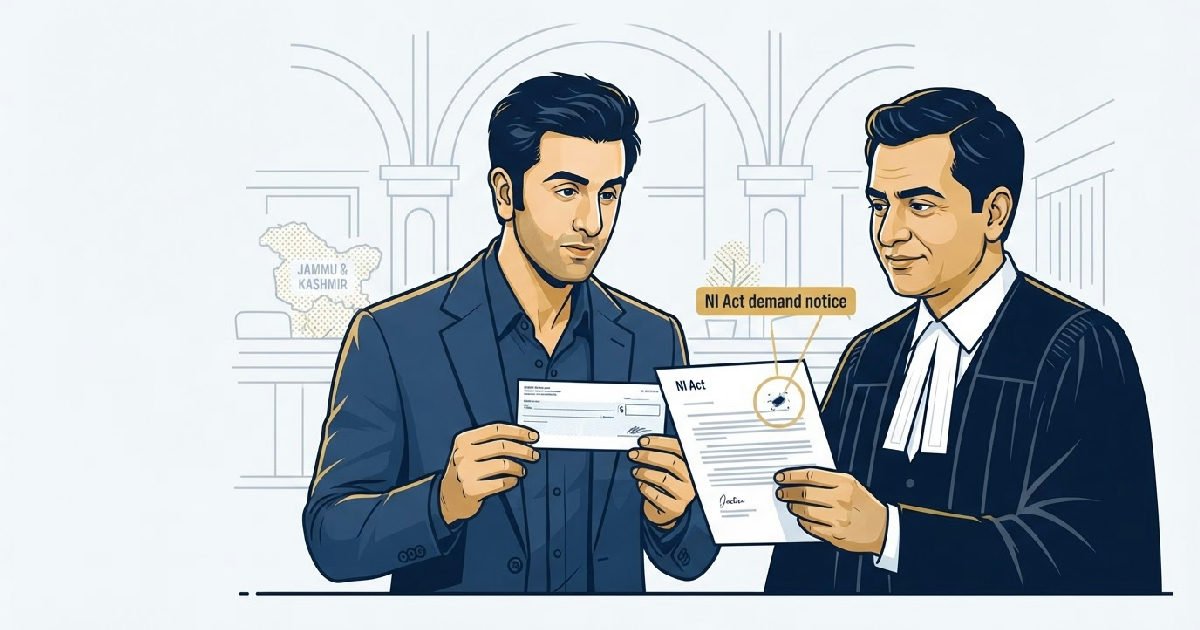
In a significant ruling on May 3, 2025, the High Court of Jammu & Kashmir and Ladakh affirmed that a statutory notice under the Negotiable Instruments Act, 1881, cannot be dismissed solely due to a minor typographical error, provided its overall intent remains clear, impacting NI Act demand notice validity.
Justice Rajnesh Oswal presided over the case of Pawan Kumar Vs Ranbir Singh, refusing to quash cheque dishonour proceedings involving a substantial sum of ₹21 lakhs, despite the notice containing an apparent mistake in the demand amount.
NI Act demand notice interpretation clarified
This decision underscores a crucial shift towards a more holistic interpretation of legal documentation in cheque bounce cases, offering a clearer pathway for complainants like Ranbir Singh while setting a precedent for individuals like Pawan Kumar who might attempt to leverage minor discrepancies to evade liability.
The High Court of Jammu & Kashmir and Ladakh has brought much-needed clarity to the interpretation of demand notices, which are foundational to cases under the Negotiable Instruments Act. Justice Rajnesh Oswal emphasized that courts must read these notices as a whole.
This means a single, isolated word or figure that doesn’t align with the notice’s general message shouldn’t be used to invalidate the entire document.
The specific case: Pawan Kumar versus Ranbir Singh
The core of the matter involved a complaint filed by Ranbir Singh against Pawan Kumar, alleging the dishonour of two cheques totaling ₹21 lakhs. Kumar had issued these cheques to discharge a prior financial obligation. Singh initiated proceedings under Sections 138 and 142 of the NI Act after the cheques were returned unpaid.
Initially, a trial court issued process against Pawan Kumar. Kumar then challenged this before the Principal Sessions Judge, Kathua, who dismissed his revision petition. This led Kumar to escalate the matter to the High Court, contending a flaw in the statutory notice itself.
Defense arguments and the typographical dispute
Pawan Kumar’s counsel, Mr. Anil Khajuria, argued that the demand notice was fatally defective because it only requested payment of ₹50,000, despite the actual cheque amounts being ₹21 lakhs. He asserted that Section 138 mandates a precise demand for the “said amount” mentioned in the dishonoured cheques. A defective notice, he claimed, should invalidate the entire complaint.
However, the complainant’s counsel, Mr. Ved Bhushan Gupta, conceded the discrepancy but maintained it was merely a typographical error. He highlighted that the notice explicitly referred to the two dishonoured cheques amounting to ₹21 lakhs. The figure of ₹50,000 appeared only in the final paragraph, clearly a clerical mistake when viewed in context with the rest of the document.
Understanding India’s Negotiable Instruments Act
The Negotiable Instruments Act, 1881, forms a cornerstone of commercial law in India, designed to instil confidence in financial instruments like cheques. It sets out strict guidelines for their use and provides legal recourse when they are dishonoured. Specifically, Chapter XVII, encompassing Sections 138 to 142, deals with the penalties associated with cheque dishonour, aiming to enforce financial discipline.
The strict requirements of Section 138
Section 138 of the NI Act outlines precise conditions that must be met to establish an offence for cheque dishonour. The cheque must represent a legally enforceable debt, and it must be presented within its validity period. Crucially, if the cheque bounces due to insufficient funds, the payee must issue a written demand notice to the drawer.
This notice must be sent within 30 days of receiving the bank’s memo about the dishonour. The drawer then has 15 days to make the payment. Failure to do so within this period allows the payee to file a complaint, initiating criminal proceedings against the drawer.
The role of demand notices in cheque dishonour cases
A demand notice is more than just a formality; it’s a mandatory precursor to legal action in cheque dishonour cases. Its purpose is to clearly inform the cheque drawer about the dishonour, state the reason, and demand the exact amount owed. This notice also provides a final opportunity for the drawer to settle the debt before facing criminal charges.
The notice must clearly communicate that the cheque was presented and dishonoured. It must also specify the exact amount claimed and give a 15-day deadline for payment, warning of impending legal action under Section 138 if the payment isn’t made.
Judicial interpretation and evolving standards
Indian courts have historically approached demand notices under Section 138 with a “strict compliance” mindset, given the penal nature of cheque dishonour provisions. This has often meant that any deviation from the prescribed format or content could be grounds for dismissing a complaint. However, the recent J&K High Court ruling suggests a nuanced evolution in this approach.
Past Supreme Court rulings on demand notice validity
Previous Supreme Court judgments, such as the one in Kaveri Plastics v. Mahdoom Bawa Bahrudeen Noorul decided in September 2025, have heavily emphasized the need for the demand notice to specify the exact cheque amount.
The Supreme Court has previously held that even a typographical error demanding an amount different from the cheque’s face value could be fatal to the notice’s validity. The phrase “said amount of money” in Proviso (b) to Section 138 has been interpreted to refer exclusively to the cheque amount, reinforcing a stringent requirement for accuracy.
Despite this, courts have often allowed for the severability of additional claims like interest or legal costs, provided they are clearly distinguished from the principal cheque amount. An omnibus demand, without this clear distinction, can still lead to invalidation. This is especially relevant in cases involving director liability for cheque dishonour.
The current J&K High Court decision builds on this framework by evaluating the “overall content and intent” when a minor error is present.
Distinguishing minor errors from substantive defects
Justice Oswal’s ruling effectively differentiates between a minor, clerical error and a fundamental flaw that compromises the notice’s purpose. The judgment highlights that if the larger context of the demand notice clearly indicates the true nature and quantum of the debt, a single incorrect figure in isolation won’t undermine its legal standing. This prevents defendants from exploiting trivial errors to escape their financial obligations.
The court’s examination focused on whether the recipient of the notice could reasonably understand the demand being made. In the case of Pawan Kumar, despite the ₹50,000 figure, the notice consistently referred to the ₹21 lakhs from the dishonoured cheques. This demonstrates a shift towards practicality and the prevention of technicalities overriding the substantive justice of a case.
Implications for businesses and legal practitioners
This ruling from the High Court of Jammu & Kashmir and Ladakh carries significant implications for businesses and legal professionals navigating cheque dishonour cases. It provides a degree of flexibility for complainants, ensuring that minor drafting oversights don’t automatically derail legitimate claims. But it doesn’t absolve parties of the responsibility to be meticulous.
Mitigating risks in notice drafting
While the judgment offers some leeway for typographical errors, careful drafting of demand notices remains paramount. Legal practitioners should strive for absolute accuracy in specifying the cheque amount and other details. The best practice is still to ensure that every part of the notice is consistent and error-free to avoid any potential challenges, however minor.
Businesses, too, should review their processes for generating and dispatching these notices. Implementing robust internal checks can help catch errors before they lead to litigation. This proactive approach can save time, money, and legal battles.
Potential impact on cheque bounce litigation trends
The ruling could influence future cheque bounce litigation by making it harder for accused parties to use minor technicalities as a primary defense. It encourages courts to look beyond superficial errors and focus on the substantive communication of the demand.
This might lead to a slight reduction in cases dismissed on purely technical grounds related to notice defects, potentially streamlining the judicial process for cheque dishonour.
However, it doesn’t negate the essential requirements of burden of proof in cheque dishonour cases, or other procedural aspects. Litigants will still need to ensure that the core elements of their demand notices are correctly articulated and served within the statutory timelines. The decision provides clarity but does not lower the bar for diligent legal practice.
Navigating the complexities of financial liabilities
This judgment from the Jammu & Kashmir High Court is a reminder of the intricate balance courts must strike between procedural exactitude and substantive justice. The Negotiable Instruments Act is designed to ensure financial accountability, and overly strict interpretations of minor errors could undermine this objective.
The ruling reinforces the principle that the spirit of the law should prevail over its letter, particularly when the intent is unmistakably clear.
For individuals and businesses, it emphasizes the importance of both issuing cheques responsibly and meticulously managing financial communications. While a small typo might not sink a case, it can certainly introduce complications and delays. Understanding the evolving judicial stance on these matters, including challenging financial capacity, is crucial for navigating India’s commercial legal landscape effectively.
| Aspect of Demand Notice | Traditional Strict Interpretation | J&K High Court Holistic Interpretation |
|---|---|---|
| Impact of Solitary Typographical Error | Potentially Fatal, leading to dismissal. | Generally Non-Fatal if overall intent is clear. |
| Focus of Judicial Scrutiny | Literal wording and precise figures. | Overall content, tenor, and clear communication of demand. |
| Outcome for Minor Discrepancies | High likelihood of complaint invalidation. | Lower likelihood of invalidation; proceedings continue. |
| Legal Precedent Emphasis | Exact matching of demand and cheque amount. | Reasonable understanding by recipient of true demand. |
What was the core issue addressed by the J&K High Court?
The High Court addressed whether a demand notice under the Negotiable Instruments Act, 1881, should be dismissed if it contains a single typographical error, specifically an incorrect amount mentioned in one part of the notice.
What was the court’s ultimate decision in the Pawan Kumar Vs Ranbir Singh case?
Justice Rajnesh Oswal ruled that a demand notice must be read as a whole. He determined that a solitary typographical error, which was not in sync with the overall tone and content of the notice, would not invalidate the cheque dishonour proceedings, upholding the complaint against Pawan Kumar.
How does this ruling impact future cheque dishonour cases in India?
This judgment reinforces that courts will likely prioritize the substantive intent and clarity of a demand notice over minor clerical mistakes. It may make it more challenging for accused parties to get cases dismissed based purely on technicalities arising from trivial errors in the notice, encouraging a more practical approach to justice in NI Act matters.