
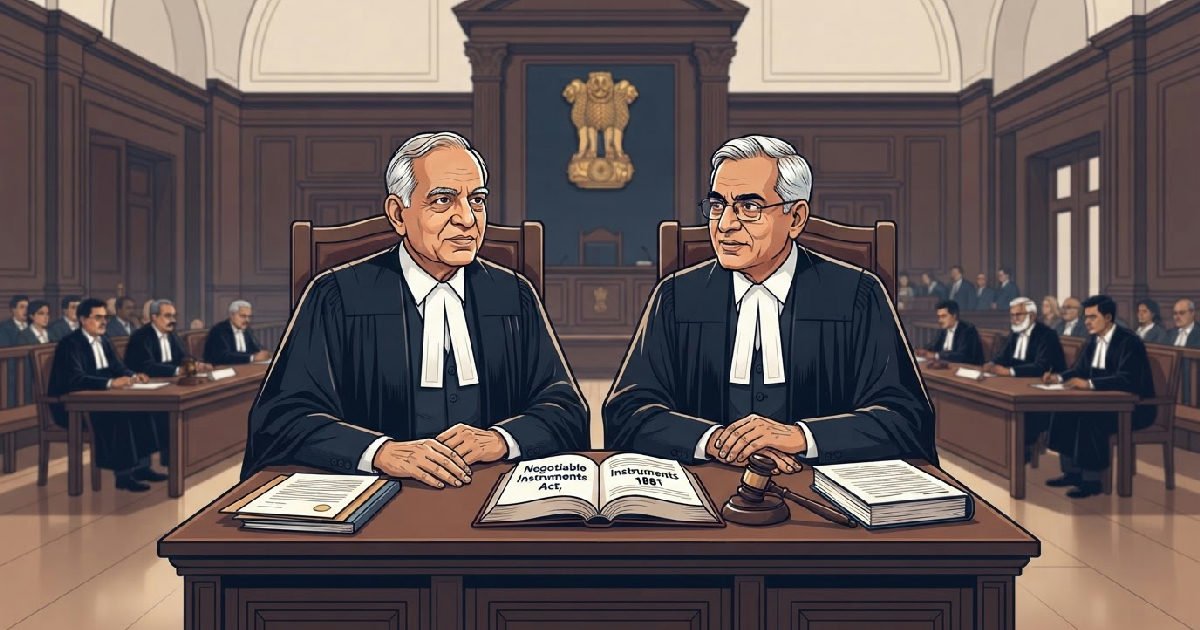
The Supreme Court reaffirms that denying debt or liability alone does not shift the burden of proof from an accused in cheque dishonour cases, as stated on July 2, 2018. A bench comprising Justice A.K.
Sikri and Justice Ashok Bhushan emphasized that Section 139 of the Negotiable Instruments Act, 1881, creates a presumption in favour of the cheque’s holder, and a mere denial by the accused won’t suffice.
Understanding the Negotiable Instruments Act, 1881
This critical clarification underscores the judiciary’s consistent effort to strengthen the credibility of negotiable instruments within India’s financial system. It means anyone accused in a cheque dishonour case must present concrete evidence to challenge the statutory presumption, rather than relying on unsubstantiated claims.
The Negotiable Instruments Act, 1881 (NI Act), forms the bedrock for governing financial instruments like promissory notes, bills of exchange, and cheques in India. Its Section 138, introduced via a 1988 amendment, transformed cheque dishonour from a civil matter into a quasi-criminal offense.
This amendment aimed to combat the prevalent issue of dishonoured cheques and foster greater trust in cheque-based transactions. It provided a legal teeth to ensure commercial morality and hold drawers accountable for the instruments they issue.
The statutory presumption under Section 139
Central to cheque dishonour cases is Section 139 of the NI Act, which stipulates a statutory presumption. This presumption holds that the holder of a cheque received it for the discharge, either wholly or partially, of a debt or another liability.
This provision is indispensable for proceedings under Section 138, as it effectively shifts the burden of proof. Once the issuance of the cheque is established, the onus moves to the drawer to prove otherwise, streamlining the legal process.
Purpose of the Act in modern finance
The core purpose of the NI Act, particularly Sections 138 and 139, is to maintain confidence in banking transactions and commercial dealings. By creating a strong legal framework, the Act encourages the use of cheques as reliable instruments for payments.
It aims to deter individuals from issuing cheques without sufficient funds or genuine intent to honour them. This statutory backing helps prevent frivolous denials from undermining the efficacy of the financial system.
The Kishan Rao v. Shankargouda Landmark Case
The Supreme Court’s July 2018 reiteration came within the context of the significant case, Kishan Rao v. Shankargouda. This case provided a clear demonstration of how high courts should apply the principles of revisional jurisdiction and the burden of proof.
The specific judgment, issued on July 3, 2018, by Justice A.K. Sikri and Justice Ashok Bhushan, reinforced established legal positions. It clarified the robust nature of the cheque dishonour presumption under the NI Act.
Case background and journey through courts
In Kishan Rao v. Shankargouda, the complainant, Kishan Rao, had extended a ₹2,00,000 loan to Shankargouda for business expenses on December 25, 2005. Shankargouda then issued a post-dated cheque for the amount, dated January 25, 2006, which subsequently bounced due to insufficient funds.
Shankargouda’s defense hinged on an unsupported claim that Kishan Rao had stolen the cheque. He failed to provide any direct evidence or even testify in court to substantiate this serious allegation. The trial court rightly convicted Shankargouda under Section 138 of the NI Act.
He received a sentence of a ₹2,50,000 fine and six months of simple imprisonment. His initial appeal against this conviction was also dismissed, confirming the lower court’s findings regarding the debt and the dishonoured cheque.
High Court’s overturned decision on cheque dishonour
Despite the trial and appellate courts confirming the conviction, the High Court intervened, exercising its revisional jurisdiction. It surprisingly set aside Shankargouda’s conviction, concluding he had successfully created doubt about the debt’s existence.
This decision, however, was made despite the accused presenting no concrete evidence to support his claims. The Supreme Court later critiqued this approach, highlighting the High Court’s overreach in reappreciating evidence, a role typically reserved for appellate courts. The Supreme Court upholds such liabilities consistently.
Rebutting the Presumption: The Evidentiary Burden
The presumption under Section 139 is not absolute; it’s a rebuttable presumption. This means an accused person can present evidence to disprove the existence of a legally enforceable debt or liability for which the cheque was issued. The legal framework provides avenues for defense, but with specific requirements.
Crucially, the standard of proof required from the accused to rebut this presumption is not as stringent as the “beyond a reasonable doubt” standard applied to the prosecution. Instead, it’s based on a “preponderance of probabilities.”
The standard of proof for the accused
Under the “preponderance of probabilities” standard, the accused needs to demonstrate that their version of events is more probable than the complainant’s. They don’t need to definitively prove their innocence but must cast sufficient doubt on the presumed facts.
This can be achieved by adducing direct or circumstantial evidence, or even by highlighting inconsistencies within the complainant’s own material during cross-examination. It’s a strategic legal battle where the defense must be proactive.
Insufficiency of bare denial for rebuttal
The Supreme Court has made it unequivocally clear that a mere denial of the debt or liability is insufficient to rebut the presumption. Such a bare denial fails to shift the burden of proof back to the complainant, leaving the statutory presumption intact.
Accused individuals must do more than just say they don’t owe the money or that the cheque was misused. They need to provide a plausible explanation backed by some form of evidence. A successful resolution for a bounced cheque case often requires this.
Consistent Judicial Stance on Cheque Dishonour
The Supreme Court’s position isn’t an isolated incident but rather a consistent judicial stance, reinforced through numerous judgments over the years. This uniformity aims to provide clarity and predictability in cheque dishonour cases, which form a significant portion of litigation.
Various benches of the Supreme Court and high courts have echoed the same principle, ensuring a cohesive interpretation of the Negotiable Instruments Act. This steadfast approach strengthens the integrity of India’s financial contracts.
Recent Supreme Court affirmations
Recent rulings continue to underscore the importance of actual evidence from the accused. On April 7-8, 2026, a Supreme Court bench including Justices J.K. Maheshwari and Atul S. Chandurkar held that the presumption under Section 139 can’t be dislodged pre-trial through a defense of no enforceable debt; rebuttal must happen during trial.
Just this year, on June 22, 2026, the Supreme Court, in Renuka v. The State of Maharashtra and Another, reiterated this point, stating the presumption cannot be rebutted at the pre-trial stage by disputed defenses alone. Furthermore, on July 17, 2026, Justices Manoj Misra and Vijay Bishnoi upheld a Karnataka High Court order, stressing that the accused must explain the circumstances of cheque issuance.
Delhi High Court and Magistrate observations
Lower courts have also followed the Supreme Court’s lead. On October 18, 2021, Metropolitan Magistrate Swati Gupta of Saket Courts, New Delhi, emphasized that merely denying liability doesn’t rebut the Section 139 presumption; cogent evidence is essential.
More recently, on October 17, 2024, Justice Anish Dayal of the Delhi High Court made a similar observation in a case involving a friendly loan of ₹73,60,000, where a cheque of ₹1,80,000 was issued as partial payment.
He explicitly stated, “The presumption under Section 139 of the NI Act cannot be rebutted by mere denials or by exploiting inconsistencies in the complainant’s case. The accused must provide solid evidence to prove that the cheque was not issued to settle any debt or liability.”
Implications for Cheque Transactions and Legal System
This consistent judicial stance has profound implications for how cheque transactions are viewed and processed legally in India. It places a significant responsibility on individuals issuing cheques, reinforcing the seriousness of financial commitments made via these instruments.
For businesses and individuals, it means greater certainty in financial dealings, knowing that legal recourse for bounced cheques is robust. This principle works to bolster confidence in the Indian banking and commercial ecosystem.
Enhancing credibility of negotiable instruments
The continuous reiteration by the Supreme Court serves to enhance the overall credibility of negotiable instruments. When a cheque is issued, the legal system presumes it represents a genuine, legally enforceable debt, compelling the issuer to be responsible.
This robust legal backing makes cheques a more reliable form of payment, encouraging their wider acceptance and use in commerce. It minimizes the risk of fraudulent or casually issued instruments, benefiting all parties involved.
Addressing the burden of mounting cheque bounce cases
The strict interpretation of Section 139 is also a strategic move to address the overwhelming number of cheque bounce cases clogging India’s judicial system. As of December 18, 2024, there were approximately 43 lakh (4.3 million) such cases pending across the country.
By requiring concrete evidence from the accused, the courts aim to filter out frivolous defenses and expedite the resolution of genuine disputes. This helps reduce the burden on courts and ensures a more efficient justice delivery system.
States like Rajasthan lead with over 6.4 lakh pending cases, followed closely by Maharashtra, Gujarat, Delhi, Uttar Pradesh, and West Bengal. This backlog underscores the necessity for clear legal guidelines and stricter enforcement. Consulting a criminal defense attorney is vital for navigating these charges.
| Case / Jurisdiction | Key Date | Cheque Amount (approx.) | Court Observation |
|---|---|---|---|
| Kishan Rao v. Shankargouda (SC) | July 3, 2018 | ₹2,00,000 | Mere denial insufficient; High Court overstepped. |
| Saket Courts, New Delhi (MM Swati Gupta) | October 18, 2021 | ₹40,000 (claimed security loan) | Cogent evidence needed to rebut presumption. |
| Rohitbhai Jivanlal Patel v. State of Gujarat (SC) | December 9, 2022 | Seven cheques of ₹3,00,000 each | Source of cash irrelevant if presumption not disproven. |
| Rajesh Jain v. Ajay Singh (SC) | October 13, 2023 | ₹6,95,204 (fine twice this amount) | Rebuttal by preponderance of probabilities. |
| Delhi High Court (Justice Anish Dayal) | October 17, 2024 | ₹1,80,000 (partial payment for ₹73,60,000 loan) | Presumption cannot be rebutted by mere denials. |
| Supreme Court (Justices Maheshwari & Chandurkar) | April 7-8, 2026 | ₹50,00,00,000 (settlement cheque) | Rebuttal must occur during trial, not pre-trial. |
| Supreme Court (Justices Misra & Bishnoi) | July 17, 2026 | ₹8,50,000 | Accused must explain cheque issuance circumstances. |
Impact on financial prudence and liability
This judicial emphasis encourages greater financial prudence among individuals and businesses. Issuing a cheque now carries an even stronger implicit acknowledgement of a debt, making casual or speculative issuance riskier.
It places a clear onus on the drawer to maintain sufficient funds and to honour their commitments, fostering a more responsible financial environment. The legal system is clearly signalling that cheque transactions are to be taken seriously, with significant consequences for default.
Looking ahead: Future implications for cheque cases
The Supreme Court’s unwavering stance means future cheque dishonour cases will likely see a continued stringent application of Section 139. Accused parties will face an even higher bar to successfully defend against charges if they lack compelling evidence.
This trend suggests a potential reduction in the number of appeals based on bare denials, leading to quicker resolutions in trial courts. It reinforces the original legislative intent of promoting reliability in negotiable instruments.
Potential for legislative adjustments or further guidance
While the judicial interpretation is firm, the sheer volume of pending cases might still prompt further legislative review. The government could consider amendments to expedite cases or introduce alternative dispute resolution mechanisms to alleviate court backlogs.
However, any such changes would likely complement, rather than undermine, the fundamental principle that the cheque dishonour presumption requires solid evidence for rebuttal. The courts will continue to provide guidance through new judgments, refining the application of these principles.
What is Section 139 of the Negotiable Instruments Act?
Section 139 of the Negotiable Instruments Act, 1881, establishes a legal presumption. It states that when a cheque is issued, it is presumed to have been given for the discharge of a debt or other liability, unless proven otherwise by the accused.
Can an accused person simply deny the debt to escape liability?
No, a mere denial of the debt or liability is not sufficient to rebut the presumption under Section 139. The Supreme Court has repeatedly clarified that the accused must present concrete and cogent evidence to disprove the existence of the debt or liability.
What kind of evidence is required to rebut the presumption?
To rebut the presumption, the accused must bring forward evidence, either direct or circumstantial, that demonstrates the non-existence of the debt or liability on a “preponderance of probabilities.” This could include financial records, communication, or other documents that cast doubt on the complainant’s claim.