
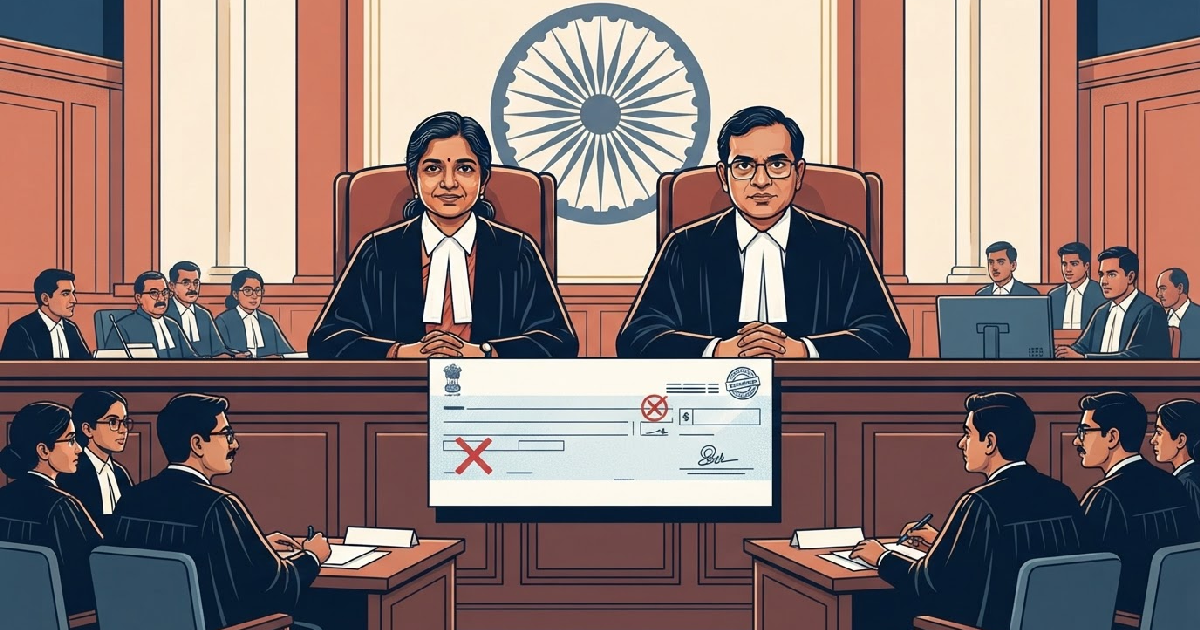
India’s Supreme Court, in a pivotal ruling on Tuesday, August 4, 2026, clarified the crucial burden of proof in cheque dishonour cases. A bench comprising Justice B.V. Nagarathna and Justice Ujjal Bhuyan unequivocally stated that defendants challenging a complainant’s financial capacity must raise this defence early, specifically in their reply to the statutory demand notice.
This decision, rendered in the case of Kuntegowda v. Thurubaiah, sets a clear precedent. It ensures that complainants are not unfairly burdened with proving their financial wherewithal unless the defence is explicitly and timely presented by the accused.
Karnataka High Court acquittal overturned
The Supreme Court’s judgment directly addressed and overturned an acquittal previously granted by the Karnataka High Court. The case revolved around a hand loan of Rs. 4.5 lakh advanced by the complainant. The accused, Kuntegowda, had been convicted by the trial court, a decision later affirmed by the appellate court with a modified sentence.
However, the Karnataka High Court acquitted him, citing the complainant’s failure to prove his financial capacity to lend the amount. This acquittal came despite the defence not being specifically raised in the initial reply to the demand notice. The Supreme Court found this intervention by the High Court to be an improper exercise of its revisional powers.
Justice B.V. Nagarathna, delivering the judgment, highlighted a critical aspect of such cases. She noted that showing financial capacity by the complainant isn’t a prerequisite for invoking Section 138 of the Negotiable Instruments Act, 1881. Instead, a legal demand notice combined with a cheque return memo from a bank is sufficient to initiate cheque dishonour proceedings.
Reinforcing statutory presumptions for negotiable instruments
This ruling strongly reinforces the statutory presumptions embedded within the Negotiable Instruments Act, 1881. Specifically, Sections 118 and 139 are central to these proceedings. Once the execution of a cheque and the drawer’s signature are admitted, the law presumes the cheque was issued for consideration and towards discharging a legally enforceable debt or liability.
This presumption is fundamental to the integrity of cheque transactions. It places a significant onus on the accused to rebut it. A mere denial, therefore, is often insufficient to overcome this legal assumption; concrete material must be presented by the defence.
The Court reiterated that the failure of the accused to respond to the statutory notice issued under Section 138 of the NI Act gives rise to an inference that the complainant’s version carries merit. This means silence or a vague response can significantly weaken the accused’s position.
The crucial role of the demand notice
The Supreme Court emphasized that the initial burden of raising a defence regarding the complainant’s financial capacity falls squarely on the accused. This defence must be specifically pleaded in the reply to the statutory demand notice, which is a critical stage in the legal process.
The law mandates that a legal notice be sent within 30 days of receiving a cheque return memo from the bank. This notice demands payment within 15 days. Failure to respond adequately to this notice can lead to adverse inferences.
Clarity on demand notice validity is paramount for all parties involved in cheque dishonour proceedings. The accused’s prompt and specific response is now more critical than ever.
Implications for defense strategy in cheque dishonour cases
The judgment has significant implications for how defence strategies are formulated in cheque dishonour cases. Accused individuals and their legal teams can no longer wait until trial to spring a defence about the complainant’s financial capacity. This approach will likely be rejected by the courts.
Instead, any such challenge must be a proactive element of the initial response to the demand notice. This procedural clarification aims to streamline legal proceedings. It reduces the scope for delaying tactics based on belatedly introduced financial capacity arguments.
Evidence to rebut the presumption
While the burden shifts to the accused to raise the defence, they also have methods to discharge it. The Court outlined that the accused can present independent witnesses or documentary evidence. These might include bank statements or income tax returns to substantiate their claims of the complainant’s lack of financial means.
Effective cross-examination of the complainant can also be employed, but it must be precise and lead to credible material. Merely asserting a lack of financial capacity or relying on vague admissions during cross-examination won’t suffice to rebut the statutory presumption.
This ruling reinforces the need for a robust and evidence-backed defense from the outset. Understanding how to write a cheque correctly and the processes surrounding it can also prevent common disputes.
Precedent and judicial consistency in cheque law
This latest ruling isn’t an isolated development. It builds upon established legal principles and previous judgments, reinforcing judicial consistency in cheque dishonour cases. The Supreme Court specifically referenced its earlier pronouncements, including Rohitbhai Jivanlal Patel v. State of Gujarat (2019).
A key precedent was also Tedhi Singh v. Narayan Dass Mahant, decided on March 14, 2022.
In that case, a two-judge bench held that “unless a case is set up in the reply notice of the accused that the complainant did not have the wherewithal, it cannot be expected of the complainant to initially lead evidence to show that he had financial capacity.” This demonstrates a consistent judicial stance.
Another relevant case, Sanjabij Tari v. Kishore S. Borcar from September 25, 2025, further underscored these principles. Here, the Supreme Court restored a conviction, finding the High Court’s interference inappropriate when it acquitted an accused based on the complainant’s limited salary. The judgment clarified that cash loans remain enforceable even if they exceed ₹20,000, despite technicalities under Section 269SS of the Income Tax Act.
Revisional jurisdiction limits clarified
The Supreme Court used the Kuntegowda v. Thurubaiah case to re-emphasize the limits of revisional jurisdiction for High Courts. A High Court, while exercising its revisional powers, shouldn’t re-appreciate evidence or overturn concurrent findings of conviction simply because an alternative view is plausible. Such interference is only justified when the findings are perverse or suffer from serious legal infirmity.
In this instance, the Karnataka High Court had overstepped these boundaries. Its acquittal, based on an unraised defence, was deemed an improper use of its revisional authority.
The Supreme Court highlighted that previous cases like State of Maharashtra v. Jagmohan Singh Kuldip Singh Anand and State of Kerala v. Puttumana Illath Jathavedan Namboodiri had already defined these limits clearly. This decision will help to clarify roles across the judiciary.
Streamlining justice and preventing delays
The broader aim of this Supreme Court ruling is to accelerate the resolution of cheque dishonour cases and deter frivolous litigation. Cheque bouncing complaints often clog the judicial system, leading to significant delays. By mandating early disclosure of financial capacity challenges, the Court hopes to reduce the time spent on unsubstantiated defences.
This move is expected to ensure smoother and faster proceedings for genuine recovery claims. It aligns with the original intent of Section 138 of the Negotiable Instruments Act, 1881, which was introduced to strengthen financial discipline and the credibility of cheque transactions.
Beyond financial capacity: other cheque law nuances
While the focus remains on financial capacity, recent judicial pronouncements have also clarified other aspects of cheque law. For example, a separate ruling by a bench of Justices Manoj Misra and Vijay Bishnoi on August 5, 2026, addressed cash transaction limits under Section 269SS of the Income Tax Act.
They clarified that violating these limits, while incurring a penalty under tax law, doesn’t automatically invalidate the underlying debt. Nor does it rebut the statutory presumptions under the Negotiable Instruments Act. This distinction is crucial for understanding the separate legal frameworks at play. Understanding common cheque issues explained can help avoid such legal pitfalls.
The implications are clear: a debt incurred in cash, even if it exceeds prescribed limits for tax purposes, remains legally enforceable if proven. The legal sanctity of the cheque itself takes precedence in dishonour cases, independent of tax compliance. This further solidifies the complainant’s position.
Comparative overview of cheque dishonour proceedings
Understanding the key stages and requirements in cheque dishonour cases is vital for both complainants and accused parties. Here’s a snapshot of the procedural requirements and their legal context:
| Procedural Aspect | Requirement/Timeline | Legal Implication |
|---|---|---|
| Cheque Presentation | Within 3 months of issue date or validity period | Essential for legal enforceability under NI Act |
| Demand Notice Issuance | Within 30 days of receiving bank return memo | Mandatory step before legal action |
| Payment Window for Accused | 15 days from receipt of demand notice | Failure to pay opens door for complaint filing |
| Complaint Filing | Within 1 month after the 15-day notice period ends | Initiates legal proceedings under Section 138 |
| Financial Capacity Defence | Must be raised in reply to demand notice (per SC ruling) | Shifts burden of proof; impacts complainant’s evidentiary requirement |
The path forward for litigants
For individuals and businesses involved in cheque transactions, this Supreme Court judgment serves as a strong reminder. Adhering strictly to procedural timelines and presenting all relevant defences at the earliest opportunity is crucial. Delay or omission can significantly impact the outcome of a case.
Complainants will find their position strengthened, as they are now less likely to face unexpected challenges to their financial capacity deep into a trial. This clarity should lead to more efficient resolution of disputes. It also reinforces public confidence in the legal framework governing financial instruments.
What was the main outcome of the Supreme Court’s recent ruling on cheque dishonour?
The Supreme Court ruled that if an accused person wants to claim the complainant didn’t have the financial capacity to lend the money, they must raise this defence in their reply to the statutory demand notice. If they don’t, the complainant isn’t required to prove their financial capacity later in court.
Why is it important to raise the financial capacity defence in the reply notice?
Raising this defence in the reply notice is crucial because it ensures the issue is addressed early in the legal process. The Supreme Court indicated that failing to do so can lead to an inference that the complainant’s claims are valid, potentially strengthening their case.
How does this ruling affect the burden of proof in cheque dishonour cases?
This ruling reinforces that the primary burden of proof for rebutting the statutory presumption (that the cheque was for a valid debt) lies with the accused. The complainant doesn’t need to prove financial capacity upfront unless the accused specifically challenges it in their initial reply to the demand notice.