
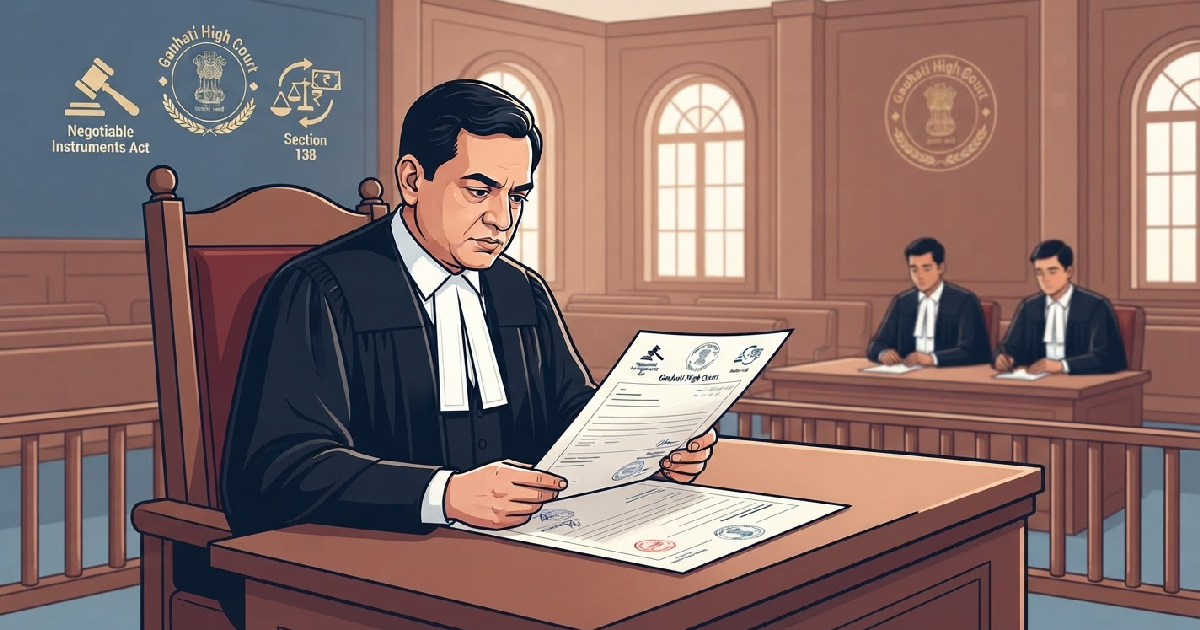
The Gauhati High Court delivered a significant ruling on August 4, 2026, clarifying the procedural requirements for cheque dishonour cases under Indian law. Justice Sanjeev Kumar Sharma held that a statutory notice issued under Section 138 of the Negotiable Instruments Act, 1881, does not need to explicitly use the word “demand.”
A notice advising or requesting payment of the cheque amount is legally valid if it clearly conveys the requirement to pay and the consequences of non-payment.
Gauhati High Court clarifies cheque bounce notice validity
This decision stems from the case of Protima Dutta Kalita v. Smt. Rina Borgohain, where a criminal revision petition against a cheque bounce conviction was dismissed. The ruling provides crucial clarity for those navigating legal processes related to dishonoured cheques, prioritizing the substance of the communication over rigid terminology.
This new judgment refines the procedural requirements for initiating proceedings against individuals whose cheques have bounced. It offers significant clarity for payees and their legal representatives across India. The ruling underscores the judiciary’s practical approach to substance over mere form in such matters.
Many jurisdictions previously saw cases dismissed on technical grounds due to strict interpretations of notice wording. This decision helps prevent such procedural obstacles. It ensures that genuine claims are not derailed by minor linguistic nuances, promoting a fairer legal process.
The underlying dispute: Protima Dutta Kalita v. Smt. Rina Borgohain
The specific case originated from a personal financial transaction between Protima Dutta Kalita, the petitioner, and Smt. Rina Borgohain, the respondent, who were acquainted. Ms. Kalita had reportedly sought financial assistance of ₹1.30 lakh for her son’s marriage from Smt. Borgohain.
Smt. Rina Borgohain claimed she arranged the money through her self-help group and handed it over after Ms. Kalita promised repayment. This arrangement often relies heavily on trust. The respondent also presented a handwritten acknowledgment of debt signed by Ms. Kalita.
When repayment was sought, Ms. Kalita allegedly issued a cheque for the same amount. The cheque was subsequently dishonoured. This led Smt. Borgohain to initiate legal proceedings under Section 138 of the Negotiable Instruments Act, 1881.
Judicial journey: from conviction to high court dismissal
The Chief Judicial Magistrate, Golaghat, initially convicted Protima Dutta Kalita. She was sentenced to one year’s simple imprisonment along with compensation of ₹3 lakh. This compensation amount was double the original cheque value.
On appeal, the Sessions Judge reduced the sentence. But the conviction itself was upheld. The Gauhati High Court ultimately found no merit in Ms. Kalita’s objections, affirming both the conviction and the modified sentence as legally sustainable. They dismissed the criminal revision petition.
Understanding the legal interpretation of demand notices
Justice Sanjeev Kumar Sharma emphasized that the law does not prescribe a rigid format for the demand notice under Section 138 of the Negotiable Instruments Act. The primary purpose remains to offer the drawer a fair opportunity to make payment. This also allows them to avoid criminal prosecution within the stipulated timeframe.
The Court cited the Supreme Court’s decision in Central Bank of India & Anr. v. Saxons Farms & Ors., which supports this flexible interpretation. This precedent established that the underlying goal of the notice is to give the drawer a chance to rectify the default. This principle guides bad cheque laws across India.
In another important ruling, Suman Sethi v. Ajay K. Churiwal (2017), the Supreme Court clarified that the demand in the notice must specifically refer to the exact cheque amount. Additional claims, such as interest or costs, can be included but must be severable. This ensures the notice’s validity if the core cheque sum is clearly specified.
The Gauhati High Court’s ruling aligns with this established judicial philosophy. It promotes a practical approach to legal compliance. This decision prevents unnecessary quashing of proceedings based on hyper-technical readings of notice text, aiming for justice based on the spirit of the law.
Legislative history of India’s cheque bounce laws
Section 138 of the Negotiable Instruments Act, 1881, was introduced in 1988 through an amendment. This marked a significant shift in India’s financial legal landscape. Before this crucial addition, dishonour of cheques only resulted in civil liability, which was seen as insufficient to deter misuse.
The criminalization of cheque bounces aimed to bolster financial integrity and prevent commercial malpractices. It established a quasi-criminal offense, adding stronger enforcement to financial transactions. This legislative move was a direct response to the growing number of cheque defaults impacting trade and commerce.
Further amendments in 2002, via the Negotiable Instruments (Amendment and Miscellaneous provisions) Act, 2002, inserted Sections 143 to 147. They also modified Sections 138, 141, and 142. These changes aimed to address loopholes and facilitate quicker case disposal.
The 2018 Amendment further strengthened payee remedies and introduced provisions to tackle delays in legal proceedings. These included mechanisms for interim compensation under Section 143A to the complainant during the trial. Such measures aimed to reduce the burden on complainants, offering quicker financial relief, and establishing sole proprietor NI Act liability.
Additionally, the 2018 changes mandated deposits during appeals under Section 148, aiming to offer quicker relief to payees. These legislative efforts consistently aim to enhance the credibility of cheque transactions. They streamline the legal process for those impacted by dishonoured payments.
Impact on cheque dishonour cases and financial accountability
This latest ruling from the Gauhati High Court could significantly reduce technical dismissals of cheque bounce complaints. Payees may find it easier to ensure their legal notices are deemed valid, even without using specific legal jargon. This puts a greater onus on drawers to understand their obligations, promoting stricter financial discipline.
For businesses and individuals, the judgment underscores the importance of clear communication in legal notices. Focusing on the clear intention to seek payment rather than precise word choice will be key. This decision might streamline the initial stages of litigation, saving time and resources for all parties involved.
Legal practitioners will now have clearer guidance on drafting demand notices, particularly in the Gauhati High Court’s jurisdiction. They won’t need to meticulously scrutinize notices solely for the presence of the word “demand.” This shift supports a more purposive interpretation of the law, reducing legal ambiguities surrounding cheque bounce notice requirements.
This ruling reinforces the principle that procedural technicalities shouldn’t overshadow the substantive intent of legal provisions. It aims to prevent debtors from evading liability based on minor textual omissions in notices. Such judicial clarity helps both creditors seeking redress and debtors understanding their legal position.
The decision is also expected to contribute to the reduction of pendency in cheque dishonour cases. By eliminating a common ground for technical defense, courts can focus on the merits of the case. This means faster justice for victims of bounced cheques across the country.
Key precedents shaping cheque dishonour jurisprudence
The legal framework governing cheque dishonour in India is shaped by a series of landmark judgments from various High Courts and the Supreme Court. These rulings continually refine the application of the Negotiable Instruments Act, 1881. They provide essential guidance for legal practitioners and litigants alike.
Here’s a comparative look at some pivotal decisions, including the recent Gauhati High Court judgment, highlighting their contributions to Section 138 jurisprudence:
| Aspect | Protima Dutta Kalita Case | Central Bank of India & Anr. v. Saxons Farms & Ors. | Suman Sethi v. Ajay K. Churiwal |
|---|---|---|---|
| Court | Gauhati High Court | Supreme Court | Supreme Court |
| Date | August 4, 2026 | (Date not specified in research) | 2017 |
| Key Point | “Advice” to pay can be legal demand if notice clearly seeks payment. | Primary purpose of notice is to offer drawer fair opportunity to pay. | Demand notice must specifically refer to the exact cheque amount. |
| Impact | Reduces technical grounds for notice invalidity; focuses on intent. | Establishes foundational principle for notice interpretation. | Ensures clarity and specificity in monetary demand. |
The evolving landscape of financial law in India
The Gauhati High Court’s stance reinforces the principle that procedural technicalities shouldn’t overshadow the substantive intent of legal provisions. This judicial philosophy is vital for maintaining public trust in the legal system. It ensures that justice is accessible and not hindered by minor errors.
It aims to prevent debtors from evading liability based on minor textual omissions in notices, ensuring accountability. This judicial outlook promotes financial accountability, especially in small to medium-scale transactions. Such rulings are crucial for commercial stability in India.
This ruling also aligns with broader efforts to ensure faster resolution of commercial disputes within the Indian judiciary. Reducing grounds for quashing cases based on notice wording can expedite trials. This means fewer cases get bogged down in preliminary arguments about technicalities.
Moreover, the decision provides greater predictability for both complainants and accused parties. When the interpretation of legal requirements is clearer, it reduces the scope for prolonged legal battles over notice validity. This can lead to more efficient dispute resolution mechanisms moving forward.
As India’s economy continues to evolve, the integrity of financial instruments like cheques remains paramount. Courts are increasingly interpreting laws to uphold this integrity, adapting to contemporary business practices. This latest judgment serves as another step towards a more robust and less litigious commercial environment.
What was the core ruling by the Gauhati High Court?
The Gauhati High Court ruled that a statutory notice under Section 138 of the Negotiable Instruments Act, 1881, does not need to explicitly use the word “demand.” If the notice, read as a whole, clearly conveys the requirement to pay the cheque amount, it is considered legally valid.
Who was involved in the specific case that led to this ruling?
The ruling stemmed from the criminal revision petition of Protima Dutta Kalita v. Smt. Rina Borgohain. The case involved Ms. Kalita, who had issued a cheque of ₹1.30 lakh to Smt. Borgohain, which was subsequently dishonoured.
How does this ruling impact cheque bounce cases in India?
This ruling simplifies the procedural requirements for legal notices in cheque dishonour cases. It reduces the likelihood of cases being dismissed due to minor technicalities in the wording of the demand notice, potentially streamlining litigation and promoting financial accountability.