
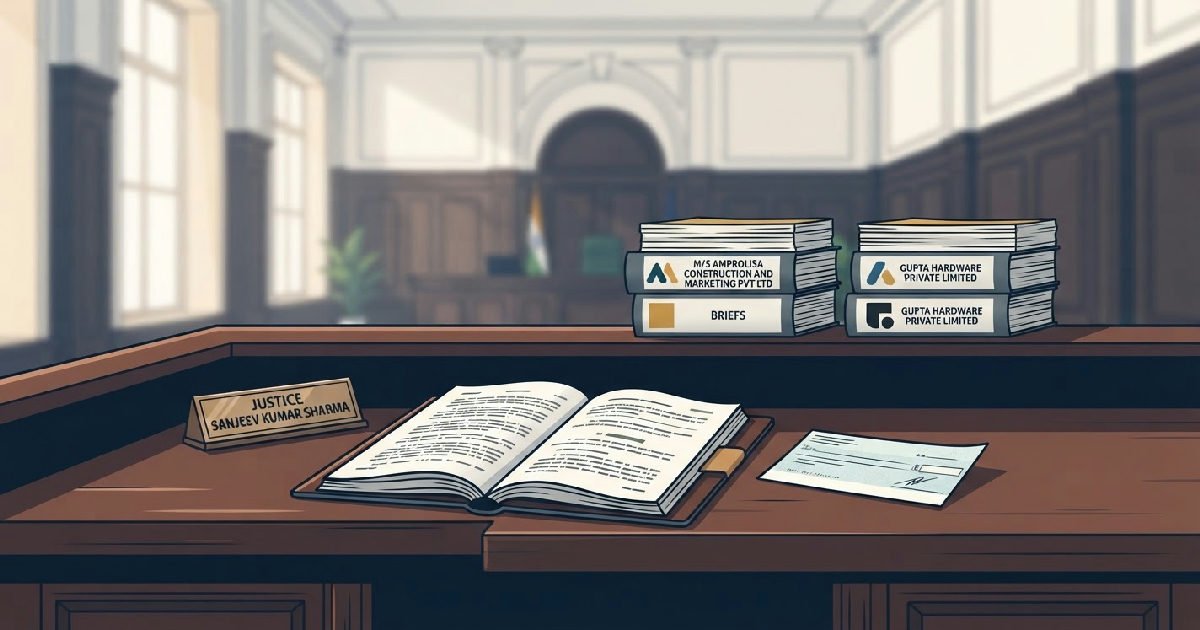
Gauhati High Court limits technical dismissals for corporate complainants
The Gauhati High Court has ruled that an initial lack of proper corporate authorisation when filing a Section 138 cheque bounce complaint is a curable defect. Justice Sanjeev Kumar Sharma held that companies can rectify procedural errors, such as a flawed Power of Attorney, at any stage of the trial.
The February 2026 judgment prevents the premature dismissal of financial disputes over mere technicalities. The ruling stems from a petition filed by M/s Amprolisa Construction and Marketing Pvt Ltd. The company sought to quash criminal proceedings initiated by Gupta Hardware Private Limited over a dishonoured payment.
Gupta Hardware initially filed the complaint through its marketing manager, Manab Lahkar. But the foundational documents lacked proper corporate backing at the time of institution. Litigants navigating bounced cheque victim rights frequently encounter these strict initial filing requirements, which defence lawyers often target to stall proceedings.
After both prosecution and defence evidence concluded, Gupta Hardware asked the lower court for permission to submit fresh authorisation. They wanted to introduce a subsequent Board of Directors resolution and a newly drafted General Power of Attorney. The Judicial Magistrate in Kamrup (Metro), Guwahati, approved the request.
Magistrate decision upheld on appeal
Amprolisa Construction quickly challenged the magistrate’s order before the Gauhati High Court. The petitioner argued the original complaint was entirely unmaintainable because Gupta Hardware lacked proper authorisation when the case began. They claimed allowing new documents amounted to illegally filling gaps in the prosecution’s evidence.
Justice Sharma rejected this argument entirely. The High Court noted that the respondent virtually conceded the initial Power of Attorney suffered from infirmities. But the court ruled those infirmities were successfully cured by the subsequent board resolution.
Procedural law exists to facilitate justice, not obstruct it. The court clarified that any initial defect regarding the natural person instituting the complaint, or the presence of proper authority, remains a curable defect under the Negotiable Instruments Act.
Historical context of the Negotiable Instruments Act
Section 138 was introduced into the Negotiable Instruments Act, 1881, through a sweeping set of amendments that took effect in 1989. Lawmakers designed the provision to introduce strict liability for cheque dishonour. The core objective was to restore confidence in banking operations and commercial transactions across India.
The offence carries a quasi-criminal nature. It blends civil recovery mechanisms with harsh penal sanctions to deter financial negligence. A drawer facing conviction under this section can receive a prison sentence of up to two years, a fine extending to twice the cheque amount, or both.
But courts have struggled for decades to balance this strict liability with procedural fairness. The statute requires complaints to meet rigid timelines. Payees must present the cheque within its validity period and issue a legal notice within 30 days of receiving a bank dishonour memo.
Corporate representation complexities
Companies face an additional layer of procedural complexity. As juristic entities, corporations cannot physically appear in a courtroom. They must authorise a natural person to act on their behalf through a formal Board Resolution or a legally valid Power of Attorney.
When high-volume businesses process hundreds of bounced cheques monthly, administrative errors frequently occur in these authorisation documents. The Gauhati High Court ruling ensures that these routine clerical oversights do not automatically invalidate a legitimate financial grievance.
Supreme Court alignment on cheque dishonour cases
Justice Sharma’s ruling directly aligns with established Supreme Court jurisprudence on corporate representation. In the landmark case of M.M.T.C. Ltd. v. Medchl Chemicals and Pharma (P) Ltd., the apex court established that unauthorised filings do not permanently doom a complaint. A company can ratify the action later.
The Supreme Court has consistently held that throwing out a case at the threshold due to authorisation flaws is too hasty. Cases like Samrat Shipping Co. Pvt. Ltd. and Haryana State Coop. Supply and Marketing Federation Ltd. previously cemented this principle into national law.
This judicial consensus severely limits the tactics available to defaulting parties. Defence counsels can no longer rely on finding a missing signature on a board resolution to secure an immediate dismissal. The focus remains locked on whether a legally enforceable debt existed.
The systemic burden of financial litigation
Cheque dishonour cases represent one of the heaviest burdens on the Indian judicial system. They account for a massive portion of all pending criminal litigation nationwide. The sheer volume of these disputes forces lower courts to operate under extreme administrative pressure.
As of April 2022, data showed over 3.3 million cheque bounce cases were pending across the country. The backlog is actively expanding, with the national docket increasing by 737,124 cases in just a five-month window leading up to that report.
Research analyzing cases filed between 1980 and 2015 highlighted the severe delays plaguing subordinate courts. Section 138 cases remained pending for an average of 1,326 days. That equates to more than three years and seven months of litigation for a single bounced payment.
Dismissing cases on curable technicalities only forces complainants to refile, assuming they remain within statutory limitation periods. This cyclical refiling process worsens court congestion. Rulings that clarify director liability in cheque dishonour cases and authorisation requirements help streamline these lengthy trials.
Categorising fatal versus curable defects
While the Gauhati High Court protected curable defects, courts draw a hard line against substantive statutory failures. Litigants must understand the distinct difference between a procedural irregularity and a fatal defect that permanently voids a legal complaint.
A fatal defect involves a failure to meet the core legal prerequisites of Section 138. If a complainant misses the 30-day window to issue a demand notice, the complaint is entirely barred by limitation. No subsequent amendment can cure a missed statutory deadline.
Recent Supreme Court rulings highlight how strict these substantive requirements remain. In the 2025 Kaveri Plastics decision, the court ruled that a demand notice must precisely match the dishonoured cheque amount. Even minor typographical errors in the demanded sum invalidate the entire prosecution.
Recent High Court interpretations
Other regional benches have spent the last year clarifying exactly what can and cannot be fixed before a magistrate. On September 4, 2025, the Delhi High Court ruled that a complaint can be modified to cure formal defects before the magistrate takes official cognizance.
The Kerala High Court followed a similar logic on May 18, 2026. That bench determined a conviction cannot be reversed at the revision stage simply because of a flawed Power of Attorney pleading. The accused must definitively prove the defect caused actual prejudice or a failure of justice.
Defect classification in Section 138 proceedings
| Defect Type | Legal Classification | Judicial Remedy Available |
|---|---|---|
| Flawed Power of Attorney | Curable procedural defect | Filing of fresh document during trial or appeal |
| Missing Board Resolution | Curable procedural defect | Submission of subsequent resolution before verdict |
| Demand amount mismatch | Fatal substantive defect | Invalidates complaint completely (Kaveri Plastics 2025) |
| Notice beyond 30-day limit | Fatal statutory defect | Complaint barred by limitation laws |
| Failure to arraign company | Fatal structural defect | Requires entirely fresh complaint if time permits |
Broader implications for corporate legal strategy
Justice Sharma’s ruling fundamentally shifts how corporate legal departments handle recovery litigation in Northeast India. Companies can proceed with slightly more confidence when filing bulk litigation. They know isolated administrative errors won’t instantly cost them their recovery rights.
But the judgment does not give corporations permission to be sloppy. The High Court specifically noted that Amprolisa Construction was given full opportunity to cross-examine the witness regarding the new documents. The complainant still bears the burden of proving the delayed authorisation is legitimate.
This ruling forces defence attorneys to evaluate cases on their actual merits. If the signature on the cheque is undisputed and the funds were insufficient, dodging liability has become significantly harder. The days of winning a cheque bounce trial solely by exploiting a dated Power of Attorney are ending.
Corporate directors must still ensure their underlying paperwork is sound. When drafting a demand notice under NI Act, precision remains non-negotiable. Substantive errors regarding the debt amount or the exact identities of the accused directors remain lethal to a case.
Subsequent rulings shape NI Act boundaries
Justice Sanjeev Kumar Sharma continued to shape Negotiable Instruments jurisprudence months after the Amprolisa Construction decision. On August 4, 2026, he delivered another critical ruling regarding the strict phrasing required in statutory notices.
In the case of Protima Dutta Kalita v. Smt. Rina Borgohain, the dispute centred on a ₹1,30,000 personal loan for a wedding. The cheque bounced, and the accused argued the subsequent legal notice was invalid because it did not explicitly use the word “demand.”
Justice Sharma dismissed that hyper-technical defence. He ruled that a statutory notice does not need to explicitly contain the word “demand” to be legally valid. As long as the notice, when read as a whole, clearly conveys the requirement to pay the cheque amount, it satisfies the statute.
This subsequent ruling reinforces the Gauhati High Court’s broader philosophy. Substantive justice and clear intent matter far more than rigid adherence to specific formatting or isolated terminology. Lower courts are expected to evaluate the reality of the financial transaction above all else.
What is a Section 138 cheque bounce complaint?
It is a criminal legal proceeding initiated under the Negotiable Instruments Act, 1881. When a cheque is returned unpaid due to insufficient funds, the payee can file this complaint to recover the money and seek penal action against the drawer. The offence can carry up to a two-year prison sentence.
Can a company fix a flawed Power of Attorney during a trial?
Yes. The Gauhati High Court recently reaffirmed that an initial defect in authorisation is a curable procedural error. If a company files a complaint with a flawed Power of Attorney or missing Board Resolution, they can submit corrected documents later in the trial without having the case dismissed.
What constitutes a fatal defect in these financial cases?
A fatal defect is a substantive error that permanently invalidates the legal action. Examples include failing to send the demand notice within 30 days of the cheque bouncing, or demanding an amount in the notice that does not precisely match the exact amount written on the dishonoured cheque.