
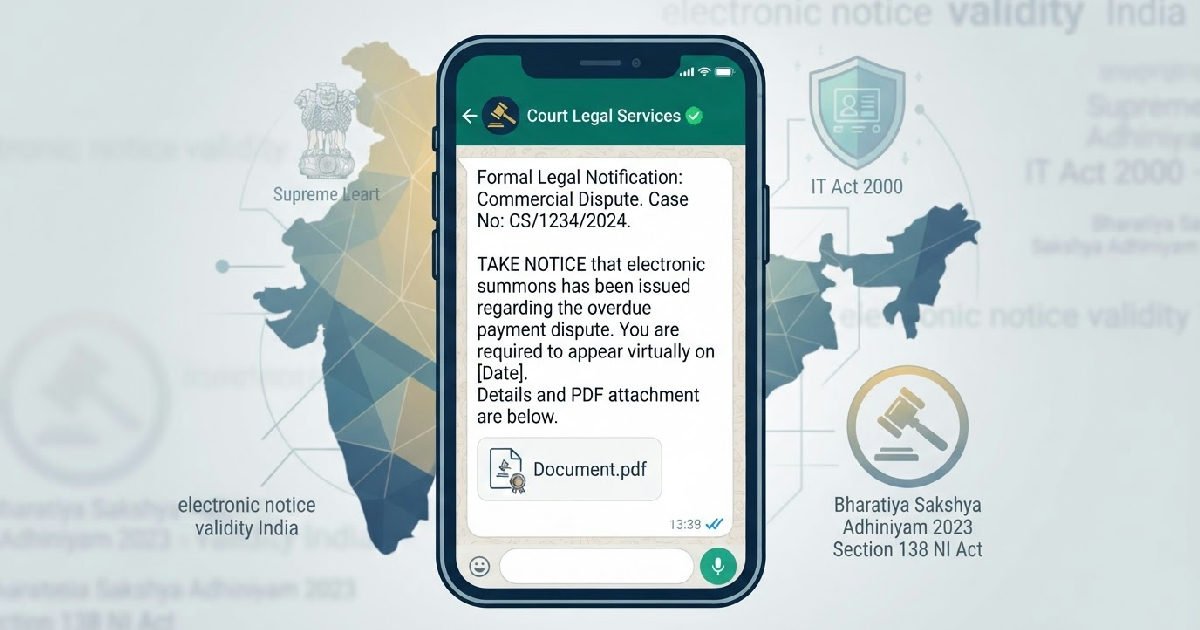
The landscape of legal communication in India is rapidly evolving, with courts increasingly acknowledging the use of electronic means like email and WhatsApp for serving notices in commercial disputes. This shift reflects the digital transformation across industries, yet it comes with nuanced legal considerations.
While a digital notice can provide crucial evidence, it doesn’t always fully substitute traditional methods, particularly when specific statutory requirements are at play.
WhatsApp email legal: notice validity in India
Companies routinely rely on digital platforms for daily communications, and it’s natural for this to extend to initial demands for payment or action. However, understanding the precise legal standing of a PDF sent via chat or an email marked “without prejudice” is essential for businesses navigating India’s complex legal framework.
India’s legal system has adapted to embrace digital communication, primarily through landmark legislation. The Information Technology Act, 2000 (IT Act), serves as the foundational pillar, ensuring that electronic documents and communications hold legal weight. This act prevents the denial of legal validity to information or documents simply because they are in electronic form.
Specifically, Section 4 of the IT Act asserts that electronic records possess the same legal standing as physical documents, provided they meet other legal stipulations. Section 5 extends this recognition to electronic signatures, legitimizing digitally signed PDFs attached to emails. This forms a crucial basis for validating notices sent via digital channels.
Furthermore, Section 10A of the IT Act validates e-contracts, ensuring enforceability even if executed electronically. Section 13 outlines the protocols for the time and place of dispatch and receipt of electronic records, adding clarity to the often-disputed aspect of when a digital notice is deemed served.
Admissibility of electronic evidence in court
Beyond establishing legal validity, the admissibility of electronic evidence in court is paramount for any commercial dispute. The Indian Evidence Act, specifically Section 65B, previously governed this, but it has been replaced by Section 63 of the Bharatiya Sakshya Adhiniyam (BSA), 2023, effective July 2024. This new provision maintains rigorous standards for electronic records.
Under Section 63 of the BSA, electronic information, including emails and WhatsApp messages, is admissible as evidence. Crucially, this admissibility hinges on the submission of a certificate under Section 63(4) of the BSA. This certificate must identify the electronic record and detail its production process, ensuring its integrity and authenticity in judicial proceedings.
Moreover, Section 88A of the Indian Evidence Act creates a legal presumption that an electronic message sent to a known email address has been received by the recipient. This mirrors the presumption applied to traditional registered post, significantly strengthening the evidential value of email communications in commercial litigation.
Supreme Court rulings shape digital communication
The Supreme Court of India has played a pivotal role in shaping the legal stance on electronic notices. During the height of the COVID-19 pandemic, the Court, in In Re: Cognizance for Extension of Limitation (2020), permitted service of notices, summons, and pleadings via email, fax, and instant messaging services like WhatsApp.
This temporary measure aimed to ensure judicial continuity, recognizing read receipts on WhatsApp as initial proof of service.
This ruling marked a fundamental shift in judicial attitudes towards digital service, acknowledging its practical utility. In a separate instance, Trimex International FZE, Dubai v. Vedanta Aluminum Limited (2010), the Supreme Court upheld the validity of a contract formed through an exchange of emails, reinforcing the enforceability of electronically concluded agreements.
However, the Supreme Court, through Justices Abhay S. Oka and Ujjal Bhuyan, issued a critical clarification. They explicitly stated that notices under Section 41A of the Code of Criminal Procedure (CrPC) or Section 35 of the Bharatiya Nagarik Suraksha Sanhita (BNSS) should not be served electronically.
The Court emphasized traditional physical delivery for these notices, citing concerns over potential misuse and the need to guarantee receipt, especially where personal liberty is at stake.
| Legal Document / Act | Electronic Notice Validity | Key Condition / Exception |
|---|---|---|
| Commercial Contractual Notices | Generally Valid | Requires proof of delivery, authenticity, and contractual allowance. |
| Pleadings / Summons (during pandemic) | Permitted by Supreme Court | WhatsApp read receipts as prima facie proof. |
| Section 138 Negotiable Instruments Act | Risky, traditional preferred | Some High Courts accept, but strict timelines and service methods traditionally required. |
| Section 41A CrPC / 35 BNSS Notices | Explicitly NOT permitted | Mandates traditional physical delivery due to personal liberty concerns. |
| Electronically Executed Contracts | Valid | Upheld by Supreme Court in Trimex International. |
High Court perspectives on digital communication
High Courts across India have further solidified the legal recognition of electronic notices, albeit with specific conditions. The Bombay High Court, in SBI Cards & Payments Services Pvt. Ltd. v. Rohidas Jadhav (2018), validated a WhatsApp notice. The court noted that double blue ticks indicated delivery and that the attachment had been opened, with Justice G.S. Patel observing the “blatantly demonstrate” proof of receipt.
Similarly, the Delhi High Court, in M/S. Karuna Abhushan Pvt. Ltd. v. Shri Achal Kedia (2020), accepted WhatsApp messages as valid legal evidence. This ruling reiterated that blue ticks could prove a recipient read the message but stressed the continued necessity of complying with Section 63 (formerly 65B) requirements for admissibility.
The Allahabad High Court, in Rajendra v. State of U.P. (2020), also affirmed the validity of a demand notice sent via WhatsApp and email under Section 138 of the Negotiable Instruments Act. This was contingent on the documented proof of delivery.
Many other High Courts have recognized WhatsApp as a legitimate channel for serving various civil and matrimonial documents, provided the recipient’s number is verified and read receipts are preserved.
Critical requirements for effective electronic notices
For an electronic notice to be legally robust in a commercial dispute, several specific requirements must be met. Proof of delivery and authenticity is paramount. For emails, beyond a mere “Sent” screenshot, delivery confirmations, recipient server acceptance, and underlying network transaction records, such as Simple Mail Transfer Protocol (SMTP) server logs, are often necessary if receipt is disputed.
For WhatsApp, the double grey ticks (delivered) and double blue ticks (read) offer convenient proof. Screenshots documenting these delivery and read receipts, along with message timestamps and a history of consistent communication between parties, significantly bolster credibility. Compliance with Section 63 of the BSA, 2023, remains critical for admissibility in court.
The content of the notice itself is equally important. It must contain a clear written demand, specifying the exact amount sought, the date of the demand, and a precise call to action or payment. Informal language, the absence of specific amounts or invoice numbers, or sending from a personal rather than a company ID can severely weaken the notice’s legal standing.
Contractual provisions also play a vital role. If a commercial contract explicitly permits notice via email, this clause carries significant weight. Many modern contracts now include “notices clauses” that detail the permissible modes of communication, recipient addresses, and timelines. Failure to adhere to these contractual stipulations can render an otherwise valid electronic notice ineffective.
When digital delivery falls short for companies
Despite the growing acceptance of electronic communication, there are specific situations where digital notices alone may prove insufficient or even legally invalid. Statutory notices, particularly those with stringent requirements, often fall into this category.
For instance, while some courts have shown flexibility, notices under Section 138 of the Negotiable Instruments Act, 1881 (cheque bounce cases), traditionally demand service via registered or speed post with acknowledgment due.
The strict timelines associated with Section 138 notices—sending within 30 days of a cheque return memo and allowing 15 days for payment—make relying solely on WhatsApp a calculated risk. The Supreme Court’s explicit ruling against electronic service for Section 41A CrPC and Section 35 BNSS notices further highlights this limitation.
These notices, involving personal liberty, mandate traditional physical delivery to ensure proper receipt and prevent potential misuse.
Furthermore, in high-value recovery cases or when a counterparty has begun to ignore communications, sole reliance on electronic messages can be insufficient. Contracts that mandate a specific mode of notice, such as courier or registered post to a particular address, also override general electronic validity. Businesses must therefore understand these critical exceptions to avoid jeopardizing their claims.
Strategic use of electronic and traditional methods
For businesses seeking to maximize the effectiveness of their legal communications in commercial disputes, a dual-pronged approach often proves most prudent. Combining the speed and immediate record-keeping benefits of electronic communication with the undeniable legal certainty of traditional methods can create a robust and defensible position. This strategy ensures both timely action and irrefutable proof of service.
Using email or WhatsApp for initial commercial follow-ups, particularly when there’s an established communication thread or the contract permits it, is an efficient first step. It generates an immediate written record and puts the other party on notice.
However, when a claim becomes serious, involves significant value, or falls under a statute with specific service requirements, a formal legal notice sent via a trackable traditional mode, such as registered post, becomes imperative.
This blended approach minimizes the risks associated with sole reliance on either method. Speed without verifiable proof can weaken a legal file, while proof without speed can lead to missed deadlines and lost opportunities.
By leveraging both, companies can ensure their notices are both timely and legally sound, significantly strengthening their position in commercial recovery efforts and potential litigation. Ignoring a legal notice can have serious consequences for the recipient, underscoring the importance of proper delivery.
Is a WhatsApp message alone sufficient for a legal notice in India?
While a WhatsApp message can serve as valid evidence and proof of initial communication, especially if blue ticks confirm delivery and reading, it’s not always sufficient on its own. For statutory notices like Section 138 (cheque bounce) or notices under CrPC, traditional physical delivery is often required or strongly recommended due to stricter legal mandates and concerns about guaranteed receipt.
What makes an email legal notice valid and admissible in an Indian court?
An email legal notice is valid if it complies with the Information Technology Act, 2000, and is admissible under Section 63 of the Bharatiya Sakshya Adhiniyam, 2023. Key factors include clear content, proof of delivery (server logs, delivery confirmations), and a certificate under Section 63(4) confirming its authenticity and production process.
If the contract specifies email as a valid communication mode, this further strengthens its validity.
What common mistakes weaken the legal standing of an electronic notice?
Common mistakes include using informal language, omitting specific amounts or invoice numbers, sending from a personal email or number instead of an official company ID, or dispatching it to an incorrect or outdated contact. Lack of follow-up when acknowledgment isn’t received, and treating a chat as the sole legal step, thereby missing limitation periods, can also significantly weaken its enforceability.
Need to send or reply to a commercial notice?
Do not depend only on a forwarded PDF. WhatsApp or call for a free consultation. We assist companies in Delhi with legal notices, replies and commercial recovery.
Related Service: Commercial Law