
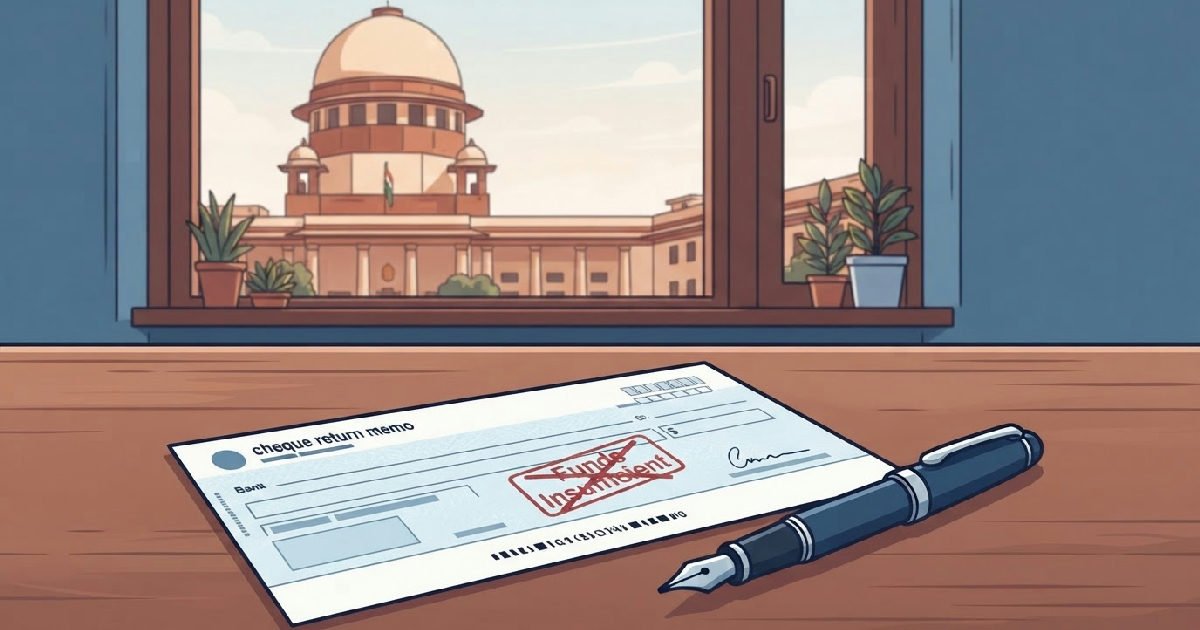
Navigating a cheque bounce case in Delhi requires a precise legal roadmap under Section 138 of the Negotiable Instruments Act, 1881 (NI Act), which criminalises cheque dishonour. Individuals whose cheques are returned unpaid face strict deadlines and mandatory documentation. Missing these critical windows can invalidate the entire legal process, rendering the complaint time-barred and eliminating recourse. For anyone involved in a cheque bounce case, understanding the intricacies is essential.
The journey to resolve a dishonoured cheque begins immediately after the bank notifies the payee, providing a crucial “cheque return memo.” This document not only clarifies why the cheque bounced but also initiates the statutory timeline for all subsequent legal actions, making swift and informed decisions essential for anyone pursuing a bad cheque prosecution.
The journey to resolve a dishonoured cheque in a cheque bounce case begins immediately after the bank notifies the payee, providing a crucial “cheque return memo.” This document not only clarifies why the cheque bounced but also initiates the statutory timeline for all subsequent legal actions, making swift and informed decisions essential for anyone pursuing a bad cheque prosecution.
Understanding Cheque Dishonour Under the NI Act
When a cheque is presented for payment but returned by the bank, it’s officially termed a “dishonoured cheque.” This act triggers the provisions of Section 138 of the NI Act, which aims to enhance the credibility of negotiable instruments and penalise drawers who issue cheques without sufficient funds or intent to pay. This legal framework offers a powerful mechanism for payees to recover their dues in a cheque bounce case.
Understanding the reasons behind a cheque bounce case is crucial as the reasons for dishonour can vary significantly. Common issues include “insufficient funds,” “signature mismatch,” “account closed,” or a “stop payment instruction” from the drawer. Each reason is critical, as it informs the legal strategy and the specific evidence required for a successful cheque bounce lawyer in Delhi to assess the case.
Here are the common reasons a cheque might be returned unpaid in a cheque bounce case:
The reasons for dishonour can vary significantly. Common issues include “insufficient funds,” “signature mismatch,” “account closed,” or a “stop payment instruction” from the drawer. Each reason is critical, as it informs the legal strategy and the specific evidence required for a successful cheque bounce lawyer in Delhi to assess the case.
In any cheque bounce case, certain prerequisites must be met to ensure a valid claim under Section 138.
For a successful cheque bounce case, the cheque must have been issued in discharge of a legally enforceable debt or liability.
In the context of a cheque bounce case, the cheque must have been presented to the bank within its period of validity, usually three months from the date printed on the cheque.
Here are the common reasons a cheque might be returned unpaid:
The cheque return memo is pivotal in a cheque bounce case, as it officially confirms the dishonour and marks the starting point for subsequent legal timelines.
In a cheque bounce case, payees must obtain the memo promptly, as the 30-day window for sending a legal demand notice commences from the date of its receipt.
| Reason for Dishonour | Description |
|---|---|
| Insufficient Funds | The drawer’s account lacks the necessary balance to cover the cheque amount. |
| Signature Mismatch | The signature on the cheque does not match the specimen signature held by the bank. |
| Account Closed | The account from which the cheque was drawn has been closed. |
| Stop Payment Instruction | The drawer has issued an instruction to their bank to stop payment on the cheque. |
A formal legal demand notice is a critical component of any cheque bounce case.
In the context of a cheque bounce case, the legal demand notice must be dispatched to the drawer within 30 days of receiving the cheque return memo.
Contents of the demand notice in a cheque bounce case must include details of the dishonoured cheque, including its number, date, amount, and the names of the payee and drawer.
Prerequisites for a Valid Section 138 Case
Before initiating proceedings, certain conditions must be met to ensure the complaint is maintainable under Section 138. First, the cheque must have been issued in discharge of a legally enforceable debt or liability. Cheques given purely as gifts or as security deposits, without a direct link to an existing debt at the time of presentation, typically do not fall under this section.
Second, the cheque must have been presented to the bank within its period of validity, which is usually three months from the date printed on the cheque. Failure to meet either of these foundational prerequisites can lead to the dismissal of the case, regardless of other procedural accuracies.
Ensuring proper service of the demand notice is crucial in any cheque bounce case.
Retaining all postal receipts as evidence is crucial in a cheque bounce case.
Filing a criminal complaint is a critical step in a cheque bounce case if the drawer does not resolve the issue.
The Role of the Cheque Return Memo
After filing in a cheque bounce case, adherence to established timelines is crucial.
The limitation period for filing in a cheque bounce case is essential, as missing deadlines can render the complaint time-barred.
The “cheque return memo” is the pivotal document that officially confirms the dishonour and, crucially, marks the starting point for subsequent legal timelines. Issued by the drawee bank, this memo explicitly states the reason for non-payment.
Payees must obtain this memo promptly, as the 30-day window for sending a legal demand notice commences from the date of its receipt. Without this official bank record, proving the date of dishonour and adhering to statutory timelines becomes exceptionally challenging, if not impossible.
Documentation is key to a strong cheque bounce case.
Key documents in a cheque bounce case include the original dishonoured cheque and the cheque return memo issued by the bank.
The Demand Notice: A Critical First Step
Once a cheque is dishonoured and the return memo collected, the payee must issue a formal legal demand notice. This step is not merely a formality; it’s a statutory requirement that provides the drawer with an opportunity to settle the debt before criminal proceedings are initiated. The notice acts as a final warning.
Drafting the complaint for a cheque bounce case requires meticulous attention to detail.
The legal demand notice must be dispatched to the drawer within 30 days of receiving the cheque return memo. This strict deadline cannot be overlooked; failure to send the notice within this period renders the entire case time-barred, losing the right to file a Section 138 complaint.
The judicial process for a cheque bounce case involves verification and recording of evidence.
Potential outcomes for a cheque bounce case under Section 138 can have serious implications.
Settlement opportunities can arise even after initiating a cheque bounce case.
Contents of the Demand Notice
A properly drafted demand notice must include several key pieces of information. It should clearly state the details of the dishonoured cheque, including its number, date, amount, and the name of the payee and drawer. The notice must also specify the reason for the cheque’s dishonour as indicated in the bank’s memo.
Key considerations in a cheque bounce case include understanding legal pitfalls and ensuring the debt is enforceable.
The research provided does not specify any mandated grace period for payment within this notice.
Jurisdiction is another critical aspect in a cheque bounce case.
Ensuring Proper Service of Notice
Effective service of the demand notice is paramount. It must be sent via a reliable method that provides proof of delivery, such as registered post, speed post, or courier with acknowledgement due. Simply sending a WhatsApp message or an unrecorded email is insufficient and will not be recognised by the courts as valid service.
Understanding Section 138 is fundamental for any cheque bounce case.
Retaining all postal receipts and delivery reports as evidence is crucial to demonstrate that the notice was properly dispatched. This helps prevent drawers from deliberately evading notice to escape liability, as proving proper dispatch is key.
Filing the Criminal Complaint in Delhi Courts
If the drawer does not resolve the issue after receiving the demand notice, the payee may then proceed with filing a criminal complaint. This is a critical juncture, and adherence to established timelines is crucial.
Timelines for a cheque bounce case should be strictly adhered to.
The complaint must be filed before the appropriate court in Delhi. Selecting the correct court is a fundamental step to avoid procedural delays or dismissal.
A cheque issued as a security deposit can lead to a cheque bounce case under certain conditions.
The Limitation Period for Filing
The provided research does not specify the exact limitation period for filing a criminal complaint after the demand notice is sent. However, adhering to statutory timelines is critical, as missing deadlines can render the complaint time-barred. It’s important to consult legal counsel to understand specific jurisdictional requirements and filing windows.
Essential Documentation for a Strong Cheque Bounce Case
A successful cheque bounce case against a company or individual hinges on meticulous documentation. Prosecutors must present a comprehensive set of evidence to substantiate their claims and satisfy the court regarding the validity of the debt and the proper adherence to legal procedures. Any missing or incomplete document can weaken the case significantly.
Key documents include the original dishonoured cheque, the original cheque return memo issued by the bank, and a copy of the legal demand notice along with proof of its dispatch and delivery (e.g., postal receipts, acknowledgement cards, tracking reports). You’ll also need any underlying agreements, invoices, loan documents, or other proofs of the legally enforceable debt or liability for which the cheque was issued.
Drafting the Complaint and Affidavit
The criminal complaint itself is a crucial document. It must be drafted meticulously, detailing all the facts of the case, including the issuance of the cheque, its dishonour, the sending of the demand notice, and the drawer’s failure to pay. The complaint must be supported by a sworn affidavit from the complainant, affirming the truthfulness of the statements made.
Careful attention must be paid to naming the correct parties. In cases involving companies, identifying the responsible directors or signatories is vital. Incorrectly naming the defendant can lead to prolonged legal battles or even dismissal. This is a common pitfall that company directors need to be particularly aware of.
The Judicial Process and Potential Outcomes
Once the complaint is filed, the court will take cognisance of the matter and proceed with the verification of the complainant and witnesses, if any. If satisfied, summons will be issued to the accused. The process typically involves recording evidence, cross-examination, and finally, arguments leading to a judgment.
The potential outcomes for a cheque bounce case under Section 138 are significant. While specific details on penalties are not provided in the research, the NI Act treats cheque dishonour as a criminal offense, implying serious consequences for non-compliance.
Settlement and Mediation Opportunities
It’s worth noting that even after a complaint is filed, there are often opportunities for out-of-court settlement. Many courts encourage mediation or Lok Adalat proceedings to resolve cheque bounce cases, which can save considerable time and legal expenses for both parties. A mutual settlement can lead to the withdrawal of the complaint.
However, any settlement must be formalised and recorded in court to ensure its legal validity and prevent future disputes. Payees should consult with their legal counsel to determine the most appropriate course of action, balancing the desire for swift resolution against the potential for full recovery through adjudication.
Key Considerations and Common Pitfalls
Filing a cheque bounce case in Delhi is a nuanced process. One common pitfall is the assumption that a “stop payment” instruction automatically exempts the drawer from liability. While it’s a reason for dishonour, courts often examine the intent behind such an instruction to determine if it constitutes a valid defence under Section 138.
Another critical aspect is the nature of the debt itself. Section 138 strictly applies to legally enforceable debts. If the underlying transaction was illegal, time-barred, or for an unrecognised liability, the cheque bounce complaint may not succeed. Therefore, ensuring the legal standing of the original debt is as important as following procedural steps.
Understanding Jurisdiction in Delhi
Determining the correct court for filing a complaint in Delhi is crucial. The research does not specify the exact jurisdictional rules; however, ensuring the complaint is lodged with the appropriate court is vital to avoid procedural delays. Local legal counsel can assist in identifying the proper forum for your case.
What is Section 138 of the NI Act?
Section 138 of the Negotiable Instruments Act, 1881, defines the criminal offence of cheque dishonour. It provides a legal pathway for a payee to recover funds from a bounced cheque, imposing consequences on the drawer if they fail to make payment after receiving a valid demand notice.
What are the critical timelines for a cheque bounce case?
The cheque must be presented to the bank within three months of its date of issue. A legal demand notice must then be sent to the drawer within 30 days of receiving the cheque return memo. The research does not specify further timelines for filing a criminal complaint or any grace period for payment after the notice.
Can a cheque issued as a security deposit lead to a Section 138 case?
Generally, a cheque issued solely as a security deposit, without an existing, legally enforceable debt at the time of its presentation, may not directly lead to a Section 138 conviction. However, if the security deposit cheque was intended to discharge a liability that subsequently materialised and became due, then a Section 138 case might be successfully pursued.
Whatsapp or Call for Free consultation.
Related Service: https://arpitmarwah.com/cheque-dishonor-lawyer/