
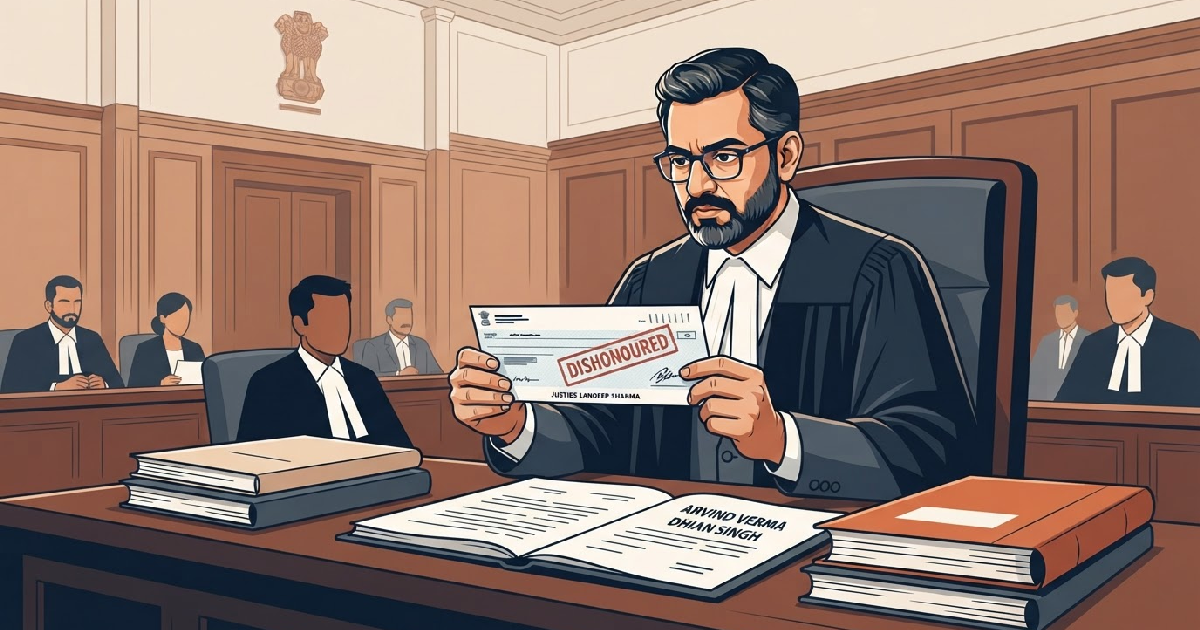
A cheque dishonour cannot be definitively decided based solely on an unproven return memo, ruled the Himachal Pradesh High Court on March 24, 2026.
Justice Sandeep Sharma, presiding over the case of Arvind Verma v. Dhian Singh, underscored that such documents require robust verification during a full trial, not at the preliminary quashing stage of a complaint.
Himachal Pradesh High Court clarifies cheque dishonour evidence standards
This pivotal decision sends a clear message to lower courts and litigants regarding the evidentiary standards in cases filed under Section 138 of the Negotiable Instruments Act.
This ruling effectively dismisses attempts by petitioners accused under Section 138 of the Negotiable Instruments Act (NI Act) to quash proceedings based on disputed facts surrounding a return memo. The court asserted its role isn’t to act as a trial forum, pushing the burden of proving a memo’s genuineness squarely onto the lower courts where evidence can be properly presented and examined.
The Himachal Pradesh High Court emphasized that the question of cheque dishonour authenticity is primarily a matter for a trial court to determine. It dismissed a petition by Arvind Verma, who sought to invalidate a complaint lodged by Dhian Singh under Section 138 of the Negotiable Instruments Act. Verma’s defense hinged on the claim that a return memo was misleading.
Verma had argued that his cheque was returned not due to insufficient funds, but because his HDFC Bank account was “frozen.” The court clarified that such a nuanced dispute requires a comprehensive examination of facts and evidence. It ruled against a summary judgment at the quashing stage, highlighting the need for a full legal process.
Evidentiary requirements for return memos
Justice Sandeep Sharma explicitly stated that merely producing a return memo isn’t enough to settle a cheque dishonour case. The authenticity and correctness of such a document must be proven in accordance with the law. This typically involves testimony from bank officials or other corroborating evidence.
This ruling reinforces the principle that procedural documents, while often prima facie evidence, aren’t beyond challenge. Litigants must be prepared to substantiate their claims with “cogent and convincing evidence” when a bank memo’s validity is contested. This ensures fairness and prevents misuse of the legal system.
Case background: Arvind Verma v. Dhian Singh
The specific case, Cr. MMO No. 1129 of 2025, involved a ₹10 lakh cheque issued by Arvind Verma. Complainant Dhian Singh initiated proceedings under Section 138 of the NI Act after the cheque was dishonoured. Verma’s defense centred on a return memo dated July 6, 2022, which cited “account freezed” as the reason for non-payment, rather than a lack of funds.
The High Court determined that whether the account was frozen or lacked sufficient funds constitutes a factual dispute. Resolving this issue demands a full trial, not merely a review of documents at the quashing stage. The court consequently upheld the trial court’s decision to take cognizance and frame an accusation against Verma.
Understanding the Negotiable Instruments Act framework
The Negotiable Instruments Act, 1881, particularly its Chapter XVII (Sections 138 to 142), forms the backbone of laws governing cheque dishonour in India. This legislative framework aims to ensure the credibility of commercial transactions. It also penalizes those who issue cheques without adequate provisions to honour them.
The recent High Court ruling provides a critical clarification within this existing legal structure. It emphasizes due process and evidentiary rigor, preventing accused individuals from bypassing a full trial through premature quashing petitions based solely on disputed return memos.
Section 138: Penalties for insufficient funds
Section 138 of the NI Act makes the dishonour of a cheque for insufficiency of funds a criminal offense. It requires several conditions: a cheque must be issued against a legally enforceable debt or liability and returned unpaid.
A demand notice must then be issued by the payee within 30 days of receiving the dishonour memo, and the drawer must fail to make payment within 15 days of receiving the notice.
This section is crucial for maintaining trust in financial dealings. However, as the Himachal Pradesh High Court has now reinforced, the path to proving “insufficiency of funds” isn’t always straightforward. It demands solid evidence beyond a contested bank slip, especially when the reason for dishonour is disputed.
For more details on the nuances of this law, you can explore India’s Section 138 NI Act: Navigating Cheque Dishonour Laws and Key Rulings.
Presumptions and the burden of proof
While Section 146 of the NI Act posits that a bank’s return slip with an official mark serves as prima facie evidence of dishonour, this presumption isn’t absolute. It can be challenged and disproved by the accused. The onus remains on the complainant to establish the dishonour and the precise reason behind it, with convincing evidence.
In cases where the specific reason for dishonour is contested—like whether it was “insufficient funds” or a “frozen account”—the court will require tangible proof. This might involve bank statements, correspondence with the bank, or direct testimony from bank officials to confirm the stated reason on the return memo.
Implications for cheque dishonour litigation in India
This ruling by the Himachal Pradesh High Court has significant implications for both complainants and accused individuals in cheque dishonour cases across India. It sets a higher bar for the evidentiary process, particularly regarding the very document that initiates many such legal battles. Legal professionals will likely need to adjust their strategies.
Lawyers will need to anticipate greater scrutiny of return memos and prepare to present more robust evidence early in the legal process. This shift could lead to longer trial durations, but it also promises potentially more equitable outcomes. It emphasizes that procedural shortcuts won’t suffice when facts are genuinely contested.
Increased scrutiny on initial complaints
Complainants will now face increased pressure to ensure the return memo is unimpeachable, or they must be prepared to buttress its authenticity with additional evidence from the outset. This move aims to prevent the abuse of legal process. It ensures that only genuinely substantiated cases proceed to trial and consume judicial resources.
The ruling effectively curtails attempts to dismiss a complaint based solely on an unverified or disputed bank document. It pushes for factual clarity before a case can be quashed. This safeguards against frivolous petitions that might otherwise delay justice for legitimate claims.
Impact on legal strategies for complainants and accused
For the accused, the ruling means that merely alleging discrepancies in the return memo won’t be enough to quash a complaint. They’ll need to gather their own evidence to challenge the memo’s validity effectively during the trial. This could involve procuring bank records or other financial documentation to support their claims, such as a frozen account, rather than expecting a quick dismissal.
Conversely, complainants must be meticulous. They can’t assume the return memo will stand unchallenged. They must proactively prepare to prove its authenticity, potentially by securing affidavits from bank officials or compelling their appearance in court to testify. Understanding India’s Strict Notice Period for Cheque Dishonour Cases also becomes critical for complainants to ensure their initial filing is robust.
Judicial scrutiny and evidentiary burdens
This decision aligns with a broader judicial trend of demanding concrete evidence. It discourages premature legal resolutions without a thorough factual inquiry. Courts are increasingly careful not to overstep their appellate or supervisory roles by delving into factual disputes best resolved at the trial level.
The High Court’s powers under Section 528 of the Bharatiya Nagarik Suraksha Sanhita (BNSS) allow it to prevent abuse of the legal process. However, as Justice Sandeep Sharma noted, these powers don’t extend to conducting a mini-trial to ascertain the truth of a disputed document, which remains the trial court’s purview.
Differentiating High Court powers from trial courts
High Courts typically focus on questions of law, procedural irregularities, or situations where no prima facie case exists. They are not designed to re-evaluate evidence or make factual determinations that are the exclusive domain of trial courts. This ruling clarifies that jurisdictional boundary, ensuring the proper functioning of the judicial hierarchy.
The court’s remark that it cannot “act as a trial court to verify documents or appreciate evidence” is a crucial distinction. It reinforces the trial court’s primary role in establishing facts through a full evidentiary process. This approach ensures that justice is served based on proven facts rather than assumptions or unverified claims.
Consistency with NI Act jurisprudence
The ruling is consistent with previous interpretations of the NI Act, which, while offering presumptions, always allows for rebuttal. Earlier decisions have indicated that minor infirmities in a return memo might not vitiate a trial. Substantive proof of dishonour can come from alternative sources like bank officer testimony.
This maintains a balance between protecting creditors and ensuring fair process for debtors. The Supreme Court of India has also weighed in on premature cheque bounce complaints, setting precedents that guide lower courts to avoid early dismissals when factual disputes remain.
Evolving landscape of financial crime and evidence
The Himachal Pradesh High Court’s ruling reflects an evolving legal landscape where financial transactions are increasingly digital. Despite this, the need for verifiable evidence remains paramount. As banking practices become more complex, the reasons for cheque dishonour can also become more intricate and open to interpretation, demanding higher standards of proof.
This decision serves as a reminder that legal processes must adapt to these complexities. It demands greater transparency and proof from all parties involved in financial disputes, moving towards a system that values concrete evidence over mere procedural documentation.
Why authenticity matters in the digital age
In an era dominated by digital banking and electronic records, the authenticity of documents like return memos is more crucial than ever. While technology can simplify transactions, it also introduces new avenues for potential disputes over documentation. Ensuring that digital or physical memos genuinely reflect the bank’s action is fundamental to justice.
This ruling highlights the judiciary’s commitment to preventing manipulation or misrepresentation of digital financial records. It ensures that critical evidence is not merely presented but properly verified through a rigorous trial process. This provides a stronger foundation for legal judgments.
Anticipating future procedural changes
This decision might spur further procedural adjustments in how cheque dishonour cases are handled. Banks might be encouraged to provide more detailed and indisputable reasons for dishonour on return memos. Judicial guidelines could also be developed for faster verification of such documents, improving efficiency without sacrificing accuracy.
Ultimately, the ruling aims to streamline the judicial process by front-loading evidentiary requirements. It ensures that cases reaching the trial stage are built on a more solid foundation of proven facts, rather than contested documents alone. This fosters greater confidence in the legal system’s ability to resolve complex financial disputes.
| Aspect | Quashing Stage Decision | Trial Stage Requirement |
|---|---|---|
| Return Memo Authenticity | Not solely determined | Must be proven with evidence |
| Reason for Cheque Dishonour | Disputed fact, not resolved | Decided based on pleadings & material |
| High Court Role | Cannot verify documents | Oversees legal process, not facts |
| Burden of Proof | Complainant to prove dishonour | Requires “cogent and convincing evidence” |
What was the core ruling by the Himachal Pradesh High Court?
The Himachal Pradesh High Court ruled on March 24, 2026, that a cheque dishonour case cannot be decided solely based on a bank return memo if its authenticity has not been established. The court stated that the genuineness of such a memo must be proven during a full trial, not at the quashing stage of a complaint.
Why can’t a return memo alone prove cheque dishonour?
While a bank return memo can serve as prima facie evidence, its authenticity can be disputed by the accused. If the reason for dishonour is contested, such as whether it was due to “insufficient funds” or a “frozen account,” a court needs robust evidence to verify the memo’s claims. The High Court clarified that it cannot perform this factual verification outside of a trial setting.
What does this mean for individuals facing cheque bounce complaints?
For individuals accused in cheque bounce cases, this ruling means that they cannot easily get a complaint quashed simply by questioning the return memo’s validity. They will need to present their arguments and supporting evidence during a full trial. Conversely, complainants must ensure their return memos are verifiable and be ready to provide additional proof of authenticity in court.