
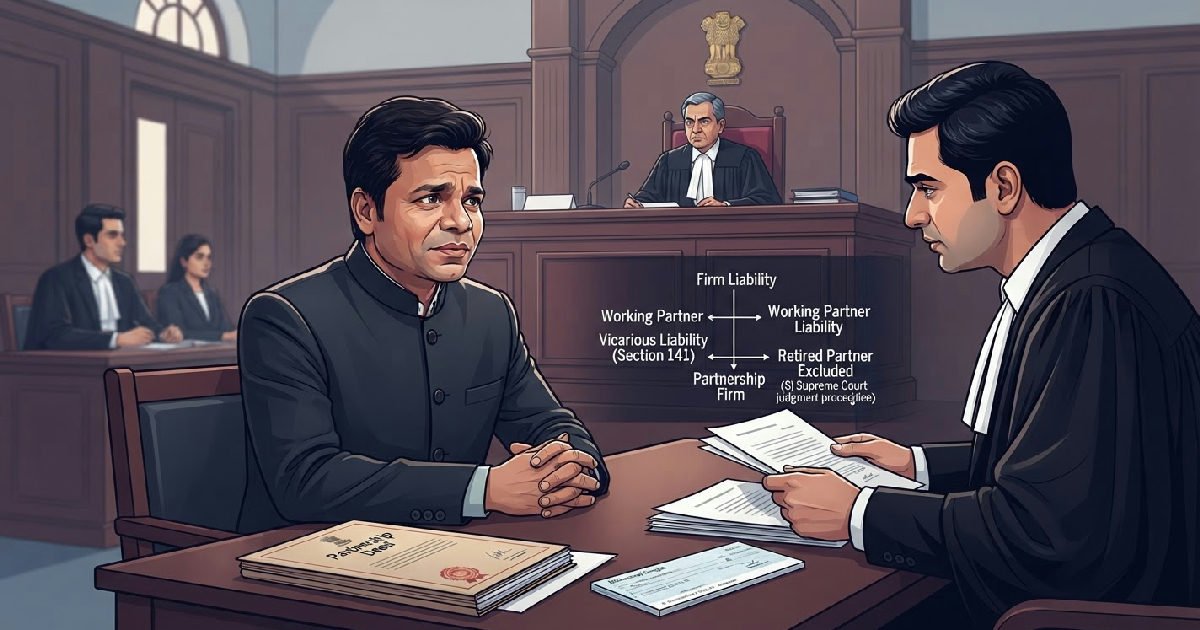
The legal landscape surrounding the dishonor of cheques issued by partnership firms in India has been significantly clarified by recent Supreme Court judgments. These rulings establish precise parameters for determining the criminal liability of partners under the Negotiable Instruments Act, 1881 (NI Act).
While Section 138 of the NI Act addresses the core offense of cheque dishonor, the complexity primarily arises from Section 141, which extends criminal liability to individuals associated with the firm.
This evolving jurisprudence confirms that mere status as a partner is insufficient to attract criminal sanctions. Instead, courts now focus heavily on a partner’s active role, responsibilities, and involvement in the firm’s day-to-day financial conduct at the time the offense occurred.
Crucially, the Supreme Court has underscored that a partnership is not treated as a separate legal entity like a company, fundamentally altering how prosecutions must be framed and managed, particularly concerning cheque bounce case against a partnership firm.
Vicarious liability, firm cheque bounced
Section 141 of the NI Act serves as the statutory mechanism to impute criminal liability to individuals for offenses committed by an entity like a firm or company.
For partnership firms, this section stipulates that when an offense under Section 138 is committed by the firm, every person who was “in charge of and responsible for” the conduct of the firm’s business at the time of the offense is also deemed guilty.
The phrase “in charge of and responsible for” is not a mere template but a strict factual requirement. The Supreme Court, in cases like S.M.S. Pharmaceuticals v. Neeta Bhalla, emphasized that a complaint must contain specific and direct averments detailing how the accused partner met this criterion.
General allegations copied directly from the statute are frequently being rejected by appellate courts as insufficient to sustain a criminal prosecution.
Vicarious liability is complex because it extends the criminal net beyond the primary offender—the firm—to the individuals governing its actions. If a partner can successfully demonstrate non-involvement in the firm’s financial decisions or cheque issuance, they may be able to quash proceedings. However, the initial onus to prove an individual partner’s responsibility lies squarely with the prosecution, establishing a rigorous safeguard against blanket prosecutions.
Requirement for a real role averment
Legal experts advise complainants against simply relying on listing every name found on an old letterhead or partnership document. The complaint must establish a “real role averment.” This means it must articulate a tangible link between the partner and the management of the firm’s relevant business affairs, especially financial ones.
This requirement is critical for partners who were genuinely non-executive or sleeping partners. In the 2022 Supreme Court ruling Dilip Hariramani v. Bank of Baroda, the court explicitly set aside a conviction, affirming that mere status as a partner does not automatically trigger vicarious criminal liability under the NI Act.
The liability under Section 141 is criminal and must be proven on a case-by-case basis based on active involvement or neglect, rather than being jointly and severally in the manner of civil liability. Establishing who is in charge of the business requires documentary evidence, such as the partnership deed, bank mandate, or specific operational documents.
The crucial distinction: firm versus company liability
One of the most frequent sources of confusion in Section 138 cases stems from the tendency to treat partnership firms similarly to registered companies. The Supreme Court has repeatedly highlighted a fundamental legal difference: a partnership firm is not a separate legal entity from its partners.
A firm is legally considered a “compendious name” for the individuals who compose it, meaning its existence is inseparable from its partners. This contrasts sharply with a company, which is a distinct legal person with limited liability for its shareholders. This distinction has major ramifications for filing a complaint.
While the 2012 case Aneeta Hada v. Godfather Travels established that a company must first be prosecuted for vicarious liability to arise, the Supreme Court has distinguished this principle for partnership firms. This distinction is pivotal in understanding partner liability.
When the firm is not named as the accused
In a key judgment delivered on July 14, 2025, in Dhanasingh Prabhu v. Chandrasekar & Another, the Supreme Court clarified that a complaint under Section 138 can be maintained against partners even if the partnership firm itself is not formally arrayed as an accused.
The justification hinges on the fact that partners have unlimited and personal liability for the firm’s actions, which is jointly and severally enforceable.
This ruling marks a significant departure from the strict interpretation applied to companies and provides flexibility for complainants, though legal advice still often favors including the firm where possible. Conversely, the liability of a company director is strictly vicarious and relies entirely on the prosecution of the company as the primary offender.
The unlimited personal liability of partners represents perhaps the biggest financial risk, distinguishing them from the limited liability of company shareholders. For cheque bounce cases, this means partners face criminal sanctions and are personally liable for outstanding debt, reinforcing the need for strict compliance with statutory duties.
| Legal Characteristic | Partnership Firm | Registered Company |
|---|---|---|
| Legal Entity Status | Not separate; ‘compendious name’ for partners | Separate legal entity (corporate veil) |
| Partner/Director Liability | Unlimited and personal | Limited liability (for shareholders/members) |
| Primary Offender (S. 138) | The Firm/Partners | The Company |
| Requirement to Implead Entity | Optional (post-Prabhu ruling), but notice to partners is notice to the firm | Mandatory for vicarious liability to arise |
| Liability Basis | Primary and vicarious (depending on role) | Strictly vicarious (under Section 141) |
Determining liability for signing versus non-signing partners
The determination of liability under the NI Act typically begins with the individual who drew or signed the cheque that subsequently bounced. The signatory partner is always the highest-risk individual accused, as they are directly responsible for the act criminalized under Section 138.
The courts consistently maintain that only the drawer or signatory of the cheque can be prosecuted directly under Section 138. If the cheque was drawn on the firm’s account, the partner who signed on behalf of the firm is deemed the drawer for the purpose of the initial offense.
For non-signatory partners, liability rests entirely upon Section 141. The prosecution must demonstrate that these partners, despite not signing the instrument, were actively involved in managing the firm’s affairs or financial operations and thus fell under the category of those “in charge of and responsible for” the business.
The role of account operation and bank mandate
To successfully prosecute a non-signatory partner, complainants must gather crucial documentary evidence showing operational control. Key documents include the partnership deed, which defines roles and responsibilities, and the bank mandate, which specifies who has the authority to operate the firm’s bank account and issue financial instruments.
If a partner can show that the bank mandate explicitly excluded them from account operations or that their role was purely advisory or passive, their defense against criminal liability strengthens considerably.
The Allahabad High Court reinforced this strict interpretation in the June 10, 2026, ruling Madhu Singh v. State of U.P., holding that a joint account holder who did not sign the dishonored cheque cannot be prosecuted under Section 138.
This strict focus on financial and operational involvement means that partners who claim non-involvement in financial affairs must provide verifiable proof. Such proof might include specific clauses in the partnership deed or internal memoranda, effectively dismantling the prosecution’s claim of a “real role averment.”
The complex status of retired and sleeping partners
The liability of partners changes significantly upon retirement, introducing further layers of legal complexity under the NI Act. A retired partner cannot be held vicariously liable under Section 141 NI Act for a cheque dishonor that arises from dues incurred after their official date of separation from the firm.
However, simply signing a private retirement deed is insufficient to escape ongoing criminal liability. The Indian Partnership Act, 1932, imposes mandatory procedural requirements for retirement that must be strictly complied with to ensure full legal insulation.
Specifically, a retiring partner must issue a public notice of their retirement and officially notify the Registrar of Firms. The Supreme Court underscored this requirement in Shivappa Reddy v. S. Srinivasan on May 30, 2025, clarifying that failure to comply with these statutory formalities means the partner’s liability can continue, even if they have factually left the firm.
Sleeping partners and procedural compliance
The law also addresses the liability of “sleeping partners,” or those who were added to the firm largely “for name” without significant operational involvement. While these partners often attempt to claim innocence based on their passive role, their liability ultimately depends on the same Section 141 test: whether they were “in charge of and responsible for” the business at the relevant time.
If a complaint contains a strong, fact-based role averment showing even a degree of oversight or the capacity to influence financial decisions, a sleeping partner may be dragged into trial. The court will not typically quash proceedings under Section 482 CrPC if disputed factual issues regarding management involvement exist, preferring that these matters be adjudicated fully through trial.
For a partner who has left the firm, the key date is when the underlying debt giving rise to the cheque was incurred, not just the date the cheque bounced. If the debt was active while they were a partner, liability may still attach, further emphasizing the need for comprehensive separation agreements and public notices upon retirement.
Navigating recent supreme court judgments
The judiciary has spent the last few years refining the application of the NI Act to non-corporate entities. They’ve attempted to balance the need for commercial accountability with the constitutional right to due process. The recent stream of rulings focuses on establishing clear lines of demarcation between primary and vicarious liability.
The judgment in Dhanasingh Prabhu, which allowed the maintenance of a complaint against partners without naming the firm, is particularly influential. It simplifies the procedural burden on complainants who are focused on recovering funds and prosecuting the individuals ultimately responsible for the firm’s financial decisions, treating partners’ liability as primary rather than merely secondary to the firm’s.
However, this ruling does not negate the core requirement of Section 141 regarding vicarious liability. The principle remains that a partner’s liability hinges on their being “in charge of and responsible for” the firm’s business at the time the offense was committed. For situations involving multiple bounced cheques, establishing this role at the relevant time is still crucial.
Key documents for liability assessment
For both prosecution and defense, success hinges on documented evidence defining roles, responsibilities, and financial control. The complexity of partnership structures means that documents often speak louder than oral testimony, particularly when challenging or affirming liability under Section 141.
The existence of a formalized partnership deed is paramount. It serves as the initial evidence defining the extent of each partner’s involvement in management, finance, and operations. Failure to produce a clear deed can muddy the waters, forcing courts to rely on the firm’s internal correspondence and bank mandates.
A partner seeking to prove non-involvement must furnish evidence demonstrating that they were actively prevented from operating the firm’s financial accounts. This might include producing resignation or retirement documents, alongside the public notices mandated by the Partnership Act, to definitively sever their link to ongoing liabilities.
Procedural hurdles and advice for complainants
The procedural requirements for filing a cheque bounce case under the NI Act are rigid and must be followed precisely to ensure maintainability against a partnership firm or its partners. Beyond the liability question, the sequence of events laid out in Section 138 remains non-negotiable.
The cheque must be presented within its validity period (six months from issue date). Upon being returned unpaid, the payee must issue a demand notice within 30 days of receiving the bounce memo, and the drawer must then fail to pay the amount within 15 days of receiving that notice.
For a partnership firm, notice served on the partners is considered valid notice served on the firm, given its status as a “compendious name.” This avoids the procedural complexity that can arise when attempting to serve notice on a registered corporate entity.
Mitigating risks for the complainant
Complainants must be extremely precise in drafting the complaint, ensuring every accused partner has a clear and demonstrable link to the offense. While it is tempting to implead all partners, legal experts strongly advise focusing only on the signatory partner and those non-signatory partners for whom a clear “role averment” can be established.
If the complainant omits the firm entirely, they rely heavily on the Dhanasingh Prabhu precedent. However, the safest legal practice remains to name the partnership firm as a primary accused, followed by the signing partner under Section 138, and the actively responsible non-signing partners under Section 141. Gathering documents like bank mandates before filing dramatically strengthens the case against non-signing individuals.
Failing to name the firm and prosecuting only the individual can present difficulties if the account used to draw the cheque is clearly identified as belonging to the firm. Although recent rulings favor prosecuting partners directly, minimizing procedural vulnerability remains crucial for successful prosecution under the criminal statute.
What is the primary difference between a firm and a company under the NI Act?
The primary difference is their legal status: a company is a separate legal entity, whereas a partnership firm is not, viewed as a ‘compendious name’ for its partners. This means partners have unlimited personal liability, and recent Supreme Court rulings allow partners to be prosecuted directly even if the firm itself is not formally named in the complaint.
Can a non-signatory partner be held criminally liable for a bounced cheque?
Yes, a non-signatory partner can be held liable under Section 141 of the NI Act, but only if the prosecution can prove the partner was “in charge of and responsible for” the conduct of the firm’s business at the time the offense occurred. Mere status as a partner is insufficient; the complaint must contain a specific role averment backed by evidence of involvement.
How can a retired partner avoid liability for future cheque bounces?
A retired partner must comply with the mandatory statutory formalities under the Indian Partnership Act, 1932, to avoid continuing liability. This includes providing a public notice of retirement and formally notifying the Registrar of Firms. Failure to complete these procedures means the retired partner’s liability can persist for debts incurred while they were still associated with the firm.
Partnership cheque returned in Delhi? Call or Whatsapp for consultation.
Related: https://arpitmarwah.com/cheque-bounce-lawyers-in-delhi/