
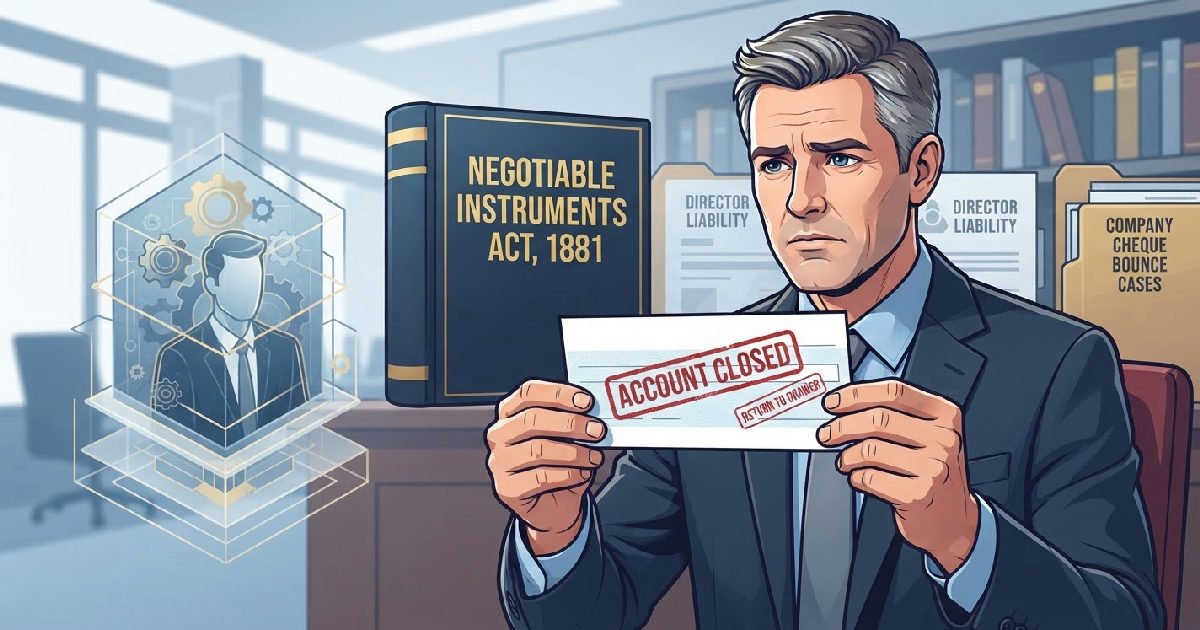
When a company cheque bounces, the legal repercussions extend far beyond the corporate entity itself. Under India’s Negotiable Instruments Act, 1881 (NI Act), specifically Sections 138 and 141, individuals deemed “in charge of and responsible for the conduct of the business” can face significant personal company cheque bounce liability.
This framework aims to ensure accountability and prevent corporate structures from becoming shields for financial misconduct.
Cheque bounce liability for who is in charge of the business
The core principle rests on identifying those individuals who held genuine control and responsibility at the time the offense occurred. It’s not merely about holding a title; it demands proof of active involvement or oversight. Understanding these nuances is critical for both complainants seeking justice and directors navigating their legal obligations.
The legal landscape surrounding company cheque bounce liability can be complex, particularly when it comes to pinpointing individual responsibility. While the company is always the primary offender for issuing a dishonored cheque, Section 141 of the NI Act introduces the concept of vicarious liability. This means others closely associated with the firm can also be held accountable.
Liability under this section hinges on whether a person was “in charge of and responsible for the conduct of the business” at the time the cheque was dishonored. This isn’t a blanket provision; it requires concrete evidence of their operational control. Courts demand specific allegations, not just general accusations against all board members.
The Core of Vicarious Responsibility
For an individual to be held vicariously liable, the complaint must clearly establish their functional role in the company’s affairs. This includes their direct involvement in financial decision-making or the events that led to the cheque’s issuance and subsequent bounce. Vague statements are unlikely to satisfy judicial scrutiny, often leading to dismissal of charges against certain individuals.
The law provides a crucial defense: a person can prove the offense happened without their knowledge. They can also demonstrate that they exercised all due diligence to prevent the transgression. This safeguard acknowledges that not every director is involved in every operational detail.
Beyond Mere Designation
Holding a designation alone, such as being a director, isn’t sufficient to trigger liability in these cases. The legal system focuses on actual operational control and responsibility. Merely appearing on company records or attending board meetings doesn’t automatically imply culpability, especially for non-executive roles.
For complainants, it’s vital to plead the specific role and responsibilities of the accused individual, rather than just their Director Identification Number (DIN). This specificity is paramount for a successful prosecution under the NI Act. Without it, the case against individual directors may weaken significantly.
Key Roles and Specific Responsibilities
Certain positions within a company inherently carry a higher degree of responsibility concerning financial matters and cheque issuance. The law differentiates between various roles, assessing their direct involvement in the company’s operations and financial controls. This distinction is crucial for determining individual liability.
The specific duties and authority associated with a role directly influence the likelihood of prosecution in a cheque bounce case. Understanding these distinctions helps clarify the legal exposure of different company personnel. It also guides legal strategies for both defense and prosecution.
The Cheque Signatory’s Direct Role
The individual who actually signed the dishonored cheque on behalf of the company holds a unique position. They are always liable alongside the company, as they directly executed the instrument that subsequently bounced. This direct act of signing establishes a clear link to the offense.
However, an authorized signatory signing in an official capacity isn’t automatically personally liable solely for that act. If the signatory also serves as a director or officer in charge of financial affairs, their liability might extend due to that managerial role. The context of their signing is key.
Executive and Managerial Accountability
Managing Directors (MDs) and whole-time directors are typically presumed to be in charge of and responsible for the company’s business. Their pervasive involvement in day-to-day operations makes their liability more straightforward to establish. Similarly, other key managerial persons actively handling daily affairs can face similar liability.
These roles inherently involve oversight of financial transactions and operational decisions that directly impact the company’s ability to honor cheques. Therefore, their responsibility is more readily inferred by the courts. They often bear the brunt of individual prosecutions when a company cheque bounces.
Scrutiny for Non-Executive Directors
Non-executive and independent directors are often disproportionately included in cheque bounce complaints, largely because their names appear in company registries. However, the law provides them significant protection. They cannot be prosecuted merely by virtue of their directorship unless specific proof of their direct involvement exists.
The Supreme Court has consistently reinforced that non-executive and independent directors are not vicariously liable without concrete evidence. This evidence must demonstrate their direct involvement in financial operations, or that the offense occurred with their knowledge or consent. Mere attendance at board meetings is insufficient for prosecution.
| Role in Company | Default Liability Posture | Conditions for Imposing Liability |
|---|---|---|
| Cheque Signatory | High | Directly signed the dishonored cheque on behalf of the company. |
| Managing Director (MD) | High | Generally presumed “in charge and responsible” due to executive role. |
| Whole-time Director | Medium to High | Actively involved in day-to-day management and financial decisions. |
| Non-Executive/Independent Director | Low | Requires specific allegations of direct financial involvement or knowledge. |
| Key Managerial Person (KMP) | Medium | Involved in daily operational and financial management. |
Resignation’s Impact on Liability
The timing of a director’s resignation plays a pivotal role in determining their potential liability in a company cheque bounce case. A clean break from the company’s management can be a strong defense, but only if executed correctly and promptly. Directors must be acutely aware of the implications of their departure.
Proper legal and administrative steps are crucial to ensure that a resignation effectively shields a director from future claims. Without adequate documentation and adherence to procedures, even a genuine resignation might be challenged in court, prolonging legal battles. The date of the cheque’s issuance is the critical benchmark.
Timing is Everything
A director who formally resigned *before* a cheque was issued cannot typically be held liable for its subsequent dishonor. This holds true even if the underlying debt originated during their tenure as a director. The law focuses on who was responsible at the exact moment the alleged offense—issuance of the bad cheque—took place.
Conversely, if a director signed a cheque and then resigned, they cannot escape liability if that cheque is later dishonored. The act of signing established their responsibility. The timing of resignation relative to the cheque’s issuance is a fundamental point of legal contention.
Documenting Your Departure
For directors, thorough documentation of their resignation is paramount. This includes board resolutions accepting the resignation and regulatory filings, such as Form DIR-11 and DIR-12, with the Registrar of Companies (ROC). These filings provide official records of the departure date, which can serve as crucial evidence in court.
While corporate filings are important, they aren’t always an absolute shield. If the timing, genuineness, or effect of a resignation is disputed, these matters must be fully tested at trial. Directors should also ensure their name is removed from the bank signatory list to further solidify their non-involvement in financial transactions post-resignation.
Consequences of Ignoring Court Summons
Ignoring a court summons in a company cheque bounce case is a serious misstep that can lead to severe legal ramifications. Many individuals, especially those who believe they have minimal involvement, mistakenly assume that non-appearance will make the problem disappear. This approach invariably escalates the situation, making resolution more challenging and costly.
The legal system is designed to compel appearance and participation. Disregarding official court directives signals a disrespect for the judicial process. This can turn an already difficult situation into a much graver legal predicament, impacting personal liberty and financial standing.
Escalation of Legal Actions
The court will first issue a bailable warrant if an accused fails to appear after summons. Should the absence continue, a non-bailable warrant (NBW) may follow, which carries a risk of immediate arrest. This progression demonstrates the judiciary’s increasing compulsion for attendance and accountability.
Furthermore, the court may proceed ex-parte, meaning the case will be heard and decided without the accused’s presence. Such proceedings often result in a judgment favoring the complainant, as the defense’s side of the argument remains unpresented. This severely limits the accused’s ability to influence the outcome.
Financial and Reputational Damage
Non-appearance can significantly escalate the penalties under Section 138 of the NI Act. These penalties can include imprisonment for up to two years, a substantial monetary fine up to twice the cheque amount, or both. Ignoring a summons drastically reduces the accused’s leverage for a favorable settlement, making any eventual resolution far more expensive.
Beyond immediate legal and financial penalties, failing to resolve cheque bounce cases or appear in court severely damages an individual’s financial credibility. This can impact future business dealings, loan applications, and overall reputation within the corporate world. It’s an outcome that few directors can afford.
Strategic Considerations for Complainants and Directors
Both complainants and directors involved in company cheque bounce cases must adopt strategic approaches to protect their interests. For complainants, meticulous legal drafting is key to identifying and prosecuting responsible individuals. For directors, proactive compliance and diligent record-keeping are essential shields.
Understanding the intricacies of the NI Act and court procedures can significantly influence the outcome of these cases. A well-prepared strategy, informed by legal counsel, is indispensable for navigating the complexities of corporate liability. This ensures that legal efforts are effective and defenses are robust.
Building a Solid Case for Complainants
To successfully prosecute individuals alongside a company, complainants must do more than just list names. They must specifically plead the role and responsibility of each director, demonstrating their active involvement in the business’s conduct at the relevant time. Simply providing a Director Identification Number (DIN) is insufficient for establishing personal liability.
Prosecuting the company itself is usually a prerequisite for pursuing individuals under Section 141 of the NI Act, unless there’s a specific legal reason preventing it. Timely issuance of the legal notice—within 30 days of the cheque’s dishonor—is also a critical initial step to trigger criminal proceedings.
Directors’ Proactive Measures
Directors must maintain scrupulous records regarding their roles, responsibilities, and any changes in their association with the company. The date of resignation is paramount; if a director resigned before the cheque was issued, they are generally not liable. Official filings like Form DIR-12 with the Registrar of Companies provide crucial evidence of such a departure.
Crucially, directors should never ignore court summons. Appearance in court demonstrates respect for the legal process and allows for a proper defense. Failing to appear can lead to warrants and ex-parte judgments, drastically undermining any defense strategy and potentially leading to severe penalties. Proactive engagement, not avoidance, is the best defense in such legal battles.
What makes an individual “in charge of and responsible for the business” in a cheque bounce case?
An individual is deemed “in charge of and responsible for the business” if they had actual control over the company’s operations and financial decisions at the time the dishonored cheque was issued. This goes beyond a mere title, requiring specific allegations of their direct involvement in the company’s conduct.
Can an independent director be held liable for a company cheque bounce?
Generally, an independent or non-executive director is not held liable simply due to their position. Liability arises only if the complaint provides specific evidence of their direct involvement in the company’s financial operations or that the offense occurred with their knowledge, consent, or due to their specific negligence.
What happens if a director ignores a court summons in a cheque bounce case?
Ignoring a court summons can lead to escalating legal measures, including the issuance of bailable and then non-bailable warrants, risking arrest. The court may also proceed ex-parte, deciding the case in the accused’s absence, often resulting in an unfavorable judgment and potentially harsher penalties, including imprisonment and significant fines.
Named on a company 138 complaint in Delhi? Call or Whatsapp for free consultation.
Related: https://arpitmarwah.com/cheque-bounce-lawyers-in-delhi/