
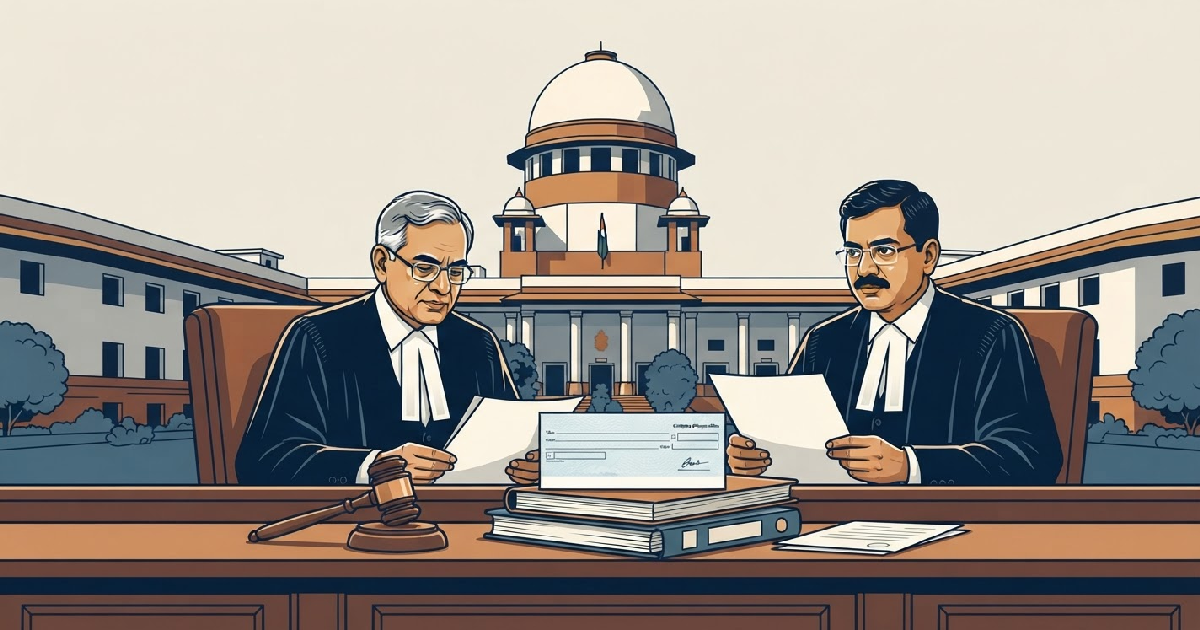
India’s Supreme Court delivered a pivotal ruling on July 29, 2026, affirming that failing to name a company as an accused in a company cheque dishonour case is a critical, incurable flaw. This decision, reported on August 4 and 5, 2026, means complainants cannot later add the company during trial, even if evidence emerges.
In a significant development, the concept of a company cheque dishonour case has gained more attention in recent years as legal practitioners seek to understand its implications.
The rise of digital transactions has also led to an increase in company cheque dishonour case scenarios, emphasizing the need for clarity in these proceedings.
Justices Manoj Misra and Vijay Bishnoi clarified that a company’s initial arraignment is a mandatory prerequisite for prosecuting its directors under the Negotiable Instruments Act, 1881. This reinforces the need for strict procedural adherence from the outset of such legal proceedings.
This is particularly relevant given the financial implications of a company cheque dishonour case on both complainants and accused parties.
The legal landscape surrounding a company cheque dishonour case continues to evolve, reflecting changes in business practices.
Understanding the nuances of a company cheque dishonour case is essential for all stakeholders involved.
Given the rise in such disputes, the importance of early legal intervention in a company cheque dishonour case cannot be overstated.
The implications of a company cheque dishonour case extend beyond individual transactions, impacting entire corporate reputations.
Effective management of a company cheque dishonour case can prevent significant financial losses for directors and stakeholders.
In navigating a company cheque dishonour case, understanding the procedural requirements is critical.
Strategically addressing a company cheque dishonour case can lead to more favorable outcomes for the involved parties.
Ultimately, the effective resolution of a company cheque dishonour case hinges on adherence to established legal protocols.
Specialized legal knowledge is vital in managing the complexities of a company cheque dishonour case.
Litigators must be equipped to handle any challenges arising from a company cheque dishonour case efficiently.
Awareness of the legal precedents can significantly impact the outcomes in a company cheque dishonour case.
Court clarifies procedural mandate for cheque dishonour cases
The apex court unequivocally stated that omitting a company as an accused in a Section 138 complaint related to a company cheque dishonour case creates a “fatal defect.” This defect renders the entire complaint non-maintainable and cannot be rectified by later legal maneuvers.
Legal professionals should prioritize clear communication when addressing issues related to a company cheque dishonour case.
Properly understanding a company cheque dishonour case can help mitigate risks for businesses.
The implications of a company cheque dishonour case extend beyond immediate financial impacts.
Effective strategies for a company cheque dishonour case can enhance corporate governance practices.
Companies should implement protocols to handle a company cheque dishonour case to minimize disruption.
In summary, acknowledging the significance of a company cheque dishonour case is crucial for business operations.
In conclusion, failing to recognize the importance of a company cheque dishonour case can have lasting repercussions.
It underscores the principle that for directors or authorized signatories to face vicarious liability in a company cheque dishonour case, the company itself must be the primary accused. This strict interpretation aligns with established precedents and emphasizes the foundational role of the company in such financial offenses.
The Manjula Kapoor appeal: a case study in procedural gaps
This significant ruling originated from an appeal lodged by Manjula Kapoor, a director and authorized signatory of M/s Cine Prime Entertainment. She faced accusations from Pankaj Sharma in a cheque dishonour case concerning a ₹5 lakh cheque.
The cheque, issued on behalf of M/s Cine Prime Entertainment, was returned unpaid with the notation “payment stopped by drawer.” The original complaint, filed against Kapoor, notably omitted the company itself as an accused party.
A Judicial Magistrate took cognizance of the complaint and summoned Manjula Kapoor on January 30, 2010. During the subsequent trial, Kapoor argued that the proceedings were invalid without the company’s impleadment.
The Himachal Pradesh High Court, however, declined to quash the proceedings. It instead directed the trial court to suo motu implead M/s Cine Prime Entertainment under Section 319 of the Code of Criminal Procedure, 1973, and initiate a de novo trial.
But the Supreme Court ultimately set aside this High Court order. The Court quashed the complaint and all consequential proceedings against Kapoor, citing the incurable nature of the initial procedural defect.
Legal foundations governing cheque dishonour
India’s legal framework, particularly the Negotiable Instruments Act, 1881 (NI Act), treats cheque dishonour as a serious criminal offense. Section 138 of this Act specifies the conditions under which a returned cheque becomes a prosecutable offense.
This provision was introduced to bolster confidence in cheque transactions and offer a more efficient legal recourse than traditional civil litigation. Strict prerequisites for prosecution include the cheque’s validity, its presentation, and a demand notice served to the drawer.
Unpacking vicarious liability for company officials
Section 141 of the NI Act extends criminal accountability to directors and other officers of a company when the company commits an offense under Section 138. This establishes vicarious liability, but only if the company itself has committed the offense.
The Supreme Court’s landmark 2012 ruling in Aneeta Hada v. Godfather Travels & Tours (P) Ltd. made it mandatory for the company to be arraigned as an accused before its directors could be held liable. This latest judgment strongly reaffirms that foundational principle of corporate accountability in legal contexts.
It means a director cannot be prosecuted if the corporate entity, on whose behalf the cheque was issued, is not a party to the complaint from the outset. This ensures clarity in assigning responsibility within corporate structures.
Constraints of section 319 CrPC
Section 319 of the Code of Criminal Procedure, 1973, grants courts the power to summon additional accused during a trial if new evidence points to their involvement. This power is discretionary and intended for extraordinary situations.
However, the Supreme Court has consistently maintained that this power must be used cautiously. It demands “stronger evidence than mere probability of complicity” and cannot serve as a mechanism to rectify fundamental defects in the original complaint.
Preventing circumvention of limitation periods
A critical rationale behind the Court’s ruling centers on the statutory limitation periods for filing complaints under the NI Act. These laws prescribe strict timeframes within which a cheque dishonour complaint must be initiated.
Allowing a company to be added under Section 319 CrPC after these deadlines would effectively circumvent these statutory limitations. The Court, referencing N. Harihara Krishnan v. J. Thomas (2018), confirmed that Section 319 cannot be used to introduce new parties beyond the prescribed period.
This stance ensures legal fairness and upholds procedural timelines. It prevents complainants from leveraging judicial intervention to cure their own initial procedural oversights, especially when assessing demand notice validity in such cases.
Wider implications for criminal proceedings
This Supreme Court ruling carries substantial implications for how cheque dishonour cases are initiated and prosecuted across India. It places an increased onus on complainants to ensure meticulous procedural correctness from day one.
An oversight in naming all necessary parties can now lead to the entire case being quashed, regardless of the merits of the underlying financial dispute. Legal practitioners must exercise extreme care in drafting these complaints.
Emphasizing procedural rigour
The decision strongly advocates for rigorous adherence to procedural norms in criminal complaints brought under the NI Act. It signals that the judiciary is unwilling to permit attempts to salvage fundamentally flawed initial filings through later amendments.
This approach could potentially increase the number of cases dismissed due to incomplete initial complaints. Complainants should now verify that all legal entities, including the company, are properly named and notified from the earliest stages of litigation.
Impact on businesses and financial transactions
The ruling serves as a vital reminder for businesses, particularly those engaged in issuing cheques. Companies and their directors must remain acutely aware of the legal consequences should a cheque be dishonoured.
It also highlights the critical importance of maintaining accurate financial records and thoroughly understanding the legal obligations associated with corporate signatures on financial instruments. This judgment indirectly promotes greater transparency in commercial dealings.
Reinforcing corporate accountability
While the ruling offers protection to individual directors who might have been improperly prosecuted, it also fortifies the principle of corporate accountability. It ensures that the company, as a distinct legal entity, faces charges directly for its financial delinquencies.
This balanced emphasis on strict procedural correctness and corporate responsibility is essential for preserving the integrity of commercial transactions. It helps maintain the delicate equilibrium between protecting individuals and holding corporate bodies liable.
Navigating future cheque dishonour cases
Legal professionals and business entities must adapt their strategies in light of this clarified judicial position. For complainants, it necessitates a more thorough checklist before filing a Section 138 case.
Conversely, for potential accused directors, it provides a stronger defense if the issuing company was not initially named. The judgment offers a clear pathway for quashing proceedings that fail this crucial initial test of cheque dishonour case maintainability.
| Aspect | Before Ruling (Himachal Pradesh High Court view) | After Ruling (Supreme Court view) |
|---|---|---|
| Company Impleadment | Could be added later via Section 319 CrPC | Mandatory at the initial complaint stage |
| Defect Curability | Curable by judicial intervention | Fatal and incurable by Section 319 CrPC |
| Director’s Liability | Potentially maintainable even if company added later | Not maintainable if company not initially arraigned |
| Impact on Limitation | Risk of bypassing statutory limitation periods | Prevents circumvention of limitation periods |
What was the Supreme Court’s recent decision on cheque dishonour cases?
The Supreme Court ruled that if a company is not initially named as an accused in a cheque dishonour complaint under Section 138 of the Negotiable Instruments Act, this is a fatal defect. This error cannot be corrected later by summoning the company under Section 319 of the Code of Criminal Procedure during the trial.
Why is it important to name the company as an accused from the start?
Naming the company as an accused from the beginning is a mandatory precondition for establishing vicarious liability against its directors or authorized signatories under Section 141 of the NI Act. Without the company being a primary accused, the complaint against individuals associated with it becomes legally untenable.
How does this ruling affect the use of Section 319 CrPC?
The ruling clarifies that Section 319 CrPC, which allows courts to summon additional accused, cannot be used to cure fundamental defects in the original complaint, especially if doing so would bypass statutory limitation periods. It reinforces that this power is extraordinary and not a mechanism to fix initial procedural errors.