
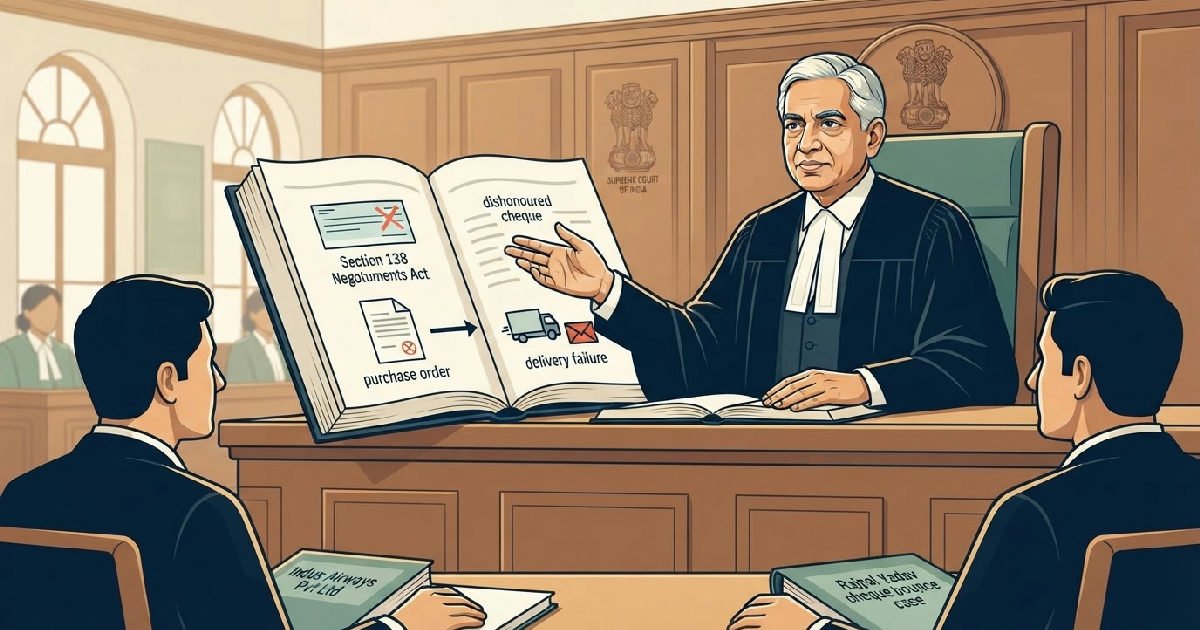
India’s Supreme Court has significantly curtailed the scope of criminal liability under Section 138 of the Negotiable Instruments Act, 1881, for cheques issued as advance payments where goods or services are never delivered.
In its pivotal ruling on 2014-04-07 in the case of Indus Airways Private Limited And Others v. Magnum Aviation Private Limited And Another, the apex court clarified that for a dishonoured cheque to attract criminal proceedings, a “legally enforceable debt or liability” must exist at the precise moment the cheque was issued, not merely when it was initially handed over.
Cheque given as advance and goods never came
This landmark decision overturned previous interpretations, including some by the Delhi High Court, which had broadly applied Section 138 to such scenarios.
The Supreme Court’s judgment underscores a critical distinction: cheques given purely as an advance, without an immediate corresponding liability, generally fall outside the purview of criminal prosecution if the underlying transaction fails to materialise. This provides a crucial safeguard for buyers, but also highlights the complexities of legally enforceable debt in commercial dealings.
The core of the Supreme Court’s ruling in the Indus Airways case revolves around the interpretation of “legally enforceable debt or liability” within Section 138. Prior to this, there was ambiguity, with some courts holding that even advance cheques could trigger criminal action upon dishonour, regardless of subsequent events like non-delivery.
However, the 2014-04-07 decision meticulously laid out that if a cheque is issued as an advance payment before goods are supplied or a service is rendered, and that supply or service never occurs, then no legally enforceable debt arises at the time the cheque is drawn.
Consequently, the dishonour of such a cheque typically does not constitute an offence under Section 138, providing a crucial precedent for similar disputes across the country, including in Delhi.
The Indus Airways precedent and its impact
The judgment from Indus Airways Private Limited And Others v. Magnum Aviation Private Limited And Another became a cornerstone for understanding advance payment scenarios. It established that the critical juncture for assessing liability is the date of cheque issuance. If a purchase order is later cancelled or goods are not supplied, the foundational condition for Section 138 — a subsisting debt — is absent.
This clarification has profound implications for commercial contracts and dispute resolution. It forces parties to consider the timing of their transactions and the conditions under which an advance payment transforms into a legally enforceable debt, shifting the focus from the act of bouncing to the underlying contractual obligations at the time of drawing.
Navigating “stop payment” instructions and delivery disputes
While advance payment cheques have a clearer legal standing post-Indus Airways, scenarios involving “stop payment” instructions by the drawer introduce another layer of complexity. A cheque returned with the remark “payment stopped by issuer” can still constitute a criminal offence under Section 138, particularly if it was issued against a legally enforceable debt.
The Supreme Court has consistently maintained that a deliberate stop-payment instruction, absent genuine dispute, is strong evidence of dishonest intent. This can be viewed more severely than a cheque bouncing due to insufficient funds, as it often suggests a conscious effort to evade payment after a liability has been established.
Stopping payment versus insufficient funds
The legal distinction between a stop-payment instruction and a bounced cheque due to insufficient funds is subtle but significant.
In cases of “payment stopped,” the burden of proof typically shifts to the accused to demonstrate that the instruction was based on a genuine, pre-existing dispute or valid reasons, rather than merely an attempt to avoid payment for a legitimate debt. Without such proof, the action can easily fall within Section 138.
This nuance highlights the importance of timely communication and clear dispute resolution mechanisms in commercial agreements. Simply stopping a cheque without a justifiable legal basis can leave the drawer vulnerable to criminal proceedings, even if the payee’s account has sufficient balance.
Evidentiary burden in delivery disputes
The core principle in any Section 138 case, especially when goods delivery is contentious, is whether money was actually due at the time the cheque was presented. This isn’t solely about when the cheque was initially handed over; it’s about the state of the transaction at the point of presentation.
For instance, if emails clearly show a buyer accepted a short supply or acknowledged receiving goods, then later ignoring a demand notice on the premise of “goods not received” would significantly weaken their defence. Such digital evidence can decisively tip the scales in favour of the complainant, establishing the existence of a legitimate debt.
Procedural requirements for a cheque bounce case
Filing a criminal complaint under Section 138 involves strict adherence to a multi-stage procedural framework. Missing any of these steps can invalidate the entire case, regardless of the merits of the underlying claim. This legal process is designed to give the drawer ample opportunity to rectify the situation before criminal proceedings commence.
Complainants must act swiftly and meticulously, ensuring all notices are properly served and timelines are met. The law prioritises due process, demanding that procedural fairness is upheld alongside the pursuit of justice for the aggrieved party.
Essential steps for complainants
First, the cheque must be presented to the bank within three months of its issuance date. Upon dishonour, the payee must receive a “return memo” from the bank, detailing the reason. Within 30 days of receiving this memo, a written demand notice must be dispatched to the drawer, requesting payment of the exact cheque amount.
If the drawer fails to make payment within 15 days of receiving this notice, the cause of action arises on the 16th day. A criminal complaint must then be filed before a Metropolitan Magistrate or Judicial Magistrate (First Class) within one month (30 days) from this date. Diligent adherence to this notice procedure is paramount for a successful prosecution.
Penalties for Section 138 violations
Conviction under Section 138 carries significant penalties. These can include imprisonment for a term extending up to two years, or a fine that may reach twice the amount of the dishonoured cheque, or even both. Such punitive measures underscore the seriousness with which the law treats the breach of trust inherent in a bounced cheque.
Moreover, under Section 143A of the Negotiable Instruments Act, courts can order the drawer to pay interim compensation of up to 20% of the cheque amount during the trial. This provision aims to provide immediate relief to the payee, though the amount must be refunded with interest if the accused is ultimately acquitted, ensuring fairness for both parties.
| Condition for Section 138 Case | Requirement Details |
|---|---|
| Legally Enforceable Debt/Liability | Must exist at the time the cheque is issued. Advance payments without immediate liability generally excluded. |
| Cheque Presentation | Within three months of issuance date. |
| Bank Dishonour | Cheque returned unpaid due to reasons like insufficient funds or stop payment. |
| Demand Notice | Sent within 30 days of bank memo, demanding exact cheque amount. |
| Failure to Pay | Drawer must fail to pay within 15 days of receiving the demand notice. |
| Complaint Filing | Within 30 days of the cause of action arising (16th day after notice). |
Importance of robust documentation in disputes
In any dispute arising from a dishonoured cheque, particularly those involving advance payments or non-delivery claims, meticulous documentation is not just helpful—it
How did the Indus Airways case change the interpretation of cheque bounce laws for advance payments?
The Supreme Court’s ruling in the Indus Airways Private Limited And Others v. Magnum Aviation Private Limited And Another case clarified that for a dishonoured cheque to lead to criminal proceedings under Section 138 of the Negotiable Instruments Act, a “legally enforceable debt or liability” must exist at the precise moment the cheque was issued.
This means cheques given purely as an advance, without an immediate corresponding liability, generally fall outside the purview of criminal prosecution if the underlying transaction (like delivery of goods or services) fails to materialize.
What is the legal difference between a “stop payment” instruction and a cheque bounced due to insufficient funds?
While both lead to a dishonoured cheque, their legal implications under Section 138 differ. A cheque bounced due to insufficient funds indicates a lack of money in the account. A “stop payment” instruction, however, implies a deliberate action by the drawer.
If a stop payment is made without a genuine, pre-existing dispute or valid reason, it can be viewed as an attempt to evade payment for a legitimate debt and may be treated more severely than insufficient funds, shifting the burden of proof to the drawer to justify their action.
What are the potential penalties for a Section 138 violation in India?
Conviction under Section 138 of the Negotiable Instruments Act can result in significant penalties. These include imprisonment for a term up to two years, or a fine that can be as much as twice the amount of the dishonoured cheque, or both.
Additionally, Section 143A allows courts to order the drawer to pay interim compensation of up to 20% of the cheque amount to the payee during the trial, which must be refunded with interest if the accused is acquitted.
Advance cheque bounced and the goods never moved? Call or Whatsapp for consultation.
Related: https://arpitmarwah.com/cheque-bounce-lawyers-in-delhi/