
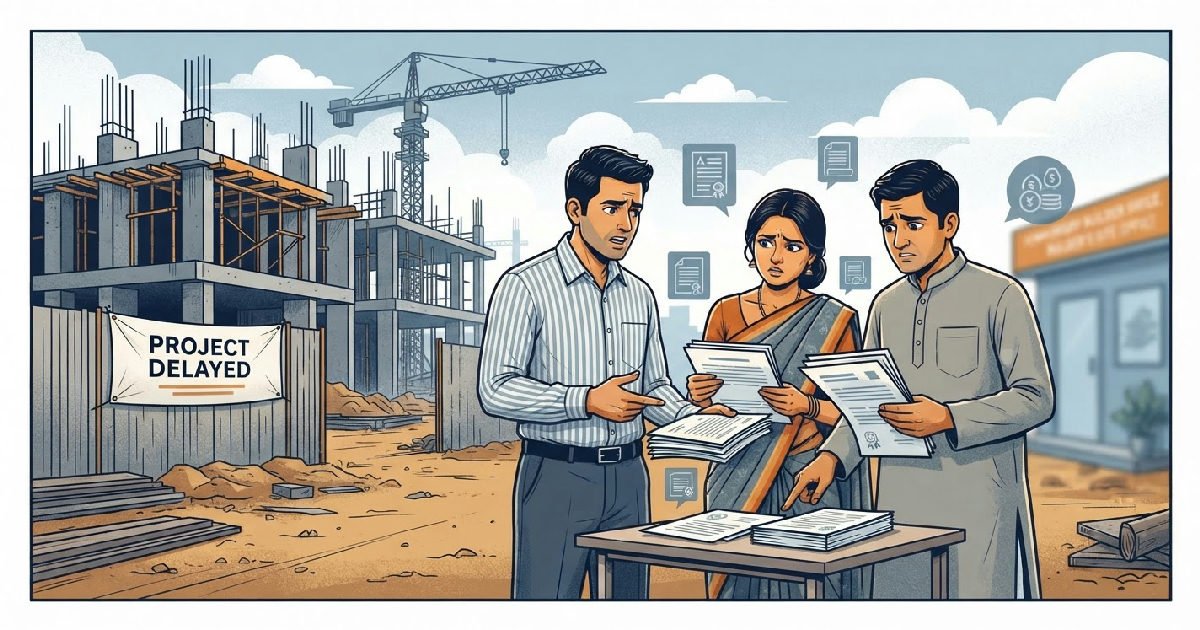
Homebuyers across the Delhi National Capital Region (NCR) are increasingly facing demands for unanticipated additional payments from builders at the crucial moment of property possession. These charges, which were often not stipulated in the original sale agreements, are creating significant financial strain and legal complexities for buyers.
Developers are reportedly adding costs such as Preferential Location Charges (PLC), club membership fees, power backup charges, “inflation” adjustments, or previously undisclosed Goods and Services Tax (GST). For many, the pressure to pay is immense, driven by the desire to exit the challenging phase of paying both EMIs and rent simultaneously.
Builder demanding extra: Delhi NCR homebuyers’ unexpected charges
The practice involves builders presenting homebuyers with a final demand for payment that significantly exceeds the agreed-upon price. These surprise additions often catch buyers off guard, leaving them with little time to assess the legitimacy of the claims.
Such demands can range from charges for premium locations within the project, which were never part of the initial booking, to compulsory memberships for amenities that buyers may not even want or use. It’s a tactic that places immense psychological and financial pressure on individuals eager to finally move into their homes.
Preferential Location Charges Explained
Preferential Location Charges (PLC) are a common point of contention. Builders often levy these for properties deemed to have a superior location, such as a corner plot, a higher floor with better views, or proximity to specific amenities.
However, the issue arises when these charges are introduced at the very end of the purchasing process, rather than being clearly outlined and agreed upon in the initial builder-buyer agreement. This last-minute addition fundamentally alters the financial landscape for the buyer.
The Hidden Costs of Club Memberships and Utilities
Beyond PLC, many homebuyers are surprised by demands for mandatory club membership fees, despite these not being part of their original purchase decision. Similarly, charges for power backup facilities are frequently added without prior disclosure or negotiation.
Further complicating matters are “inflation” adjustments, which builders apply retrospectively to the property cost, often without a clear contractual basis. Even Goods and Services Tax (GST), which should be transparently included, sometimes appears as an unexpected demand at possession, catching buyers unprepared.
Buyer’s Dilemma: Pay Up or Protest?
The core of the problem lies in the precarious position homebuyers find themselves in. They have typically invested years of savings and are simultaneously managing housing loan EMIs alongside rental payments. The prospect of further delays if they dispute the charges often pushes them to simply comply.
However, paying these unagreed charges, especially if done without proper documentation or against a signed “no-dues” letter, can have severe repercussions. It risks invalidating any future claims the homebuyer might have under consumer protection laws or real estate regulations.
It’s crucial for buyers to understand that any charge not explicitly stated in the signed agreement or not a lawful demand under the contract constitutes a dispute, not a mandatory condition for receiving keys. Simply handing over cash without a receipt is highly inadvisable and can undermine their legal standing.
Navigating the legalities of property possession can be complex, and understanding when to accept or dispute terms is paramount. Buyers should be aware of the implications of signing crucial documents without a conveyance deed, which can further complicate their ownership rights. For detailed guidance, exploring resources like possession letter without a conveyance deed can be beneficial.
Legal Recourse and Buyer Protections
Homebuyers are not entirely without recourse when faced with such demands. The key is to meticulously compare the builder’s final demand letter line by line against the terms and conditions laid out in the original sale agreement. Any discrepancy should be immediately flagged.
The Real Estate (Regulation and Development) Act, 2016 (RERA), provides a framework to protect homebuyers from unfair practices. If a charge is not part of the agreed contract, it cannot be unilaterally imposed as a condition for possession.
Scrutinizing the Sale Agreement
Before making any additional payments, homebuyers must thoroughly review their sale agreement. This document is the bedrock of the entire transaction, detailing every agreed-upon cost, facility, and condition. Any charge demanded outside of this agreement should be questioned rigorously.
Lawyers often advise clients to keep all communication and documentation related to the property purchase. This includes initial brochures, payment receipts, and any correspondence with the builder, as these can serve as vital evidence in a dispute.
The Risks of No-Dues Letters and Cash Payments
A significant pitfall for homebuyers is the builder’s demand for a “no-dues” letter before handing over possession. Signing such a letter effectively waives the buyer’s right to claim any outstanding issues or further compensation, including potential RERA delay claims. Homebuyers should be exceptionally cautious before signing any document that absolves the builder of all future liabilities.
Furthermore, builders sometimes request additional payments in cash, promising to provide a receipt later or avoiding official documentation. This practice is fraught with risk, making it incredibly difficult for buyers to prove that such payments were made, or to dispute their legitimacy later on. In cases of builder non-compliance, knowing how to file a RERA complaint can provide a structured path forward.
Navigating the Dispute: Practical Steps for Homebuyers
When confronted with unexpected charges, the first step for any homebuyer is to maintain a clear and documented record of all interactions. This includes preserving the builder’s demand letter and comparing it meticulously with the clauses of their signed agreement.
If a discrepancy is found, buyers should formally communicate their objections to the builder in writing, citing the specific clauses of the agreement. Seeking legal counsel at this stage can provide invaluable guidance on the best course of action, whether it’s negotiation, protest, or pursuing a refund.
| Charge Type | Common Issue | Buyer’s Action |
|---|---|---|
| Preferential Location Charge (PLC) | Not in original agreement | Verify agreement, formally object |
| Club Membership Fees | Mandatory despite no prior mention | Check amenity clauses, dispute mandatory nature |
| Power Backup Charges | Introduced at possession | Confirm in agreement, demand clarification |
| “Inflation” Adjustment | Retrospective price increase | Challenge contractual basis, refuse to pay |
| Undisclosed GST | Added as a last-minute cost | Verify all tax clauses in agreement, seek professional tax advice |
The decision to accept possession under protest, challenge the charges, or even seek a refund ultimately depends on the specific terms of the agreement and the buyer’s individual circumstances. Each path carries its own set of legal implications and potential timelines.
It’s crucial to make an informed decision rather than succumbing to pressure. Many homebuyers find themselves in a precarious situation, having paid significant amounts only to face additional hurdles. This careful consideration can protect their long-term interests.
The Broader Impact on Delhi NCR’s Residential Market
These recurrent disputes over undisclosed charges are eroding homebuyer confidence in the Delhi NCR real estate market. The uncertainty and potential for hidden costs deter prospective buyers, making them wary of builder promises and contractual agreements.
Such practices undermine the transparency and ethical standards that regulations like RERA aim to foster. A market where homebuyers consistently face unexpected financial burdens at the final stage of purchase struggles to maintain trust and stability.
Ultimately, a healthy residential market relies on clear communication, adherence to agreed terms, and fair practices from developers. Continuous instances of last-minute demands only serve to damage the industry’s reputation and create an adversarial environment between builders and buyers.
Beyond these immediate possession issues, many homebuyers also grapple with project delays, incurring significant financial losses. Understanding avenues for compensation, such as claiming RERA delay interest, becomes another vital aspect of property ownership in the region.
Can builders demand extra charges not in the original agreement?
Generally, no. Any charges demanded by the builder must be explicitly stated and agreed upon in the original builder-buyer agreement. If a charge isn’t in the contract or isn’t a lawful demand, it constitutes a dispute, not a mandatory payment condition for possession.
What are the risks of signing a “no-dues” letter?
Signing a “no-dues” letter typically means you are confirming that the builder has fulfilled all their obligations and that you have no further claims. This can prevent you from pursuing future legal action, including claims for delayed possession or undisclosed charges, effectively waiving your rights.
What steps should I take if a builder demands additional payments?
First, compare the demand letter with your original sale agreement line by line. Document all discrepancies in writing and formally object to the builder. Avoid cash payments without receipts and refrain from signing any “no-dues” letter prematurely. Consider seeking legal advice immediately.
Extra bill at possession in Delhi NCR? Whatsapp or call for free consultation.
Related Service: https://arpitmarwah.com/rera-lawyers-in-delhi/