
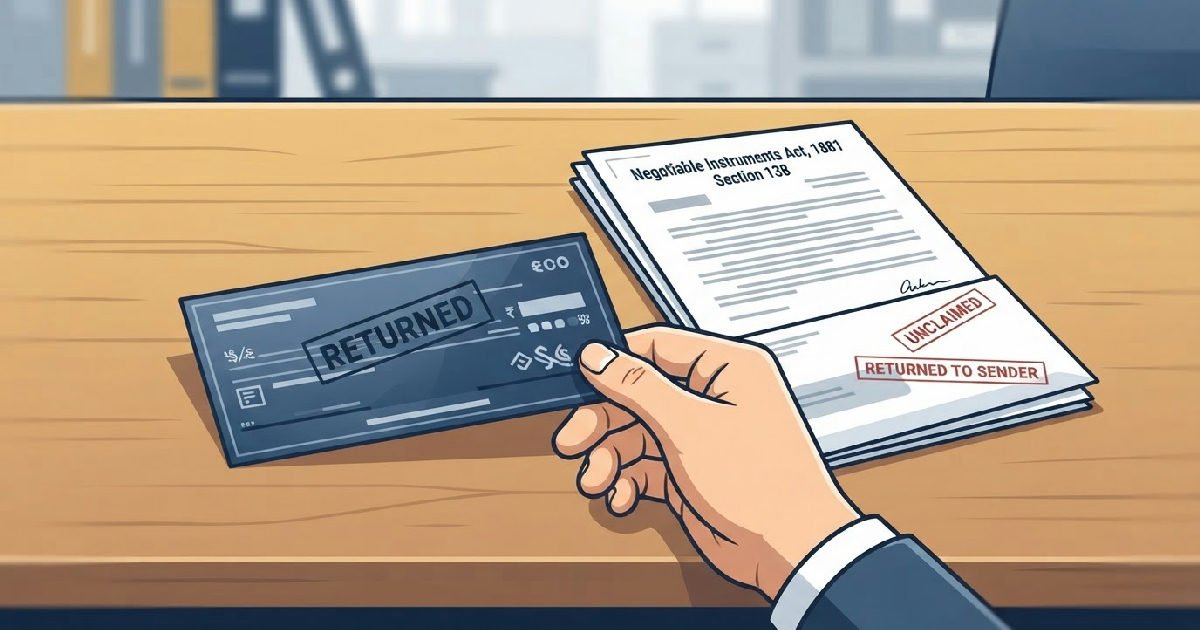
A bounced cheque notice returned as “unclaimed” or “refused” is validly served, the Supreme Court of India clarified for creditors and businesses.
This crucial legal stance under Section 138 of the Negotiable Instruments Act, 1881 (NI Act), ensures that drawers cannot evade liability by simply avoiding receipt of statutory demand notices.
Understanding the Principle of Deemed Service for a Bounced Cheque (Cheque Bounce Notice Returned Unclaimed)
The ruling reinforces the principle that once a notice is dispatched to the correct address by registered post, the legal requirement for “giving of notice” is satisfied. This interpretation is vital for maintaining the integrity of commercial transactions and expediting justice in the face of widespread cheque dishonor cases, a matter of specific concern for the Delhi High Court due to its substantial caseload.
The concept of “deemed service” is a cornerstone of legal procedure in cheque bounce cases. It dictates that even without direct physical acceptance, a notice is considered delivered if appropriate steps for delivery were taken. This principle prevents individuals from deliberately circumventing legal obligations by refusing or failing to collect correspondence.
Indian law relies on strong presumptions to ensure justice isn’t thwarted by such evasive tactics. Specifically, Section 27 of the General Clauses Act, 1897, and Section 114 of the Indian Evidence Act, 1872, form the bedrock for this legal understanding. These provisions create a presumption of service when a notice is correctly addressed and sent via registered post.
When a Notice is Returned Unclaimed or Refused
Courts consistently treat a notice as validly served when it is sent to the correct address via registered post and subsequently returned with endorsements like “unclaimed” or “refused.” This stands as definitive proof that the sender discharged their duty to inform the drawer.
The onus then shifts squarely onto the drawer to prove that the address was incorrect, they had no knowledge of the notice, or that the postal endorsement itself was erroneous. Complainants aren’t required to prove deliberate avoidance, simplifying the legal process for those pursuing payment.
Supreme Court Clarifies Valid Notice Receipt
The Supreme Court recently underscored its position regarding the validity of notice service, specifically addressing instances where a family member receives the notice. A ruling between September 30 and October 3, 2026, set aside a Kerala High Court judgment that had dismissed a conviction because the notice wasn’t personally served to the accused.
This decision emphasizes that the identity of the recipient is largely immaterial, provided the notice reaches the correct address. The Court highlighted that previous judgments, like M.D. Thomas v. P.S. Jaleel, which deemed receipt by a family member insufficient, were decided without considering binding precedents and were therefore *per incuriam*.
The Indispensable Role of a Correct Address
Despite the doctrine of deemed service, sending the notice to an outdated or incorrect address remains a critical error that can invalidate service. The legal framework is clear: the notice must be dispatched to the drawer’s accurate and current address.
For individuals, this typically means their last known residential address. For companies, the address listed on the cheque, the governing agreement, and the Ministry of Corporate Affairs (MCA) records are paramount. Ensuring precision in addressing avoids unnecessary legal hurdles.
Strict Timelines Govern Cheque Bounce Proceedings
The Negotiable Instruments Act imposes stringent timelines that payees must adhere to for a cheque bounce case to proceed. Missing these deadlines can lead to the dismissal of a complaint, underscoring the importance of prompt action following a dishonored cheque.
The initial step requires the payee to send a written demand notice to the drawer within 30 days of receiving the bank’s information about the cheque’s dishonor. This notice must specifically demand payment of the cheque amount within 15 days of the drawer’s receipt.
Should the drawer fail to make this payment within the stipulated 15-day window, the offense under Section 138 is considered complete. Following this, the payee then has a one-month period to initiate criminal proceedings by filing a complaint. Any significant delay can be detrimental.
| Action | Timeline | Commencement Point |
|---|---|---|
| Send Demand Notice | Within 30 days | Receipt of bank’s dishonor memo |
| Payment Period for Drawer | Within 15 days | Drawer’s receipt of demand notice |
| File Criminal Complaint | Within 1 month | Day after 15-day payment period expires |
Recent Legislative Changes Bolster Enforcement
Significant amendments to the Negotiable Instruments Act, effective April 1, 2025, have introduced more stringent measures and streamlined the process for cheque bounce cases. These changes reflect a growing governmental intent to curb cheque dishonor incidents and ensure financial discipline.
The enhanced provisions include an increased imprisonment term for offenders, now up to two years, double the previous one-year maximum. Additionally, fines can now extend up to twice the amount of the dishonored cheque, providing a stronger deterrent against non-payment.
The amendments also modernized the complaint filing process by introducing online complaint submissions. Banks are now legally mandated to notify account holders via SMS and email within 24 hours of a cheque dishonor. Furthermore, for high-value cheques exceeding ₹1 Crore, filing a police complaint has become mandatory.
These updates significantly impact how cheque bounce cases are handled in Delhi and across the country. They aim to reduce procedural delays and increase the efficiency of the legal system in resolving these disputes. Payees now have more robust tools at their disposal.
Delhi High Court’s Focus on Expedited Disposal
The Delhi High Court has consistently highlighted the urgent need for the swift disposal of cheque bounce cases, citing “huge pendency” within its jurisdiction. This emphasis reflects the severe strain these cases place on the judicial system and the economic impact on businesses and individuals.
In a notable decision on April 30, 2025, the Delhi High Court reaffirmed the principle that criminal complaints under Section 138 must not be filed prematurely. This means a complaint cannot be lodged before the full 15-day notice period granted to the drawer has elapsed, ensuring due process.
Practical Steps for Payees to Secure Their Claim
For payees, diligent record-keeping and adherence to legal procedures are crucial. Always send the demand notice via registered post to ensure an official record of dispatch. Moreover, retaining the tracking details and any returned envelopes with postal endorsements serves as irrefutable proof of service.
It’s also essential not to delay further action after a notice is returned. Waiting for a second unclaimed envelope, for instance, can cause one to miss the strict one-month window for filing a criminal complaint. Promptness is key to navigating the legal landscape effectively.
Securing your evidence is as important as initiating the process itself. Detailed documentation can significantly strengthen your case. Being meticulous about these administrative steps can make all the difference in the successful recovery of funds. This proactive approach helps to avoid common pitfalls in the judicial process.
Wider Implications for Commercial Transactions
The consistent judicial stance on deemed service, particularly in the context of unclaimed or refused notices, carries broad implications for commercial transactions. It promotes greater accountability among those issuing cheques, knowing that attempts to evade notice will not negate their legal liability.
This legal clarity provides a much-needed sense of security for businesses and individuals who rely on cheques as a primary mode of payment. It reinforces the seriousness of cheque dishonor as a criminal offense, encouraging more responsible financial conduct. The ongoing efforts of the judiciary and legislature continue to refine this critical area of law.
Such rulings serve as a reminder that the legal system actively supports creditors in recovering their rightful dues. They discourage fraudulent practices and strengthen the financial ecosystem. The ability to ensure proper notification is central to this protection, even when facing uncooperative parties.
Is a cheque bounce notice valid if it’s returned “unclaimed”?
Yes, absolutely. Indian courts, including the Supreme Court, consistently hold that a cheque bounce notice sent by registered post to the correct address is considered validly served even if it returns with an “unclaimed” endorsement. The law presumes proper service in such scenarios, placing the burden of proof on the drawer to demonstrate otherwise.
What happens if a family member receives the cheque bounce notice?
According to a recent Supreme Court ruling, a cheque bounce notice sent by registered post to the drawer’s correct address is considered valid service even if a family member, like the drawer’s mother, receives it. The Court clarified that the recipient’s identity is not crucial as long as the notice reached the correct address.
What are the key timelines for action after a cheque bounces?
After a cheque is dishonored, the payee must send a demand notice within 30 days of receiving the bank’s memo. The drawer then has 15 days to make payment. If they fail, the payee must file a criminal complaint within one month from the day after the 15-day payment period expires.
Notice came back unclaimed and the 15 days are unclear? Call or Whatsapp for consultation.
Related: https://arpitmarwah.com/cheque-bounce-lawyers-in-delhi/