
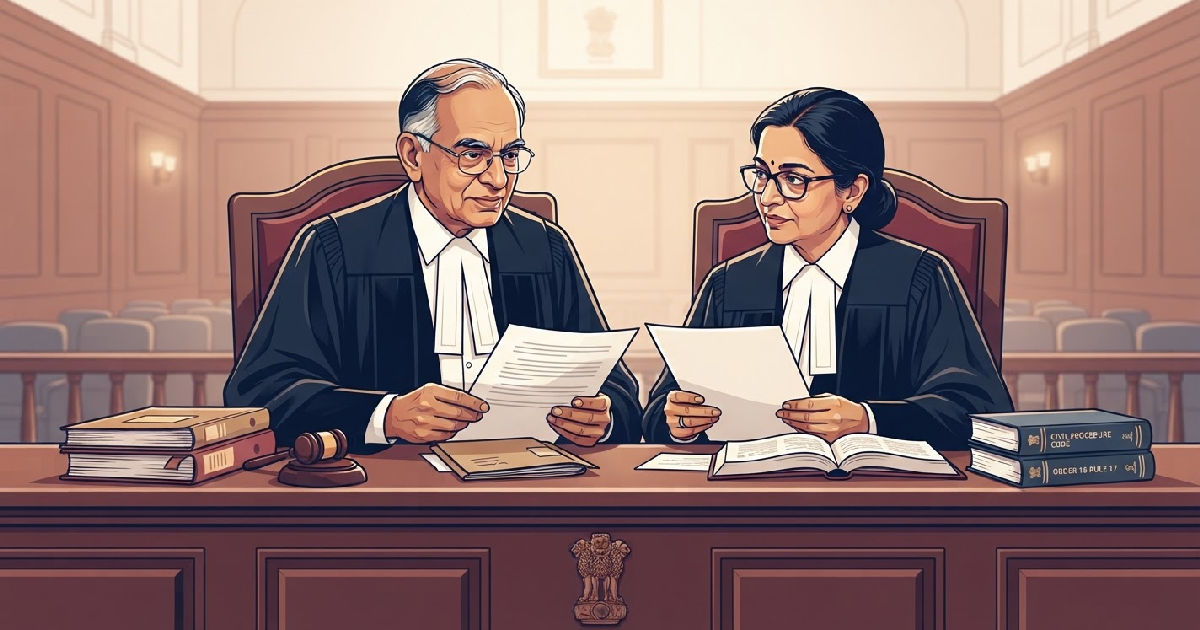
On Tuesday, August 4, 2026, the Supreme Court of India delivered a crucial clarification on the parameters for witness recall under Order XVIII Rule 17 of the Civil Procedure Code (CPC). In the case of K. Bharathamma v. Bandaru Sakku Bai and Others, Justices S.V.N. Bhatti and N.V.
Anjaria reiterated that this power is for the court’s own clarification, not for litigants to fill gaps in their evidence.
Supreme Court reiterates witness recall limitations
This ruling reinforces a similar stance taken on May 5, 2025, by Justices J.B. Pardiwala and R. Mahadevan in Shubhkaran Singh v. Abhayraj Singh & Ors. The decisions underscore the judiciary’s commitment to procedural integrity and timely justice, preventing the misuse of legal provisions to protract litigation.
The recent judgment in K. Bharathamma v. Bandaru Sakku Bai and Others has firmly established the Supreme Court’s position on witness recall. Justices Bhatti and Anjaria observed that the scope of Order XVIII Rule 17 CPC is specifically to enable the court to clarify doubts regarding evidence already led. It isn’t designed to allow parties to fill omissions in their adduced evidence.
In this particular case, the apex court set aside a High Court order. That order had allowed the re-opening of a witness’s evidence (PW-1) and the marking of documents, further directing the trial court to complete the process within ten days and cross-examination within one week. The Supreme Court found the High Court had exceeded its jurisdiction, reinforcing the strict application of the rule.
Distinguishing court’s needs from party’s convenience
Order XVIII Rule 17 CPC grants the court discretionary power to recall a witness. This means the power is primarily for the court’s benefit, allowing it to elicit answers and clarify doubts it may have about testimony. It’s not a right available to either party to conduct further examination-in-chief or cross-examination.
While a party can request a witness recall, the court controls the scope of questioning. This judicial oversight prevents litigants from using the provision as a strategic tool to improve their case or introduce new material late in the proceedings. The goal is to ensure genuine judicial necessity drives the recall, not merely a party’s desire to refine their presentation.
The consistent judicial approach to Order 18 Rule 17 CPC
The Supreme Court has consistently upheld a narrow interpretation of Order XVIII Rule 17 CPC. This consistency is evident in several key judgments preceding the *K. Bharathamma* decision. These rulings highlight a clear judicial policy aimed at streamlining civil proceedings and preventing delays.
One significant precedent is the ruling in Shubhkaran Singh v. Abhayraj Singh & Ors., delivered on May 5, 2025. Here, Justices J.B. Pardiwala and R. Mahadevan explicitly stated that only the court may question a recalled witness for clarification. Parties cannot recall or cross-examine a witness without the court’s express permission.
Background of the Shubhkaran Singh case
In the Shubhkaran Singh case, the petitioner had sought to recall witnesses for further examination, cross-examination, or re-examination. The trial court rejected this application, and the High Court of Madhya Pradesh at Jabalpur upheld that decision on January 7, 2025. A subsequent review petition was also dismissed on February 27, 2025.
The Supreme Court ultimately dismissed Shubhkaran Singh’s plea. This outcome further clarified that the power under Order XVIII Rule 17 CPC should be used sparingly and only in exceptional cases. It’s meant for removing ambiguities, not for filling lacunae in evidence.
Decoding Order XVIII Rule 17 CPC in civil litigation
Order XVIII Rule 17 of the Civil Procedure Code, 1908, explicitly states that “The Court may at any stage of a suit recall any witness who has been examined and may (subject to the law of evidence for the time being in force) put such questions to him as the Court thinks fit.” This provision is a critical aspect of procedural law in India.
Its primary purpose is to empower the court to clarify any issue or doubt it may have regarding evidence already led by a witness. This ensures judges have all necessary information to make informed decisions. It acts as a judicial safety net, allowing for clarification rather than being a tool for litigants to bolster their cases.
Limited scope and judicial discretion
The rule’s scope is intentionally limited. It isn’t meant for parties to conduct further examination-in-chief or cross-examination. It also doesn’t permit the adducing of additional material or evidence, nor is it for filling omissions, gaps, or lacunae in testimony. The provision should not allow a party to embellish, improve, or refine their evidence at a later stage.
This power is discretionary and should be exercised sparingly, reserved for exceptional cases. It’s not a routine exercise to be granted merely upon a party’s request. The absence of prejudice to the opposing party alone isn’t sufficient grounds for recalling a witness; there must be a genuine judicial necessity for clarification.
Key precedents shaping judicial interpretation
Several landmark judgments have consistently reinforced the limited nature of the Supreme Court’s witness recall power under Order XVIII Rule 17 CPC. These decisions form a clear jurisprudential path, guiding courts on the judicious application of this procedural tool.
In 2009, Vadiraj Naggappa Vernekar v. Sharadchandra Prabhakar Gogate clarified that the rule is for judicial clarification, not to fill evidentiary gaps. This ruling dismissed an appeal seeking to recall a witness to introduce additional facts omitted in an initial affidavit. It emphasized that courts shouldn’t permit parties to re-examine witnesses or plug holes in their cases.
The 2011 case of K.K. Velusamy v. N. Palanisamy further reinforced this stance. It clarified that while inherent powers under Section 151 CPC might allow reopening evidence, it must be for bona fide reasons. Any additional evidence must genuinely assist in rendering justice, not merely protract litigation.
Also, in Ram Rati v. Mange Ram (2016), the Supreme Court held that an application to recall a witness for “further elaboration on the left out points” was impermissible. The Court specifically stated that Rule 17 is for clarification, not to address omissions. These decisions set clear limits on revisional jurisdiction and powers.
Nuances in applying recall provisions
While strict, the application of Order XVIII Rule 17 CPC isn’t entirely rigid. The power is often read alongside Section 151 of the CPC, which deals with the inherent powers of the court. This allows courts to make orders necessary for the ends of justice, or to prevent abuse of process.
Section 151 can be invoked if circumstances genuinely warrant recalling a witness for examination, cross-examination, or re-examination by a party. This flexibility exists, but requires exceptional justification and clear judicial reasoning. The court also aligns its approach with Section 165 of the Indian Evidence Act.
When a liberal approach might apply: M/s. Levitate Mobile Technologies (2026)
Just weeks before the *K. Bharathamma* ruling, the Supreme Court showed a more liberal application of recall provisions in a commercial suit. On July 20, 2026, in M/s. Levitate Mobile Technologies Pvt. Ltd. v. M/s. Standard Chartered Bank, the Court allowed a witness (PW-1) to be recalled.
This decision permitted the placement of additional documents, specifically emails, on record for effective cross-examination. The Court noted the emails’ relevance and that the witness hadn’t been cross-examined on them previously. The application was allowed, but subject to a cost of Rs. 50,000 to the respondent, demonstrating a pragmatic balance in specific commercial contexts.
| Aspect of Witness Handling | Order XVIII Rule 17 CPC (Court’s Power) | General Practice (Party’s Role) | Not Permitted (Party’s Action) |
|---|---|---|---|
| Primary Purpose | Court clarification of doubts. | Adducing evidence, cross-examination. | Filling party’s omissions. |
| Initiation | Suo motu by court or party application. | Party initiated examination/cross. | Routine re-examination by parties. |
| Scope of Questioning | Limited to court’s questions for clarification. | Extensive direct, cross, and re-examination. | Adducing new material or embellishing evidence. |
| Discretion | High judicial discretion, used sparingly. | Controlled by procedural rules. | Automatic right for parties. |
Implications for civil litigation and procedural integrity
These consistent rulings from the Supreme Court carry significant implications for civil litigation strategy in India. They underscore the critical importance for legal practitioners to meticulously prepare and present all evidence during the initial phases of a trial. Relying on Order XVIII Rule 17 CPC as a fallback for a second chance is increasingly a high-risk strategy.
Lawyers must ensure all necessary questions are asked during direct and cross-examination, and that all relevant documents are presented promptly. This judicial stance actively promotes thoroughness from the outset, significantly reducing the likelihood of successful applications for witness recall. It requires careful planning rather than hoping for court-granted opportunities to correct errors.
Promoting judicial efficiency and preventing abuse
The Court’s firm stance reflects a broader judicial effort to prevent the abuse of legal processes and ensure speedy justice. Unfettered recall of witnesses would invariably lead to endless litigation, causing undue prejudice to opposing parties and undermining the principle of finality in judicial proceedings. This emphasis on efficiency is crucial for the Indian legal system, which often grapples with case backlogs.
The Court has consistently advocated for judicial discipline in applying such procedural rules. It ensures that while the interests of justice are served, parties are held accountable for their diligence in presenting their cases.
This approach cultivates a more robust and fair legal environment, discouraging frivolous or dilatory tactics where there is a delay in seeking relief. A challenge to an order might also fall under considerations of challenging a null decree, but that’s a different procedural pathway.
What is Order XVIII Rule 17 CPC?
Order XVIII Rule 17 of the Civil Procedure Code (CPC) is a provision empowering civil courts in India to recall a witness who has already given testimony. The primary purpose is to allow the court to ask questions for clarification regarding the evidence presented.
Can a party recall a witness under this rule?
While a party can apply to the court to recall a witness, the power to recall and examine them remains with the court. The rule is not intended to grant parties a right to conduct further examination-in-chief or cross-examination to fill gaps in their case.
Why does the Supreme Court limit witness recall?
The Supreme Court limits witness recall to prevent abuse of process, avoid undue delays in litigation, and ensure the finality of judicial proceedings. It encourages parties to present their full case diligently during initial stages, rather than seeking repeated opportunities for correction.