
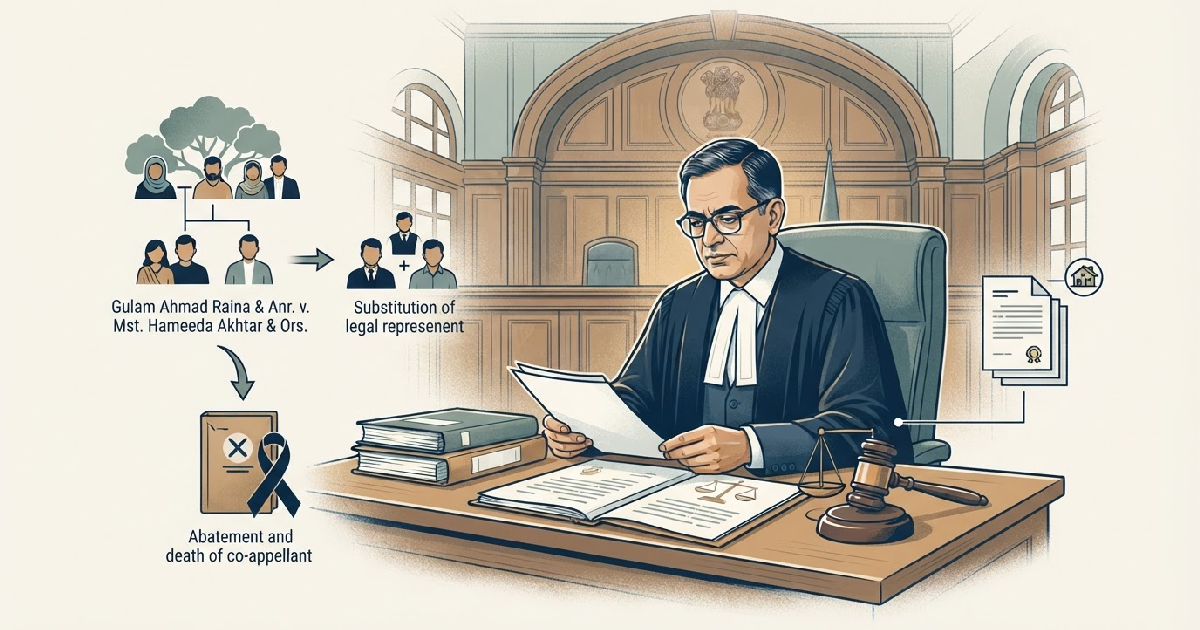
The Jammu Kashmir High Court ruled that an appeal abates if legal representatives of a deceased co-appellant aren’t brought on record within the prescribed period.
Justice Sanjay Dhar, presiding over the bench, clarified that Order 41 Rule 4 of the Code of Civil Procedure (CPC) applies only at the initial stage of filing an appeal.
High Court clarifies appeal abatement rules
It cannot be relied upon to continue an appeal after one of the joint appellants dies during its pendency. This judgment, in the case of Gulam Ahmad Raina & Anr. v. Mst. Hameeda Akhtar & Ors., reinforces the crucial role of Order 22 CPC, particularly when decrees are joint and inseverable.
The recent High Court decision directly addressed complex procedural questions arising from two connected Regular Second Appeals. These appeals originated from a long-standing property dispute where the appellants had claimed ownership and possession over ancestral land.
During the trial, the parties entered into a compromise. Commissioners were appointed to inspect, measure, and identify the properties. The trial court then passed a common decree, deciding the rights of the parties based on the Commissioners’ report and objections.
The property dispute’s origins
The appellants challenged this initial decree before the first appellate court, but both appeals were dismissed. They subsequently filed Regular Second Appeals before the High Court. It was during the pendency of these appeals that one of the two appellants unfortunately died.
The surviving appellant continued to prosecute the appeals, even getting them restored after an earlier dismissal for non-prosecution. However, applications filed by the deceased appellant’s legal representatives, seeking their substitution, were rejected.
Appeals and the appellant’s death
The principal issue before Justice Dhar was whether the surviving appellant could continue the appeals alone by invoking Order 41 Rule 4 CPC. This provision typically allows one of several aggrieved parties to appeal an entire decree if the grounds are common.
The surviving appellant argued that since both original appellants challenged the decree on identical grounds, he should proceed under Order 41 Rule 4 CPC. Respondents, however, contended the appeals had abated under Order 22 CPC because the deceased co-appellant’s legal representatives were not brought on record.
Order 41 Rule 4 CPC vs. Order 22 CPC: A critical distinction
Justice Dhar’s bench meticulously examined the objects and applicability of both Order 41 Rule 4 and Order 22 CPC. The Court emphasized that Order 41 Rule 4 is primarily designed for the initial stage of instituting an appeal.
It enables one among several plaintiffs or defendants, aggrieved by a decree on common grounds, to challenge the entire decree. This avoids multiple proceedings by allowing a single appeal to address a decree affecting all similarly situated parties.
Object of Order 41 Rule 4
However, the Court drew a crucial distinction between filing an appeal and events occurring after an appeal has already been instituted. Once all aggrieved parties have collectively joined an appeal, Order 41 Rule 4 exhausts its role, the bench observed.
Any subsequent death of a party is then governed exclusively by Order 22 CPC, which outlines the procedure for substituting legal representatives and the consequences of failing to do so. This clarification is vital for legal practitioners navigating such procedural nuances.
Why Order 41 Rule 4 doesn’t apply post-filing
Order 22 CPC comprehensively deals with the death of parties during the pendency of civil proceedings, including appeals. It mandates that legal representatives of a deceased party must be brought on record, particularly where the right to sue does not survive solely with the remaining parties.
The Court considered whether Order 41 Rule 4 could override these provisions. It concluded that it could not, reaffirming Rule 4 serves a limited purpose at the appeal’s inception. The subsequent death of one party shifts governance entirely to Order 22 CPC.
The mandate of Order 22 CPC
Justice Dhar stated, “once an appeal is filed by all the plaintiffs or all the defendants aggrieved by a decree, and one of the parties dies during the pendency of the appeal, the provisions of Rule 4 of Order 41 CPC would not come into play and the consequences of Order 22 CPC would follow.” This clearly demarcates the operational scope of each Order.
The bench also relied upon the Supreme Court’s decision in Sardar Amarjit Singh Kalra v. Pramod Gupta. This precedent reiterates that if a decree under challenge is joint and inseverable, allowing an appeal to continue after abatement against one appellant could lead to conflicting decrees. In such scenarios, the appeal cannot proceed solely at the instance of the surviving appellant.
Joint and inseverable decrees lead to full abatement
The High Court ultimately held that the decree in the present case was indeed joint and inseverable. Therefore, the surviving appellant could not continue the appeals after the legal representatives of the deceased appellant failed to come on record.
Consequently, the court dismissed the appeals, concluding they had abated. This outcome solidifies the procedural requirement for timely substitution in cases involving joint rights.
Supreme Court reinforces procedural diligence
The Jammu & Kashmir and Ladakh High Court’s ruling aligns with a consistent line of interpretation from the Supreme Court of India on the interplay between Order 41 Rule 4 and Order 22 CPC. This judicial consistency provides much-needed clarity for civil litigants and legal practitioners across the country.
Consistent rulings on abatement
For instance, in State of Punjab v. Nathu Ram (1962), the Supreme Court established that if a decree is “joint and indivisible,” the abatement of an appeal against one respondent due to non-substitution of legal representatives would lead to the abatement of the entire appeal. This prevents the possibility of contradictory judgments on the same matter.
Further reinforcing this, the Supreme Court in Smt. Gangawwa v. Smt. Ningawwa (1997) explicitly stated that Order 41 Rule 4 CPC does not save an appeal from abatement if one appellant dies and their legal representatives are not brought on record, especially when the decree is joint and indivisible.
More recently, on July 18, 2025, the Supreme Court, in Suresh Chandra (Dead) through LRs Vs Parasram, comprising Justices Manoj Mishra and P.N. Narsimha, reiterated this fundamental principle. They emphasized that if legal representatives of a deceased party in an appeal involving a joint and indivisible decree are not substituted in time, the entire appeal will abate.
Nullity of judgments and property title suits
The Court underscored that Order 41 Rule 4 CPC does not offer protection against abatement in joint appeals when one party dies without substitution. These judgments collectively highlight the judiciary’s commitment to preventing judicial inconsistencies and upholding procedural diligence.
The implications of failing to substitute legal heirs are severe, as further highlighted by recent Supreme Court pronouncements. On November 10, 2025, a bench of Justice P.S. Narasimha and Justice A.S. Chandurkar ruled that a judgment passed in favor of a person who had already died before the hearing has no legal validity and is considered a nullity.
This decision reinforces the absolute necessity of ensuring proper party representation at all stages of litigation. Just this month, on July 19, 2026, the Supreme Court dismissed civil appeals in a property title suit where the interests of co-owners were inseparable. The Court held that the appeal abated entirely due to the non-substitution of legal heirs of a deceased appellant.
It specifically stated that Order 41 Rule 4 CPC cannot be used to allow an appeal to proceed if it would lead to mutually contradictory decrees.
Similarly, on July 24, 2026, the Supreme Court again held that where defendants claim as co-owners with joint and indivisible rights from a common ancestor, the abatement of the appeal against one defendant results in the abatement of the entire appeal.
Navigating procedural lapses and seeking justice
This is because allowing the remaining appellants to succeed would create inconsistent decrees, and Order 41 Rule 4 CPC cannot be exercised to prevent such inconsistency. These rulings paint a clear picture of the judicial stance on abatement in joint property matters.
While the rules around abatement are stringent, the Supreme Court has also provided guidance on the procedural mechanisms for rectifying lapses. In Om Prakash Gupta Alias Lalloowa & Ors. v. Satish Chandra, delivered on February 11, 2025, Justice Dipankar Datta clarified the correct procedure for substituting legal heirs, setting aside abatement, and condoning delay in civil appeals.
Procedure for substitution and condonation
The Court emphasized that an application for substitution must be filed within 90 days of a party’s death. If delayed, an application to set aside abatement needs to be filed within the next 60 days, totaling 150 days. Should this 150-day window be missed, an additional application for condonation of delay under Section 5 of the Limitation Act becomes necessary.
This ruling also stressed the importance of a justice-oriented approach. Courts must not allow mere procedural lapses to defeat the merits of a case. If a valid explanation for delay is provided and no deliberate negligence is found, the delay should generally be condoned to ensure the appeal can proceed.
Furthermore, the Supreme Court clarified that any party, including the opposite party, can move an application for substitution, not just the plaintiff or appellant.
Exception for sufficient representation
However, an important exception was highlighted on January 12, 2026, when a Supreme Court bench comprising Justices Manoj Misra and Ujjal Bhuyan ruled that an appeal might not abate due to the mere non-substitution of one of the legal heirs if the deceased party’s interest is adequately represented by other legal heirs.
This pragmatic approach seeks to balance strict procedural compliance with the overarching goal of justice.
Practical implications for civil litigants
The recent J&K High Court ruling, supported by numerous Supreme Court precedents, provides a crucial reminder to litigants and legal practitioners. The distinction between the initial filing of an appeal and its subsequent pendency is not a mere technicality; it has profound consequences for the continuation of a case.
This emphasis on timely substitution under Order 22 CPC means that legal teams must be exceptionally diligent in tracking the status of all parties involved in an ongoing appeal, especially in joint cases. Failure to do so risks the entire appeal being dismissed, regardless of the merits of the original claim.
The judicial emphasis on preventing conflicting decrees in cases involving joint and inseverable rights will likely lead to even stricter scrutiny of substitution applications. This reinforces the need for proactive legal management, ensuring that the necessary steps are taken immediately upon the death of any party to avoid an unexpected and irreversible abatement.
Attorneys must proactively advise clients on the severe repercussions of non-compliance, particularly in complex property disputes or other matters where the rights of co-litigants are intertwined. This judgment serves as a wake-up call, reaffirming that procedural vigilance is as crucial as substantive legal argument in the appellate process.
Comparison of CPC procedural rules
Understanding the distinct roles of Order 41 Rule 4 and Order 22 CPC is fundamental for navigating civil appeals effectively. The table below summarizes their primary functions and the situations in which they apply.
| Procedural Aspect | Order 41 Rule 4 CPC | Order 22 CPC |
|---|---|---|
| Primary Purpose | Allows one party to appeal for all similarly aggrieved parties against an entire decree. | Manages the death, marriage, or insolvency of parties during legal proceedings. |
| Stage of Application | At the initial stage of filing an appeal. | During the pendency of a suit or appeal after its institution. |
| Key Requirement | Common grounds for challenging the decree among multiple parties. | Substitution of legal representatives of a deceased party within a prescribed period. |
| Consequence of Non-Compliance | Appeal may not be instituted on behalf of others if not all join. | Abatement of the suit or appeal against the deceased party; can abate entire appeal if decree is joint/inseverable. |
| Effect on Joint Appeals | Does not save an appeal from abatement if one party dies during pendency and LRs aren’t substituted. | Mandatory for maintaining the appeal’s validity after a party’s death, especially in joint decrees. |
What does it mean for an appeal to “abate”?
When an appeal abates, it essentially means the legal proceedings related to that specific appeal are terminated or brought to an end. This usually happens due to a procedural default, such as the failure to substitute the legal representatives of a deceased party within the time frame set by law.
Can Order 41 Rule 4 CPC prevent an appeal from abating after a co-appellant dies?
No, the Jammu & Kashmir and Ladakh High Court, consistent with Supreme Court rulings, has clarified that Order 41 Rule 4 CPC applies only when an appeal is initially filed. It cannot be used to save an appeal from abatement if one of the co-appellants dies during the appeal’s pendency and their legal representatives are not properly substituted under Order 22 CPC.
Why is it so important to substitute legal heirs in a timely manner?
Substituting legal heirs is critical because failure to do so can lead to the entire appeal being dismissed as abated, particularly if the original decree involved joint and inseverable rights. Timely substitution is essential for preventing conflicting judgments, ensuring all necessary parties are represented, and maintaining judicial integrity and finality.
It’s also vital for understanding legal principles like those allowing judgments based on clear admissions.