
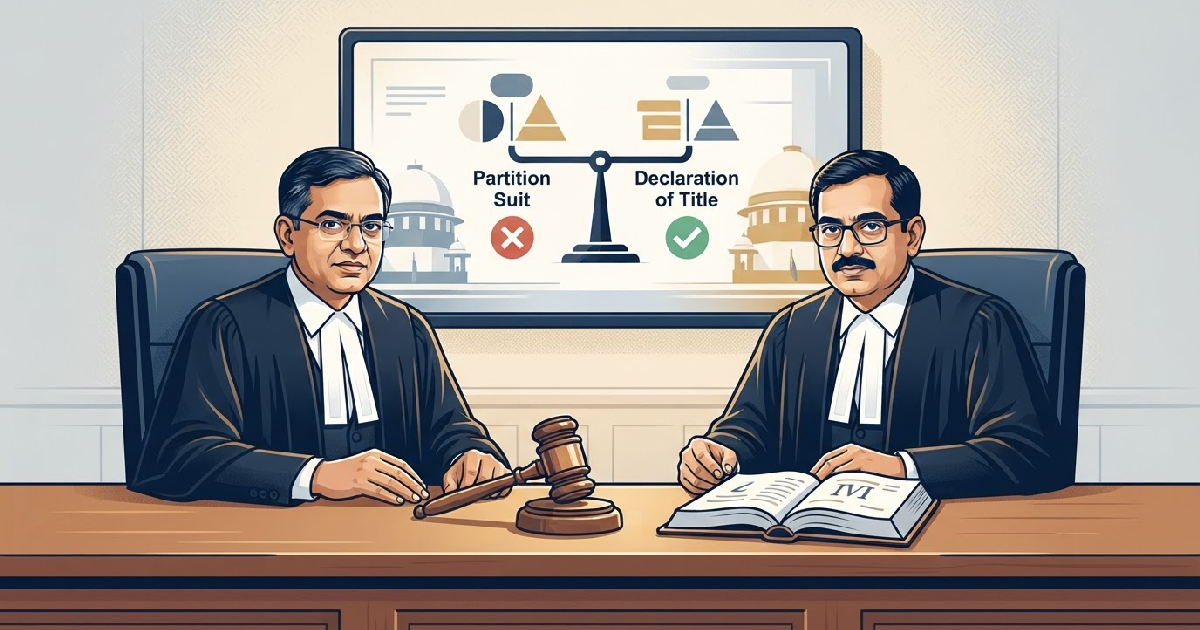
In a significant ruling delivered on July 29, 2026, the Supreme Court of India clarified the precise boundaries of judicial discretion under Order VII Rule 7 of the Code of Civil Procedure (CPC).
A Division Bench comprising Justice Sanjay Kumar and Justice Sanjeev Sachdeva held that while courts can grant a lesser or alternative relief, they cannot award a “totally different claim,” specifically declining partition in a suit primarily seeking a declaration of title.
Judicial Clarity on Distinct Claims in Civil Suits
This decision, stemming from the case of Maragadham v. Periyaraja (Neutral Citation: 2026 INSC 757), underscores the critical importance of distinct pleadings and causes of action in property disputes. The Court emphasized that relief like partition requires its own specific factual foundation and cannot be shoehorned into a suit originally framed for a different purpose.
The Supreme Court’s pronouncement is poised to bring greater precision to civil litigation, particularly in matters involving property rights. It reinforces a fundamental principle: plaintiffs must be clear and comprehensive in outlining their legal claims from the outset.
The ruling makes it clear that while courts possess powers to modify remedies, this power isn’t limitless. It doesn’t extend to allowing a litigant to pursue an entirely different case from what they initially pleaded, especially if that case demands a distinct set of facts and legal arguments.
The Maragadham v. Periyaraja dispute
The case originated with Maragadham, who had filed a suit seeking a declaration of title and recovery of possession for land in Mallapalli Village, Vellore District. Her claim rested on a registered gift deed dated December 13, 1990, executed in her favor by her grandfather, Kuttiyappa Goundar.
However, lower courts found that Kuttiyappa Goundar only held an undivided half share in the properties, not the entirety. This was because it had devolved to him and his daughter, Muniyammal, equally after his wife’s passing, under Section 15(1)(a) of the Hindu Succession Act, 1956.
Madras High Court’s earlier findings
Initially, a trial court decreed the suit in Maragadham’s favor, affirming her title. But the First Appellate Court reversed this, recognizing that the grandfather could not gift more than he owned. It ruled the gift deed void for the entire property, implying it was valid only for his undivided half share.
The Madras High Court subsequently dismissed Maragadham’s second appeal. It concurred with the First Appellate Court’s finding that the gift deed could only be valid for Kuttiyappa Goundar’s undivided half share. The Supreme Court later clarified that his undivided half share did not constitute ‘coparcenary property’.
Understanding Order VII Rule 7 CPC: Lesser vs. Different Relief
Order VII Rule 7 of the Code of Civil Procedure, 1908, is a crucial provision that governs the relief a plaintiff can seek and a court can grant. It stipulates that every plaint must specifically state the relief claimed, either simply or in the alternative.
Crucially, it also allows for “general or other relief” to be awarded by the court, “as the Court may think just to the same extent as if it had been asked for.” The interpretation of this “general or other relief” has been central to legal debates, defining the scope of judicial flexibility.
Scope of Court’s Discretion
The Supreme Court’s judgment draws a fine but critical line between a “lesser or alternative relief” and a “totally different claim.” A lesser relief is one that naturally flows from the facts already pleaded and proven.
For example, if a plaintiff claims a large parcel of land but can only prove title to a smaller portion, the court might grant title to the smaller portion. This is a proportional reduction of the original claim, not a change in its fundamental nature.
However, a claim for partition, as highlighted by the Supreme Court, demands a distinct factual foundation. It involves assessing shares, identifying all co-owners, and often a two-stage process of preliminary and final decrees. This isn’t merely a smaller version of a title declaration; it’s an entirely different type of legal action.
The Genesis of the Dispute: A Gift Deed and Undivided Shares
The core of the dispute in Maragadham v. Periyaraja revolved around a family property in Mallapalli Village, Vellore District. Maragadham’s grandfather, Kuttiyappa Goundar, had executed a gift deed transferring the entire property to her.
The legal complication arose because Kuttiyappa Goundar did not, in fact, own the entire property. Upon his wife Muniyammal’s death, her properties had devolved equally to him and their daughter under Section 15(1)(a) of the Hindu Succession Act, 1956. This meant he only had an undivided half share.
Lower Court Findings and Appeals
Initially, a trial court decreed the suit in Maragadham’s favor, affirming her title. But the First Appellate Court reversed this, recognizing that the grandfather could not gift more than he owned. It ruled the gift deed void for the entire extent of the properties, leaving it open for the grandfather to claim his rights over his half share through a separate suit.
The Madras High Court subsequently dismissed Maragadham’s second appeal. It concurred with the First Appellate Court’s finding that Kuttiyappa Goundar could not have gifted even his half share without the co-sharer’s concurrence. The Supreme Court later noted that Kuttiyappa Goundar’s undivided half share did not constitute ‘coparcenary property’.
Divergence: Title Suits vs. Partition Suits
The Supreme Court’s decision highlights the fundamental differences between a suit for declaration of title and a suit for partition. These are not interchangeable, and each requires specific legal and factual arguments.
A title suit primarily aims to establish ownership rights over a property, confirming who legally owns it. In contrast, a partition suit seeks to divide jointly owned property among co-owners, creating separate, identifiable portions for each.
Why Pleadings Matter in Property Law
The need for precise pleadings cannot be overstated, especially in property law. A partition suit, for instance, requires all co-sharers to be identified and included as parties. It also mandates that all joint properties be brought into the ambit of the suit to ensure a fair and complete division.
Proving one’s title or interest is a prerequisite for a partition decree, which often unfolds in two stages: a preliminary decree determining shares, followed by a final decree physically dividing the property. These complexities necessitate specific and separate pleading.
This emphasis is consistent with past rulings that relief should not be granted on grounds not explicitly raised, as this would cause prejudice to the opposing party.
Here’s a comparative overview of key differences:
| Feature | Title Suit (Declaration of Title) | Partition Suit |
|---|---|---|
| Primary Objective | Establish legal ownership and rights to property. | Divide jointly owned property among co-owners. |
| Cause of Action | Dispute over who rightfully owns the property. | Desire to separate shares from common property. |
| Parties Involved | Plaintiff and defendants claiming rival titles or denying plaintiff’s title. | All co-owners must be joined as parties. |
Precedent and the Limits of Unpleaded Relief
The Supreme Court’s ruling isn’t an isolated event; it builds upon a long line of jurisprudence emphasizing the importance of pleadings in civil law. The principle that relief should align with pleaded facts is deeply embedded in India’s legal system, aiming to prevent prejudice and surprise.
Several precedents support this. In Union of India v. Dinesh Prasad, the Supreme Court previously held that no relief can be granted on grounds not explicitly raised in the writ petition. Similarly, in Akella Lalitha v. Konda Hanumantha Rao, it reaffirmed that relief not founded on pleadings deprives the respondent of an opportunity to oppose such claims.
The 1951 case of Firm Sriniwas Ram Kumar v. Mahabir Prasad and Ors. established that a court cannot grant relief to a plaintiff without a foundation in the pleadings. More recently, a 2025 Supreme Court ruling in S. Santhana Lakshmi v. Munuswamy emphasized that merely proving ownership is insufficient if the plaintiff isn’t in possession; recovery must be sought.
This consistent judicial stance ensures that civil trials proceed with clarity and fairness, requiring parties to present their full case from the outset. It highlights that while courts can mold reliefs, they won’t construct an “altogether different case” for a litigant, as Justice Sanjeev Sachdeva and Justice Sanjay Kumar reiterated.
Ramifications for Property Litigation in India
This judgment serves as a clear directive for litigants and their legal counsel: be meticulous when drafting plaints. Any relief sought must be explicitly stated or be a natural, lesser offshoot of the primary claim, directly supported by the pleaded facts.
Property owners involved in disputes must carefully assess whether their primary objective is to establish ownership or to divide co-owned property. Combining fundamentally different claims without proper pleading will likely result in the rejection of the unpleaded relief.
The Mandate for Precision in Pleadings
Legal practitioners are now more firmly guided towards ensuring that their clients’ initial filings comprehensively address all potential claims and causes of action. This might involve carefully structured pleadings that seek alternative reliefs or, where claims are distinct, potentially separate legal actions.
The Supreme Court did leave an avenue open for Maragadham; she can still pursue a separate partition suit before a competent court. This indicates that while judicial efficiency and procedural clarity are paramount, access to justice for legitimate claims remains protected, provided the correct legal channels are followed.
Moreover, the ruling could potentially streamline the litigation process by discouraging attempts to introduce fundamentally new claims late in the proceedings. This clarity helps prevent delays and ensures that parties are not caught off guard by unpleaded demands.
The ruling also builds on previous decisions, such as the 2026 ruling in Venkatesha and Anr. v. K.M. Venkatamuniyappa, which stated that a plaintiff must succeed on their own case, not on the defense’s weakness.
Future Pathways for Litigants
The Court’s decision provides clear guidance, but also offers a path forward for those whose claims might not perfectly align with their initial pleadings. While the door for a partition decree within Maragadham’s original title suit is closed, the option to initiate a fresh, properly framed suit remains open.
This emphasizes that procedural requirements, while strict, are not insurmountable barriers to justice. They simply dictate the correct legal channels to navigate. The ultimate goal is to ensure all parties have a fair opportunity to present and defend against claims, fostering a transparent legal process.
The Supreme Court has consistently upheld the principle that relief cannot be granted beyond the scope of the original petition, ensuring that legal proceedings remain focused and predictable. This latest pronouncement further solidifies this approach, serving as a reminder to meticulously prepare all legal submissions. Another relevant decision is that a decree that is a nullity can be challenged at any stage.
What is Order VII Rule 7 CPC?
Order VII Rule 7 of the Code of Civil Procedure mandates that every legal complaint, or plaint, must clearly state the relief the plaintiff is seeking. It also grants courts the power to award “general or other relief” that is just and proper, even if not explicitly requested, provided it aligns with the facts presented and proven.
Why did the Supreme Court decline to grant partition in this case?
The Supreme Court declined partition because the original suit was for a declaration of title, and partition is considered a “totally different claim” with a distinct cause of action. While Order VII Rule 7 CPC allows for lesser reliefs, it does not permit awarding a fundamentally different claim that requires separate pleadings and factual grounds.
Can the plaintiff still pursue partition for the property?
Yes, the plaintiff, Maragadham, can still pursue partition. The Supreme Court explicitly stated that she is at liberty to initiate separate legal proceedings before a competent forum to seek the partition of the properties by metes and bounds, adhering to the specific procedural requirements for such a suit.