
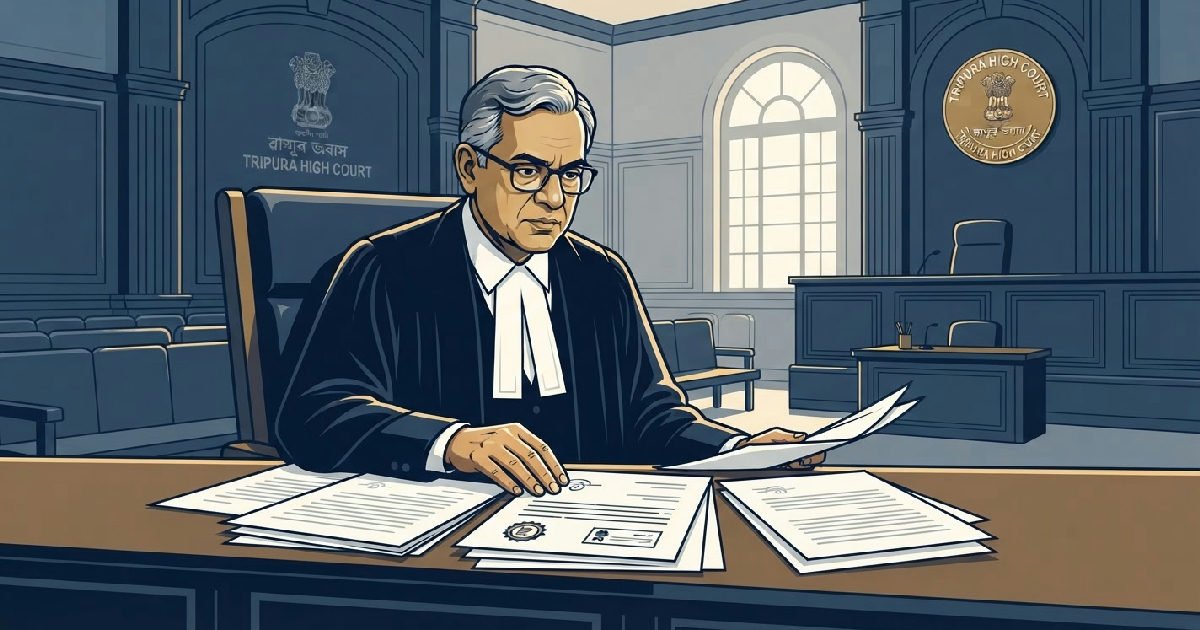
A Section 138 NI Act demand notice does not require transmission through an advocate, according to the Tripura High Court’s April 25, 2019 ruling.
This decision, delivered by Justice Arindam Lodh, asserts that the payee or holder of a dishonoured cheque can directly issue the requisite demand notice. The ruling, which emerged from the case of Subal Chandra Ghosh v. The State of Tripura, addresses a long-standing procedural question within India’s cheque dishonour laws.
Tripura High Court’s clarification on demand notice under Section 138 NI Act
It effectively removes a perceived barrier, potentially streamlining the initial stages of legal recourse for many individuals and businesses across the region. This clarification emphasizes the substance of the demand notice over the formality of its sender. It represents a key development in how courts interpret the procedural requirements for initiating criminal proceedings in cheque bounce cases.
The core of the Tripura High Court’s judgment centered on interpreting the precise wording of Section 138 of the Negotiable Instruments Act. Justice Arindam Lodh unequivocally stated that the statute does not explicitly require an advocate to dispatch the demand notice. This clears up any ambiguity regarding procedural steps.
The court emphasized that Proviso-B of Section 138 uses “plain and simple” language. It only specifies that “it is the payee or the holder who will make the demand in writing,” without any additional prerequisites concerning the sender’s professional status. This literal interpretation underpins the entire ruling and its broad implications.
Revisiting prior Supreme Court precedents
Petitioners in the Subal Chandra Ghosh case had argued that a demand notice without an advocate’s endorsement was invalid. They relied on previous Supreme Court judgments like Suman Seth v. Ajay K. Churiwal and Rahul Builders v. Arihant Fertilizers & Chemicals. However, Justice Lodh clarified these precedents during his judgment.
The court pointed out that neither of those Supreme Court rulings mandated advocate involvement in sending the notice. Instead, they primarily focused on ensuring the demand notice strictly adheres to the essential ingredients of Section 138. These ingredients include specifying the cheque amount, costs, and interest, as required by law.
Understanding India’s cheque dishonour laws
The Negotiable Instruments Act, 1881, forms the foundational legal framework for instruments like cheques, promissory notes, and bills of exchange in India. Section 138 was specifically introduced in 1988 through an amendment to address the rising problem of dishonoured cheques. Its purpose was to bolster confidence in cheque-based transactions.
Before this pivotal amendment, a bounced cheque usually resulted only in civil liability. This often proved insufficient to deter misuse and fraud effectively. The 1988 changes aimed to establish a more robust legal mechanism, ensuring greater accountability for cheque issuers and protecting financial integrity.
The criminal nature of cheque bounce cases
Dishonour of a cheque under Section 138 is classified as a criminal offence, reflecting its seriousness in the Indian legal system. It can lead to imprisonment for up to two years, a fine up to twice the cheque amount, or both penalties. However, it’s important to note that it remains a bailable, compoundable, and non-cognizable offence, which often raises questions regarding anticipatory bail conditions.
This criminal designation serves as a significant deterrent against issuing cheques without sufficient funds. The law aims to protect the integrity of financial transactions. It provides a more effective recourse for payees compared to the previous civil remedies alone.
Mandatory conditions for legal action
Initiating legal action under Section 138 demands strict adherence to several statutory conditions. First, the cheque must have been issued to discharge a legally enforceable debt or liability. This establishes the legitimacy of the financial obligation.
Next, the payee must present the cheque to their bank within its period of validity, which is three months from the date of issue or until its expiry, whichever is earlier. The bank must then return the cheque unpaid, citing reasons such as insufficient funds or a signature mismatch. This official dishonour is a critical trigger for further action.
After receiving the bank’s return memo, the payee must issue a legal demand notice to the drawer within 30 days. The drawer then gets a 15-day window from receipt of this notice to make the outstanding payment. Only if payment isn’t made within this period can a criminal complaint be filed.
This complaint must be lodged within one month after the cause of action arises, which is after the expiry of the 15-day notice period. Missing any of these steps can invalidate the entire legal proceeding. Such strict procedural requirements underscore the importance of accurate legal processing for all parties involved.
| Procedural Step | Timeline | Critical Requirement |
|---|---|---|
| Cheque Presentment | Within three months of issue or expiry | Legal debt/liability |
| Notice to Drawer | 30 days (from bank memo) | Demand cheque amount |
| Drawer Payment Window | 15 days (from notice receipt) | Full payment to avoid complaint |
| Complaint Filing | One month (from payment window expiry) | Timely legal action |
| Penalty Imprisonment | Up to two years | Based on court discretion |
Impact and accessibility for complainants
The Tripura High Court’s ruling holds significant implications for the accessibility of justice in cheque dishonour cases. By affirming that an advocate’s involvement isn’t mandatory for sending the initial demand notice, the court has lowered a procedural barrier. This could empower more individuals and small businesses to pursue their claims.
It means complainants might not need to immediately incur legal fees for sending the demand notice, potentially reducing initial costs. This shift focuses on the substance of the demand rather than the formal channel of its delivery. This aligns with broader goals of simplifying legal processes and enhancing efficiency.
Potential pitfalls and need for expert advice
While the ruling makes the process more accessible, legal experts still often advise consulting an advocate for drafting and sending demand notices. Self-drafted notices frequently contain critical errors that can invalidate the entire legal case. Common mistakes include misstating the cheque amount, using incorrect dishonour dates, or demanding sums that differ from the exact cheque value.
The law insists on strict compliance for a demand notice to be valid. For example, demanding interest alongside the principal amount without clearly separating them can lead to dismissal of the case. A legally sound notice is crucial for a successful prosecution under Section 138, ensuring all requirements are met.
Recent developments in NI Act jurisprudence
The legal landscape surrounding the Negotiable Instruments Act continues to evolve with rulings from various courts. While the Tripura High Court clarified who can send a demand notice, other significant judgments have focused on its content and service. These developments highlight the ongoing judicial effort to refine procedural fairness and efficiency.
For instance, the Supreme Court, on September 19, 2025, in Kaveri Plastics v. Mahdoom Bawa Bahrudeen Noorul, reaffirmed a critical aspect: the demand notice must demand precisely the cheque amount. Even a minor discrepancy or “typographical error” in the demanded sum can invalidate the notice, rendering the complaint non-maintainable.
This underscores the need for meticulous accuracy and highlights why issues like material alteration by cheque drawer are triable issues.
Streamlining cheque dishonour prosecutions
Recognizing the massive backlog of cheque bounce cases, the Supreme Court has actively sought to streamline prosecutions under Section 138. In Sanjabij Tari v. Kishore S. Borcar & Anr. on September 25, 2025, the court issued comprehensive directions. These guidelines aimed to accelerate case disposal and improve judicial efficiency across India’s legal system.
The directions clarified that pre-cognizance summons are unnecessary. They also promoted operational reforms, including dasti (personal) and e-service of notices, and introduced QR/UPI-enabled payments for penalties. Furthermore, standardized complaint synopses and recalibrated compounding guidelines were advised, all designed to expedite the legal process and reduce burdens.
Defending financial capacity and notice service
Recent rulings have also clarified aspects of defense strategy and notice service. On August 5, 2026, the Supreme Court held that an accused’s defense regarding a complainant’s financial incapacity must be explicitly raised in the reply to the statutory demand notice. Failure to do so implies merit in the complainant’s version and reduces their burden of proof later in proceedings.
Proper service of the demand notice remains paramount. A Tripura High Court ruling on June 28, 2026, in Sonatan Murasingh, highlighted this. It found that serving a demand notice on a family member of the accused was not valid compliance with Section 138, leading to the accused’s acquittal.
This emphasizes the critical importance of ensuring the notice reaches the correct party directly. This specific instance also involved the complainant failing to prove their financial capacity to advance the alleged loan.
Future outlook for NI Act cases
The ongoing judicial efforts, from the Tripura High Court’s clarification to the Supreme Court’s streamlining guidelines, collectively aim to make justice more efficient. They also seek to ensure fairness within the realm of cheque dishonour cases. These developments are crucial for bolstering trust in financial instruments.
There have also been continuous debates regarding the potential decriminalization of certain Section 138 offences. This is partly due to the heavy burden these cases place on the Indian judiciary.
Amendments like Section 143A and Section 148, introduced in 2018, allowing interim compensation and requiring deposits for appeals, show a commitment to balancing payee relief with procedural improvements. The evolving legal landscape strives for a system that is both accessible and robust, continually adapting to commercial realities.
It’s a dynamic area of law, requiring careful consideration of each new ruling to understand its full implications, including those on director liability for cheque dishonour.
What is Section 138 of the Negotiable Instruments Act?
Section 138 of the Negotiable Instruments Act, 1881, addresses the criminal offense of cheque dishonour. It outlines the legal process and potential penalties when a cheque, issued for a legally enforceable debt or liability, is returned unpaid by the bank.
Does a demand notice under Section 138 NI Act require an advocate’s signature?
No, the Tripura High Court clarified on April 25, 2019, that a demand notice under Section 138 of the Negotiable Instruments Act does not need to be sent through an advocate. The payee or cheque holder can issue it directly.
What happens if a demand notice is not served correctly?
Incorrect service of a demand notice can invalidate the entire legal proceeding under Section 138 NI Act. Recent rulings emphasize that proper delivery to the accused is essential; service on a family member, for example, may not be deemed valid, potentially leading to acquittal.