
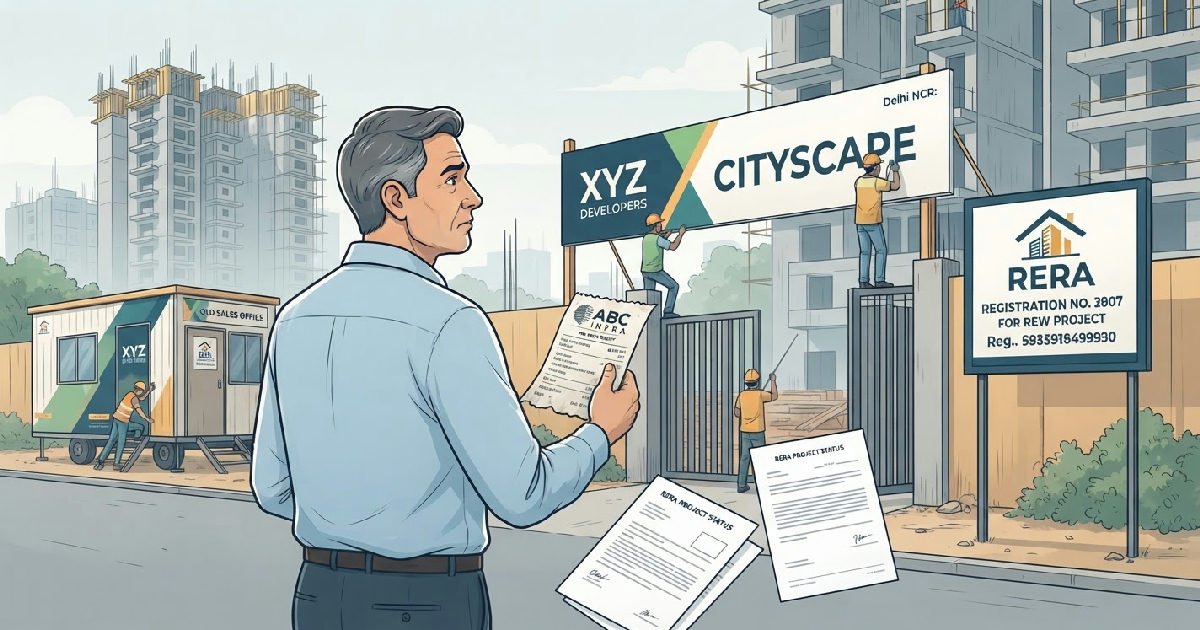
Homebuyers in Delhi NCR often face uncertainty when a real estate project undergoes a RERA promoter change, with a new developer taking over. This scenario, where a different brand might appear on the site while old receipts still bear the former company’s name, raises critical questions about accountability.
Fortunately, the Real Estate (Regulation and Development) Act, 2016 (RERA) provides clear mechanisms for addressing a RERA promoter change, ensuring that allottee rights remain protected.
Project taken over by another Promoter : A step forward
The Act mandates specific procedures for such transitions, safeguarding buyers from potential abandonment or delays. It clarifies exactly who is responsible for completing the project and fulfilling promises, even when the original developer exits the scene. Understanding these provisions is vital for any homebuyer looking to secure their investment.
The Real Estate (Regulation and Development) Act, 2016 (RERA) was enacted to bring much-needed transparency and accountability to India’s real estate sector. The Act officially came into force on May 1, 2016, with state governments subsequently tasked with framing their own specific rules under this central legislation. RERA aims to protect homebuyer interests, encourage investment, and bring transparency and equity to the real estate sector.
RERA registration is a fundamental requirement for most residential projects, specifically those exceeding 500 square meters or comprising more than eight apartments. This mandatory registration applies to both existing and new developments.
The Act’s broad scope ensures that developers, whether original or new, operate under a stringent regulatory framework, protecting consumers from opaque practices and project mismanagement. For projects not registered under RERA, buyers still have avenues for redressal, though the process might differ.
Navigating a RERA Promoter Change in Delhi NCR
One of RERA’s most crucial provisions addresses the transfer of project rights and liabilities from one promoter to another. Section 15 of the Act strictly regulates such transitions, making it impossible for a developer to simply walk away from their obligations. This section is particularly important for homebuyers in regions like Delhi NCR, where large-scale projects can see frequent corporate restructuring or sales.
A promoter cannot transfer or assign the majority rights and liabilities of a real estate project to a third party without meeting specific, rigorous conditions. This ensures that the continuity of development and the protection of buyer interests remain paramount throughout the process. Such regulations provide a vital safety net for those who’ve invested their savings in a project.
The Transfer Process and Allottee Consent
For any significant transfer of a project’s rights, the original promoter must first secure prior written consent from at least two-thirds of the allottees. Crucially, this calculation excludes the promoter themselves, ensuring that genuine homebuyer consensus is achieved. This step is a cornerstone of RERA’s protection, preventing unilateral decisions that could negatively impact buyers.
Following allottee approval, the transferring promoter must also obtain prior written approval from the respective State RERA Authority. This dual approval mechanism ensures both buyer endorsement and regulatory oversight. The transfer or assignment, however, does not extend the time for project completion; the new promoter must still adhere to the original timelines set for the project, preventing further delays.
New Promoter’s Assumed Obligations
When a new promoter takes over a project, they aren’t inheriting a blank slate. The intending (new) promoter is legally bound to comply with all pending obligations of the erstwhile (old) promoter. This includes adhering to the agreement for sale with allottees, encompassing all promised specifications, amenities, and delivery schedules.
State RERA Authorities, such as MahaRERA, have issued detailed circulars outlining the exact procedures for such changes. These often require declarations from the existing promoter, confirming no pending legal cases, no bars from financial institutions, or prohibitory court orders.
The new promoter must also submit an undertaking to the RERA Authority, guaranteeing compliance with all existing agreements, solidifying their commitment to the project and its buyers.
Identifying Liable Parties: Who to Sue in RERA
When faced with a RERA promoter change, a common question among homebuyers is who exactly to name in a complaint. RERA is designed to ensure accountability, and its broad definition of “promoter” helps clarify this. The Act aims to prevent developers from evading responsibility by transferring projects or changing corporate structures.
Regardless of the new signage on the gate or changes in company branding, the law ensures a clear line of liability. This is particularly relevant in the dynamic Delhi NCR real estate market, where developers and project names can shift. The regulatory framework provides a pathway for homebuyers to continue their claims effectively.
Naming the Promoters in a Complaint
Homebuyers should typically file a complaint against the entity named in the project’s RERA registration and the original agreement for sale. But if a new promoter has demonstrably stepped into the project, they should also be added as a party to the complaint. Evidence, such as a new brand on the gate or a letterhead on a hoarding, can help identify this new entity.
The RERA Act holds all promoters jointly liable, meaning both the old and new entities can be pursued for redressal. This joint liability is a critical protective measure for homebuyers. Retaining old receipts, any assignment or takeover letter, and a fresh RERA printout of project details are crucial documents to support your claim. This approach ensures all responsible parties are brought to account.
Joint Liability and Contractual Privity
RERA defines “promoter” broadly, encompassing virtually everyone associated with a building’s construction. This expansive definition ensures that co-promoters also share joint liability under RERA, overriding any contradictory contractual stipulations. This means no developer can use complex corporate arrangements to escape their obligations to homebuyers.
A promoter, even one who hasn’t directly received consideration from an allottee, can still be held liable for refunds with interest under Section 18 of RERA. The absence of a direct contractual relationship, or “privity of contract,” is irrelevant for fulfilling obligations and duties under the Act.
This provision reinforces homebuyer protection, ensuring claims can proceed regardless of specific payment flows. If you are struggling with claiming delay interest, understanding this joint liability can be very helpful.
The Process of Filing a RERA Complaint in Delhi NCR
For an aggrieved person, whether a homebuyer, promoter, or real estate agent, filing a complaint under Section 31 of RERA is a structured process. This can be done with the RERA Authority or an adjudicating officer. Delhi RERA has specific forms and procedures that complainants must follow, ensuring that every claim is properly documented and investigated.
Understanding these procedural nuances is crucial for a successful complaint, particularly within the fast-paced real estate environment of the Delhi National Capital Region. This robust framework for filing a RERA complaint aims to resolve disputes efficiently.
Essential Documentation for Your Claim
To support a RERA complaint, homebuyers must diligently gather and retain several key documents. These include all old payment receipts, any assignment or takeover letter related to the promoter change, and a fresh RERA printout of the project details. These documents collectively establish the history of the transaction and the current status of the project under RERA.
Further vital documents are the original allotment letter, the builder-buyer agreement, and all payment receipts. Any correspondence with the builder, whether emails or WhatsApp messages, along with project brochures and advertisements, also serves as crucial evidence. These materials paint a comprehensive picture of the commitments made and any deviations from them.
Delhi RERA: Specifics for Filing Complaints
In Delhi, complaints can be filed via the Delhi RERA Authority portal. Form M is used for violations of the Act or its rules, while Form N is for claims of loss or damage due to false information, structural defects, or delays, filed with the RERA Adjudicating Officer. Appeals against Authority or Adjudicating Officer orders go to the RERA Tribunal via Form L.
The process generally involves creating a login ID, filling out necessary information, uploading all relevant documents, and paying a prescribed fee, typically Rs. 1,000 in Delhi. RERA authorities then investigate, call for documents, and hear both sides before issuing an order. Complaints are usually disposed of within 60 days, offering a relatively swift resolution.
Homebuyer Rights and Assurances Under RERA
RERA enshrines several fundamental rights for allottees, providing a strong legal foundation for homebuyers. These rights remain active even in the event of a promoter change, ensuring continuity of protection. The Act’s emphasis on transparency empowers buyers with necessary information and recourse.
From obtaining crucial project details to claiming possession, RERA ensures that buyers are not left in the dark or at the mercy of developers. These provisions are particularly critical in high-growth regions like Delhi NCR, where market dynamics can sometimes lead to disputes or project stagnation.
Critical Rights Retained by Allottees
Allottees possess the right to obtain comprehensive information regarding sanctioned plans, layout plans, and specifications for their project. They are also entitled to know the stage-wise time schedule for project completion, ensuring full transparency throughout the construction phase. This prevents developers from making arbitrary changes or obscuring timelines.
Beyond information, buyers have the right to claim possession of their property and access common areas as outlined in the agreement. If the promoter fails to comply with the agreement or delays possession, allottees can claim a full refund of the amount paid, along with interest and compensation. This provides a robust financial safeguard against builder non-performance.
Post-Possession Protections
RERA’s protection extends even after possession. If structural defects or quality issues emerge within five years of the property’s possession, the builder is legally obligated to rectify these problems. This rectification must occur within 30 days and at no additional cost to the homebuyer.
This critical provision offers long-term peace of mind, ensuring the quality and structural integrity of the home. Moreover, regional RERA bodies, including Haryana RERA (HRERA) and Uttar Pradesh RERA (UP RERA), implement similar robust provisions across the NCR, solidifying buyer protection regardless of specific state jurisdiction.
UP RERA has even clarified that no new sale agreement is needed for transfers, with endorsements on existing agreements suffices.
Enforcement and Penalties for RERA Violations
RERA is not merely a set of guidelines; it carries significant punitive power to ensure compliance. If a promoter contravenes Section 15 of the Act—specifically regarding the transfer of project rights without proper consent and approval—the RERA Authority can impose substantial penalties. This enforcement mechanism underscores the seriousness with which RERA treats developer obligations.
The penalties are designed to be a strong deterrent against non-compliance. RERA orders are legally enforceable, providing a clear path for homebuyers to seek justice and recovery when developers fail to meet their commitments. This regulatory teeth is vital for maintaining order and trust in the residential property market.
Financial Consequences for Non-Compliance
A promoter found in contravention of Section 15 can face a penalty of up to 5% of the estimated cost of the real estate project. This significant financial consequence serves as a powerful incentive for developers to adhere strictly to the rules governing promoter changes. It ensures that cutting corners on regulatory procedures comes with a hefty price tag.
Beyond penalties, RERA orders are fully enforceable, and recovery proceedings can be initiated against non-compliant parties. This means that if an order for a refund or compensation is issued, the Authority can take steps to ensure the funds are recovered from the defaulting promoter. This robust enforcement ensures that justice is not just theoretical but deliverable.
The table below summarises the distinct and overlapping obligations between original and new promoters under RERA, particularly when a project undergoes a change in leadership:
Refunds and CompensationLiable for refunds if project fails or delaysLiable for refunds and compensation as per agreement and RERA provisions
| Aspect | Original Promoter Obligations (Pre-Transfer) | New Promoter Obligations (Post-Transfer) |
|---|---|---|
| Project Obligations | Complete construction, adhere to timelines, fulfill all agreements | Assume all pending obligations of erstwhile promoter, adhere to original timelines |
| Allottee Consent | Not applicable for original; required for transfer of majority rights | Not applicable for new; must ensure previous consent was obtained |
| RERA Approval | Not applicable for original; required for transfer of majority rights | Must obtain RERA approval for transfer and submit undertaking |
| Liability for Defaults | Primarily liable for pre-transfer defaults | Jointly liable for all project obligations, including previous defaults |
What triggers a RERA promoter change?
A RERA promoter change is typically triggered when the original developer decides to transfer the majority rights and liabilities of a real estate project to another entity. This could be due to various reasons, such as financial difficulties, strategic business decisions, or project restructuring.
Crucially, RERA requires prior consent from two-thirds of the allottees and approval from the State RERA Authority for such a transfer to be legally valid.
How does joint liability protect homebuyers?
Joint liability under RERA significantly protects homebuyers by holding both the original and the new promoters equally responsible for fulfilling project obligations. This means that even if the project changes hands, the financial and legal responsibilities towards the allottees do not diminish. Homebuyers can pursue claims against either or both entities, ensuring a robust safety net against project abandonment or non-compliance.
What documents are crucial when complaining about a promoter change?
When filing a complaint regarding a promoter change, several documents are crucial. These include all old payment receipts, any assignment or takeover letters, and a fresh RERA printout of the project details. You’ll also need your allotment letter, the builder-buyer agreement, and all correspondence with the builder, including emails and advertisements. These documents are vital for substantiating your claim.
New builder on a delayed NCR booking? Call or Whatsapp for free consultation.