
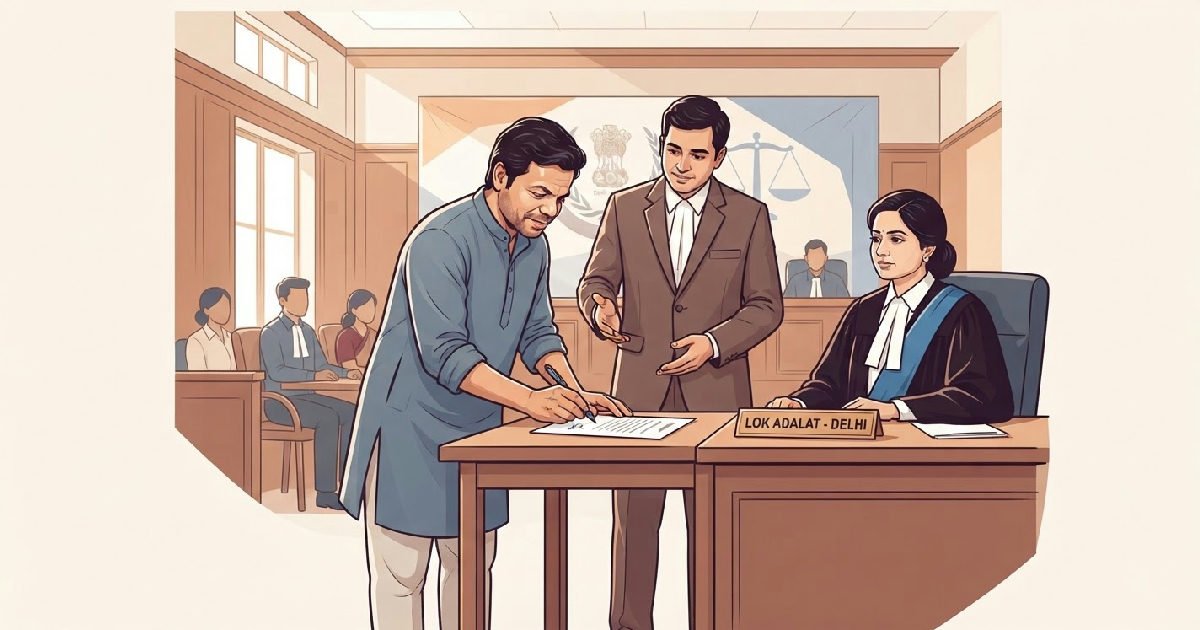
Special Lok Adalats across India, including those organised by the Delhi State Legal Services Authority (DSLSA), successfully resolved thousands of cheque bounce cases on July 18, 2026.
These alternative dispute resolution forums, operating under instructions from the National Legal Services Authority (NALSA), offer a legitimate and legally binding path to settle disputes arising from Section 138 of the Negotiable Instruments Act, 1881.
Crucially, an award issued by a Lok Adalat serves as a decree of a civil court. It is final and binding on all parties, meaning no appeal is generally permissible against it. Parties involved must understand the specific requirements for a valid award to ensure their settlement is legally sound and prevents future disputes.
Cheque Bounce Case Settled in Lok Adalat
Lok Adalats provide a vital mechanism for resolving cases filed under Section 138, which deals with the dishonour of cheques. These forums facilitate mutually agreed compromises between complainants and accused individuals.
The offences falling under the Negotiable Instruments Act are classified as compoundable under Section 147 of the Act. This allows for an out-of-court settlement with the consent of the complainant, often leading to a quicker resolution than traditional court proceedings.
However, the process is voluntary; Lok Adalats cannot compel either party to settle a matter. If a compromise isn’t reached, the case simply returns to the court from which it was referred, and legal proceedings continue as usual.
The efficacy of these special courts has been repeatedly upheld. A Supreme Court ruling on November 29, 2011, by Justices P. Sathasivam and J. Chelameswar, affirmed that every Lok Adalat award, even in a criminal case like a cheque bounce, is executable as a civil court decree. This judicial clarity reinforces their authority.
Mandatory Contents of a Lok Adalat Award
For a settlement reached at a Lok Adalat to be effective and enforceable, the resulting award must adhere to strict guidelines. These requirements ensure clarity and prevent future ambiguity or legal challenges.
The award must explicitly state the exact sum to be paid by the accused. It also needs to clearly identify who is responsible for making the payment. This eliminates any confusion regarding the financial obligations.
A specific timeline or deadline for payment is another critical component. Without a defined period, compliance becomes difficult to track and enforce. Additionally, the order must confirm that the offence is officially compounded.
If the parties agree to installment payments, the Lok Adalat award must detail a clear schedule. This schedule should specify how and when each payment will be made. Such precision is paramount for successful long-term settlements.
A crucial inclusion is a default clause. This outlines the consequences if the agreed-upon installments are not paid. Such a clause empowers the complainant to initiate recovery proceedings without further legal hurdles if the accused defaults on the payment plan.
Finally, the settlement must inform the accused that the complainant will support the closure of the case and will not make further demands once payment is completed. This provides assurance to the accused party.
Avoiding Common Pitfalls in Settlement
Parties attending Lok Adalats must exercise caution and adhere to formal procedures to protect their interests. Informality can lead to significant legal complications, potentially prolonging the dispute.
One of the most vital pieces of advice is to never leave the Lok Adalat without a copy of the official award. This document serves as the sole official record of the settlement. Without it, verifying the terms of the agreement becomes impossible.
Another common mistake involves making cash payments outside the formal process, assuming the complaint will simply be withdrawn. Informal agreements or verbal promises like “we will pay next month” are legally insufficient. Such arrangements do not stop the legal process. An accused not appearing in a cheque bounce case after such an informal agreement could face serious consequences.
Payment of the cheque amount alone does not automatically extinguish criminal proceedings either. Compounding requires the explicit consent of the complainant and an appropriate order from the court. Delhi’s cheque bounce lawyers consistently emphasize that the formal award, not prior conversations, constitutes the definitive settlement.
Special Drives Yield Significant Settlements
The recent Special Lok Adalats held on July 18, 2026, demonstrated the significant potential of these forums to clear backlogs of cheque bounce cases. Thousands of cases were resolved across multiple Indian states.
Madhya Pradesh saw 1,945 cases settled, with total settlements exceeding an impressive Rs 106 crore. Chhattisgarh resolved 1,996 cases out of 9,641 identified, amounting to approximately Rs 57 crore.
Haryana achieved 9,590 settlements, involving claims worth Rs 97.30 crore. Meanwhile, Chandigarh successfully settled 1,046 cases, with awards totaling nearly Rs 5.99 crore. These figures highlight the widespread impact of these focused efforts.
| State/Region | Cases Settled (July 18, 2026) | Total Settlement Value |
|---|---|---|
| Madhya Pradesh | 1,945 | Rs 106 crore+ |
| Chhattisgarh | 1,996 | Rs 57 crore (approx) |
| Haryana | 9,590 | Rs 97.30 crore |
| Chandigarh | 1,046 | Rs 5.99 crore (nearly) |
The combined value of settled cases across just these four regions — Madhya Pradesh, Chhattisgarh, Haryana, and Chandigarh — exceeded Rs 260 crore on a single day. This underscores the financial implications and the sheer volume of disputes addressed by the Special Lok Adalats.
Judicial Precedent Bolsters Lok Adalat Authority
The legal framework supporting Lok Adalat awards has been robustly affirmed by higher courts, cementing their role in the justice system. These rulings provide clarity and enforceability to the settlements reached.
The landmark Supreme Court decision on November 29, 2011, confirmed that any Lok Adalat award, even from a criminal case under Section 138 of the Negotiable Instruments Act, holds the power of a civil court decree. This means such awards are fully executable by a civil court.
This ruling, delivered by Justices P. Sathasivam and J. Chelameswar, was pivotal. It ensured that parties could rely on the finality and enforcement of these settlements. Before this, some ambiguity existed regarding the precise legal standing of criminal case awards.
Moreover, the Delhi High Court, in the 2017 case of M/s Shree Shyam Agencies v. M/s Payal Vision Ltd., clarified another critical point. It ruled that dishonouring a cheque issued in connection with a Lok Adalat settlement can still initiate fresh proceedings under Section 138 of the NI Act.
This provision acts as a safeguard, ensuring compliance with the settlement terms and offering recourse if the terms are breached. Cheque bounce lawyers in Delhi often leverage these precedents.
Preparing for a Lok Adalat Hearing
Effective preparation is key for both complainants and accused individuals attending a Lok Adalat. Being well-prepared can significantly improve the chances of a successful and equitable settlement.
Complainants should bring essential documents. These include a copy of the bounced cheque, the bank return memo, proof of the legal notice issued, and all complaint papers. A clear statement of the amount owed is also crucial for presentation.
For the accused, preparing a realistic payment plan is highly advisable. This demonstrates a willingness to resolve the matter and can facilitate negotiations. Providing proof of any partial payments already made is also important.
Understanding that payment of the cheque amount alone does not automatically end the criminal case is vital. The process requires formal compounding and an order from the court. Legal advice can be invaluable here to navigate the complexities.
Future Special Lok Adalats are planned, with one scheduled for Delhi on November 21, 2026. This indicates an ongoing commitment to clearing the substantial backlog of cheque bounce cases through this effective mechanism. Compounding a cheque bounce case involves specific steps that must be followed correctly.
What is a Lok Adalat award in a cheque bounce case?
A Lok Adalat award is a legally binding settlement reached between parties in a cheque bounce case under Section 138 of the Negotiable Instruments Act. It has the same legal standing as a civil court decree and is enforceable by a civil court.
Can a Lok Adalat force me to settle a cheque bounce case?
No, a Lok Adalat cannot compel you to settle a matter. It facilitates mutual compromises. If an agreement isn’t reached, the case is returned to the original court for standard legal proceedings.
What happens if I don’t follow the terms of a Lok Adalat award?
If you fail to adhere to the terms, especially regarding installment payments, the default clause in the award allows the complainant to initiate recovery proceedings. The dishonour of a cheque related to a settlement can also trigger new Section 138 proceedings.
138 listed in Lok Adalat and you want it closed properly? Call or Whatsapp for free consultation.
Related: https://arpitmarwah.com/cheque-bounce-lawyers-in-delhi/