
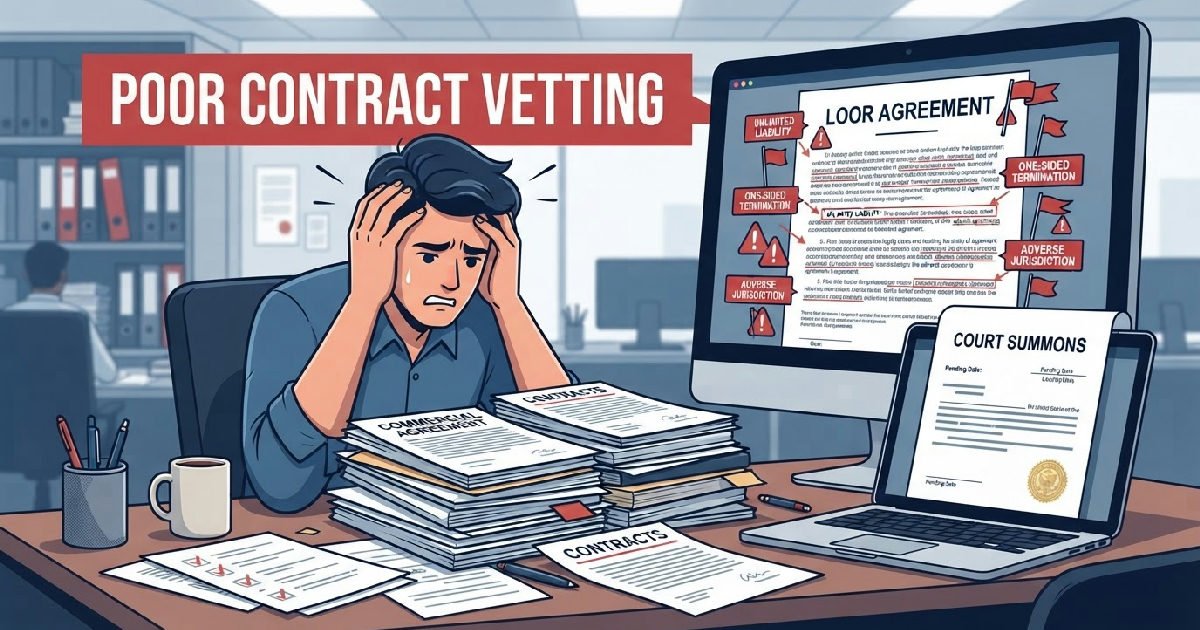
The hidden cost of poor contract vetting
For many businesses, poor contract vetting is overlooked as they view the final signature on a commercial contract as a mere formality that seals the deal. Focusing exclusively on the core commercial terms—like price, quantity, and delivery timelines—is a common and ultimately costly mistake for companies of all sizes.
But this failure to properly vet commercial contracts exposes the firm to severe and unnecessary legal and financial risk down the line.
Ignoring the small print can quickly translate into significant exposure, including delayed payments, unlimited liability, and the possibility of expensive litigation in an unfavorable jurisdiction. The time spent on a structured contract review process today acts as an essential form of insurance against future operational disruption and financial loss.
Many companies find that a short, specialized legal review is far more cost-effective than fighting a protracted commercial dispute later on.
Most commercial disputes that eventually end up in arbitration or court can be directly traced back to gaps or ambiguities left unresolved in the original contractual agreement. Proper vetting commercial contracts helps identify unfair or one-sided clauses before they become binding. It clarifies every party’s obligations, significantly reducing future legal uncertainty.
Identifying and mitigating critical legal risks
Before a contract is signed, the primary goal of the review process must be risk identification, not just confirmation of commercial terms. Businesses must actively look for specific red flags that frequently lead to disaster, such as weak termination rights or vague payment schedules. A failure to address these points shifts the risk burden unfairly onto one party.
For example, a clause that imposes unlimited liability without any reasonable cap can financially cripple a company if a major breach or claim occurs. Similarly, allowing the counterparty to set an inconvenient jurisdiction, such as a distant city or a different country, complicates and increases the cost of any eventual legal challenge.
This type of imbalance is often baked into agreements presented by larger, more sophisticated corporations.
Another area requiring intense scrutiny is the force majeure clause, especially in light of recent global supply chain disruptions. The clause must clearly define what constitutes an unavoidable event and what obligations, if any, remain for both parties during such a period. Vague or narrowly defined terms here can leave a business holding the bag when a true crisis hits.
The link between ambiguity and costly litigation
Ambiguity is the single greatest catalyst for commercial disputes and subsequent expensive litigation. If a term’s meaning is open to interpretation, it provides fertile ground for disagreement when performance issues arise. Lawyers are then forced to argue intent rather than focusing on clear contractual language.
A well-vetted contract eliminates this guesswork by ensuring that key performance indicators (KPIs) and quality standards are specific and measurable. It removes the opportunity for a counterparty to claim satisfactory performance when, in reality, the delivered product or service falls short of expectations. Clarity is the ultimate risk reduction tool in contract law.
The cost difference between a proactive, structured review and reactive litigation is staggering. Even a small contract dispute can cost tens of thousands in legal fees and months of management time. Investing in upfront legal clarity preserves cash and allows management to focus on core business objectives rather than court appearances.
Establishing a structured review process
A structured contract review process moves beyond simply scanning the document for grammatical errors or verifying the price point. It requires a dedicated, methodical examination of the contract’s mechanics and underlying legal structure. This systematic approach ensures that no critical section is overlooked due to haste or unfamiliarity with legal jargon.
The review process should involve several key internal stakeholders, including finance, operations, and legal departments, if available. This multi-disciplinary approach ensures that the commercial realities of the agreement align perfectly with the legal obligations it creates. A smooth internal workflow is essential for handling a high volume of commercial transactions.
Before the contract leaves the business for the counterparty’s signature, it should pass through a formal checklist that addresses all potential points of friction. This checklist must cover everything from the basic identity of the parties to complex indemnity provisions. Treating the review as a mandatory gate, rather than an optional step, enforces discipline and minimizes error.
Verifying authority and correct legal names
The first critical step in any commercial contract review is confirming the full legal identity and operational authority of both parties. Are the full, official legal names and addresses of both entities accurately reflected throughout the document? An error here can invalidate the entire agreement or lead to confusion over who is responsible for performance.
Just as important is verifying that the individual signing the contract possesses the requisite legal authority to bind the company. For large organizations, this often requires a board resolution or a formal power of attorney. Accepting a signature from someone without documented authority turns the contract into a potentially unenforceable document.
Businesses must also verify the legal standing of the counterparty—a basic due diligence check that confirms the entity is still active and solvent. Signing a major long-term deal with a company facing immediate dissolution poses an unacceptable financial and operational risk. This foundational step guarantees that the agreement is actually with the entity you intend to deal with.
Deconstructing the scope of work and deliverables
The Scope of Work (SOW) defines exactly what the agreement is meant to achieve and is the section most frequently misused by opportunistic parties. The SOW must be written using clear, specific, and measurable language that leaves zero room for subjective interpretation. Vague terms like “best efforts” or “timely delivery” should be replaced with concrete metrics.
The contract should meticulously detail timelines, milestones, and deliverables, attaching specific consequences to failure or shortfall in performance. What happens, for instance, if a delivery is late, or if the manufactured component fails to meet the specified quality tolerance? Pre-defined penalties or remedies drastically simplify performance management.
A thorough review involves cross-referencing the SOW against technical specifications and internal operational capacity. The company must ensure it can actually meet the outlined obligations without relying on unsustainable internal resources. Discrepancies between the contract’s demands and the firm’s capabilities are a clear precursor to breach and dispute.
Financial and liability considerations in commercial agreements
The financial section of the contract extends far beyond the headline price; it details the mechanics of money transfer and the risk distribution inherent in the deal. Two critical areas—payment terms and liability—are where most future financial conflict and exposure are generated. Careful analysis here can save millions.
It’s not enough to agree on a price; businesses need to secure precise terms regarding invoicing, due dates, currency, and methods of payment. Ambiguous payment terms are one of the most frequently cited causes of friction in B2B relationships. Firms should push for prompt payment schedules tied to verifiable milestones.
Similarly, the allocation of risk through liability and indemnity clauses determines who pays when something goes wrong. An unbalanced agreement can mean one party bears financial responsibility for events entirely outside its control. Financial vetting is therefore a comprehensive exercise in understanding cash flow and contingent liabilities.
Ensuring clarity in payment terms and penalties
Every commercial contract must clearly stipulate the exact amount, the due date, and the specific event that triggers the payment obligation. It is crucial to have a clear provision for interest or penalties on late payments, which acts as a powerful incentive for the counterparty to remain compliant. Without this leverage, collections become unnecessarily difficult.
Furthermore, businesses must review clauses related to taxes, deductions, and invoicing requirements to ensure compliance with local regulations. Any requirement for withholding tax or specific invoice formatting must be understood and incorporated into the internal accounting workflow immediately. Unexpected deductions can significantly erode profit margins.
One of the easiest ways to mitigate risk is by structuring payments in tranches tied to verifiable delivery or performance milestones. Avoid large lump-sum payments upfront unless fully secured by a bank guarantee. The following table illustrates common contract payment issues and the protective contractual measures businesses should adopt.
| Common Payment Issue | Financial Impact Risk | Protective Contractual Measure |
|---|---|---|
| Vague Invoicing Requirements | Payment delays (30-60 days) | Mandatory pre-approved invoice template and submission deadline. |
| Absence of Late Payment Clause | Loss of working capital, cash flow strain | Stipulate interest penalty (e.g., 1.5% per month) on overdue amounts. |
| Unclear Definition of “Completion” | Disputes over milestone payments | Define completion using objective, measurable criteria (e.g., successful final acceptance test report). |
| Currency Fluctuation Risk | Unexpected revenue losses (up to 10%) | Stipulate fixed currency or use an adjustable exchange rate mechanism. |
Analyzing indemnity and limitation of liability clauses
The limitation of liability (LOL) clause is perhaps the single most negotiated provision in a high-value commercial contract. It places a cap, usually financial, on the amount of damages a party can be held responsible for in the event of a breach. Businesses should always insist on a mutual and reasonable liability cap.
Unlimited liability is a critical red flag that must be challenged during the review process; it represents an open-ended risk to the entire organization. The cap should be proportionate to the contract value, often set at 100% or 150% of the total fees paid over the contract term. Companies should also ensure that liability is capped except for carve-outs like fraud or gross negligence.
Indemnity clauses specify who is responsible for paying third-party claims arising from the contract’s execution, such as intellectual property infringement or bodily injury. An overly broad indemnity obligation can leave a business financially responsible for the counterparty’s mistakes. Vetting must ensure that indemnity is reciprocal and limited only to direct claims arising from one’s own actions.
Protecting long-term interests: IP, termination, and renewal
While payment and liability deal with immediate financial risks, clauses concerning intellectual property (IP) and termination rights define the long-term strategic viability of the partnership. A weak IP clause can lead to the loss of proprietary assets, while poor termination rights can trap a company in an unproductive or costly arrangement. These strategic elements often differentiate a good contract from a bad one.
The duration of the agreement and the conditions for ending it are fundamental to risk management. A lack of clear exit options or the presence of automatic renewal mechanisms can impose long-term obligations that stifle flexibility. Businesses need to retain control over their future dealings and protect their valuable know-how.
These sections require input from senior management because they directly impact future business development and asset protection strategies. Accepting unfavorable terms here can create legacy issues that persist long after the current management team has moved on.
Defining clear intellectual property ownership
Any contract involving the creation of software, marketing materials, technical specifications, or other creative works must have an unambiguous IP ownership clause. The clause must clearly state who owns the IP created during the engagement and who retains rights to the background IP brought into the project.
If the IP is being created specifically for your company, ensure the contract contains a clear “work made for hire” declaration and an immediate, non-contingent assignment of all IP rights. If the counterparty insists on retaining ownership, the business must secure a perpetual, worldwide, fully paid-up, and irrevocable license to use the IP.
The contract should also stipulate clear restrictions on the counterparty’s use of your confidential information, branding, or proprietary data. Without strong confidentiality and IP protection, the relationship risks becoming a training ground for a future competitor. This diligence is crucial for maintaining a competitive edge.
Navigating term length and exit strategies
Understanding the contract’s term—its duration—is straightforward, but the termination clauses require meticulous attention. The vetting process must ensure the company has sufficient leverage to end the agreement efficiently if the business relationship deteriorates. Weak termination rights often force companies to maintain costly agreements long after their utility has expired.
Businesses should ensure termination is possible “for convenience” (with a reasonable notice period) and “for cause” (for specified breaches like non-performance or insolvency). There must be a specified notice period and clear details on how assets are handed over and final payments are calculated upon termination.
Watch out for lock-in clauses or exorbitant early termination penalties designed to make exiting the agreement prohibitively expensive. Similarly, automatically renewing contracts must be reviewed carefully, ensuring a sufficient window exists for providing written notice of non-renewal. This prevents the contract from accidentally rolling over into another lengthy and binding term.
Minimizing future disputes through careful planning
No matter how well-drafted a contract is, disputes can still arise, making the dispute resolution mechanism one of the most critical parts of the legal review. This section governs the entire process of conflict resolution, impacting everything from cost and speed to the final outcome.
A poorly chosen jurisdiction or an unclear process can turn a minor disagreement into a protracted and expensive legal battle. The contract must pre-emptively define the entire framework for handling conflict, ensuring predictability and cost control when the parties eventually disagree.
Effective dispute clauses prioritize efficiency and specialized knowledge. Many companies prefer commercial arbitration over traditional court litigation due to the potential for faster resolution and the confidentiality of proceedings. However, the exact rules and venue must be negotiated and clearly specified.
Scrutinizing governing law and jurisdiction
The governing law specifies which country’s or state’s laws will be used to interpret the contract. Ideally, this should be the law the business and its legal team are most familiar with, simplifying legal compliance and interpretation. Accepting foreign governing law significantly increases legal complexity and expense.
Equally important is the jurisdiction, which designates the physical location where any lawsuit must be filed. Businesses should always push for a convenient, commercially sophisticated, and accessible location. An unfavorable jurisdiction can render legal action economically unviable due to high travel and local counsel costs.
If the contract specifies arbitration, the review must detail the chosen arbitral institution (e.g., ICC, LCIA), the location of the arbitration, and the number of arbitrators. This level of specificity avoids future arguments over procedural matters, which can delay the commencement of actual dispute resolution.
The role of boilerplate clauses in risk management
Boilerplate clauses, often relegated to the end of the contract, appear standard but carry significant legal weight. Failing to review them carefully is a common oversight that exposes businesses to unnecessary risk. These clauses define the foundational rules for how the contract operates and how the parties interact.
The “Entire Agreement” clause, for example, states that the written contract is the final and complete agreement between the parties, superseding all prior discussions. This prevents reliance on verbal promises or drafts and must be present to ensure contractual certainty.
Other essential boilerplate provisions include the Amendment clause, detailing how the contract can be legally changed, and the Notices clause, specifying the official method for sending critical communications. These details govern the contract’s operational life. Note that courts, such as those that determine employment disputes not commercial in nature, rely heavily on these definitions.
The assignment and subcontracting restrictions are vital, too. They control whether a counterparty can transfer its obligations to an unknown third party without consent. For sensitive deals involving proprietary data, strong restrictions on assignment are non-negotiable for security and stability.
When to escalate the review to legal counsel
While a practical business checklist allows internal teams to handle routine, low-value agreements, not every contract can be managed solely by sales or operations staff. Knowing when to involve specialized legal counsel is a critical risk management decision. Early legal intervention is a preventative measure, not a reactive one.
The cost-benefit analysis overwhelmingly favors legal review when the stakes are high. If the contract involves substantial financial value, long-term obligations, or complex intellectual property rights, the potential cost of an error dwarfs the cost of a lawyer’s time. External counsel brings expertise and objectivity that internal teams often lack.
Legal advice becomes particularly vital when dealing with sophisticated counterparties, especially large, multinational corporations that use aggressively one-sided standard form contracts. These firms often have highly specialized in-house legal teams whose documents are designed to minimize their own risk at your company’s expense. You need equally sharp expertise on your side.
Evaluating contract value and complexity thresholds
A simple rule is to define a monetary threshold above which legal review is mandatory—for example, any contract exceeding $100,000 in annual value. Beyond sheer value, complexity in specific clauses related to liability, indemnity, or regulatory compliance mandates legal scrutiny. Complex financial instruments or multi-jurisdictional agreements automatically trigger this requirement.
Any contract that uses proprietary software, grants licenses, or involves cross-border data transfer should automatically be escalated to legal review. These areas are constantly evolving under new regulations and require specialist knowledge to ensure compliance and prevent future litigation risks.
Furthermore, if the contract is drafted by the counterparty and contains numerous unfamiliar terms or boilerplate clauses that deviate from industry norms, immediate legal assistance is necessary. An experienced lawyer can quickly identify the subtle phrasing that shifts significant risk away from the drafting party.
Final considerations for comprehensive risk reduction
Never treat a commercial contract as a mere formality that can be rushed through in the final hours of a negotiation. The comprehensive review required to effectively vet commercial contracts demands time, focus, and a multi-departmental approach. It is the company’s most potent tool against unforeseen financial exposure.
The strategic benefits of proper vetting extend beyond merely avoiding lawsuits; a clear contract facilitates smooth operations and minimizes internal friction. When obligations, timelines, and payment structures are unambiguous, both parties can focus on delivery rather than disagreement. This fosters a healthier, more productive business relationship over the contract’s term.
A well-drafted and carefully reviewed commercial agreement is not just a piece of paper; it’s a foundational document for risk management and operational stability. By diligently implementing a structured checklist and knowing when to seek expert help, businesses can significantly strengthen their position and insulate themselves from the common causes of costly commercial failure.
What is the most dangerous clause to overlook when vetting commercial contracts?
The most dangerous clause to overlook is typically the Limitation of Liability (LOL) clause. If this clause is absent or poorly drafted, it can expose the business to unlimited financial liability, meaning a breach could potentially bankrupt the company. Businesses should always insist on a cap proportionate to the contract value to manage this severe financial risk.
How does unfavorable jurisdiction affect a business dispute?
An unfavorable jurisdiction, such as a remote country or an inconvenient court district, severely increases the time and cost of litigation. The business would be forced to hire local counsel and incur significant travel expenses, potentially making a valid legal claim too expensive to pursue effectively, thereby undermining its contractual rights.
Should every commercial contract be reviewed by a lawyer?
No, not every contract requires full legal review, especially low-value, routine agreements. However, any contract involving high monetary value, long-term commitments, complex liability or indemnity provisions, or unique intellectual property creation should always be escalated to legal counsel. A proactive legal check prevents costly problems that internal teams might miss.