
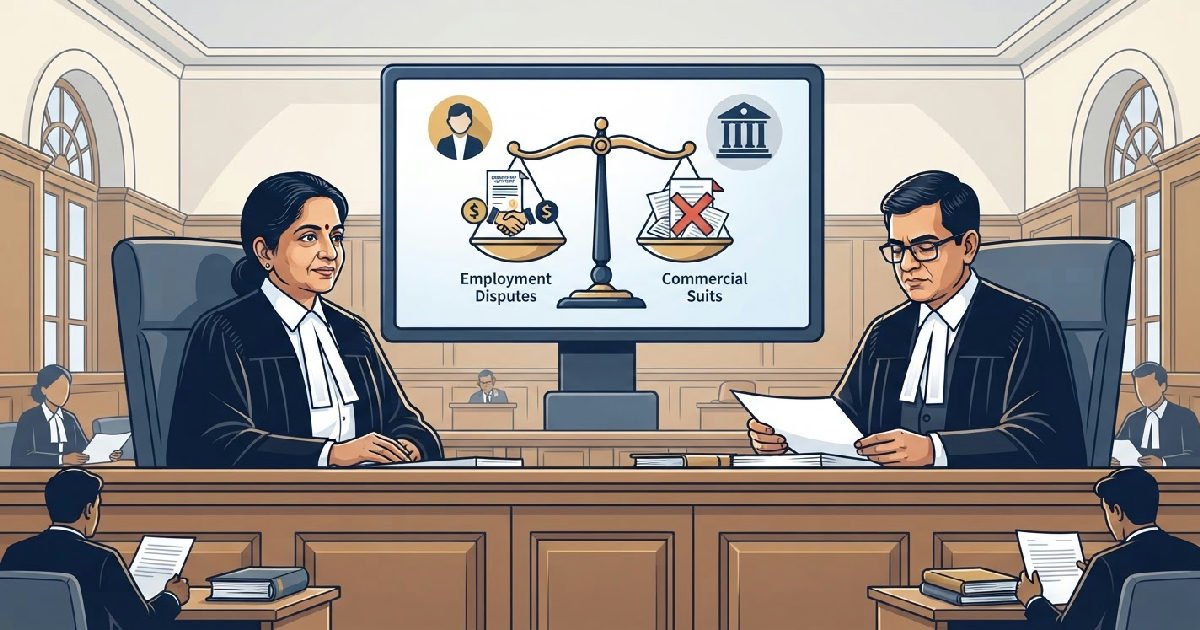
Employment disputes, including claims for salary arrears and increments, do not fall under the purview of “commercial disputes” as defined by India’s Commercial Courts Act, 2015, the Delhi High Court ruled.
This ruling, handed down on August 7, 2026, by a Division Bench comprising Justices Prathiba M Singh and Vikas Mahajan, reinforces a clear distinction in the country’s legal landscape.
Defining Commercial Disputes and the Court’s Role
The decision emerged from the case of Ram Lakhan Shukla v. Hintek Electronics Pvt. Ltd., where the court elaborated on the legislative intent behind the Commercial Courts Act. It means that matters concerning employer-employee relationships must be pursued in civil courts or specialized labor tribunals, not in the fast-track commercial courts designed for business-to-business conflicts.
The Commercial Courts Act, 2015, was enacted to streamline and expedite the resolution of high-value commercial disputes, intending to improve India’s standing in the World Bank’s Ease of Doing Business index. Its core purpose was to provide a specialized forum for specific types of commercial litigation, but the definition of “commercial dispute” has often been a point of contention.
Interpreting “commercial dispute” narrowly
Section 2(1)(c) of the Act outlines various transactions that qualify as commercial disputes, such as those involving merchants, bankers, traders, and contracts related to goods, services, and infrastructure. However, the Delhi High Court has consistently interpreted this definition narrowly, ensuring it applies only to relationships that are fundamentally commercial in character.
This careful interpretation prevents the expansion of the Act’s scope beyond its original legislative intent. The court applies the ejusdem generis principle, meaning that the specific types of disputes listed inform the general understanding of what constitutes a “commercial dispute.”
Evolution of pecuniary jurisdiction thresholds
Initially, the Commercial Courts Act applied only to disputes with a value of at least ₹1 crore. This high threshold limited its applicability, ensuring focus on larger corporate disagreements. However, an amendment in 2018 significantly reduced this to ₹3 lakh, allowing state governments to establish commercial courts at the district level for disputes above this value.
The Ram Lakhan Shukla Precedent
The recent ruling by Justices Prathiba M Singh and Vikas Mahajan was a direct outcome of the appeal in Ram Lakhan Shukla v. Hintek Electronics Pvt. Ltd. This pivotal case centered on unpaid salary and increments, highlighting the nuances of what constitutes a commercial dispute.
The path through the courts for salary claims
Ram Lakhan Shukla, who had been appointed as Senior Manager at Hintek Electronics Pvt. Ltd. on August 1, 2016, with a monthly salary of Rs. 50,000, sought to recover Rs. 14,33,073 in alleged salary arrears and increments. He initially filed his recovery suit before the Commercial Court, Saket.
That Commercial Court had proceeded ex parte on March 13, 2024, but subsequently dismissed the suit on September 12, 2024. The dismissal was based on the finding that employer-employee disputes didn’t fit the commercial dispute criteria. The High Court, however, modified the lower court’s order.
Ensuring proper forum and avoiding fresh costs
The Division Bench directed the Commercial Court to return the plaint to Shukla, rather than dismissing it outright. This procedural adjustment ensures that Shukla isn’t burdened with fresh court fees and costs when refiling his case in the appropriate civil court.
The plaint is now slated to be listed before the Commercial Court, South District, Saket Courts, New Delhi, on August 24, 2026, for its return. Shukla will then have 30 days from that date to present his case before the correct forum.
Reinforcing Earlier Judicial Stance on Employment Agreements
This August 2026 ruling isn’t a standalone decision; it significantly strengthens a prior judgment from December 2025. That earlier ruling also addressed the fundamental nature of employment agreements within the legal framework.
Key ruling in ARM Digital Media v. Ritesh Singh
On December 1, 2025, Justice Purushaindra Kumar Kaurav of the Delhi High Court delivered a judgment in the case of ARM Digital Media Pvt. Ltd. and Others v. Ritesh Singh. This case involved a digital marketing company alleging breaches of contractual and fiduciary duties by its former Managing Director, Ritesh Singh.
Singh had resigned on March 31, 2023, and subsequently joined a competing entity. The company claimed he had made unauthorized salary increases and failed to ensure statutory compliances during his tenure. But the court maintained its position.
The “personal service” distinction in contracts
Justice Kaurav explicitly ruled that disputes arising from employment agreements are not commercial disputes, even if those agreements include clauses commonly found in commercial contracts. These can include terms related to confidentiality, non-compete obligations, or the assignment of intellectual property rights.
The core principle is that the primary relationship remains one of personal service, not a commercial transaction between two businesses. This judicial consistency provides greater clarity for commercial courts act appealability in such matters.
The Rationale: Why Employment isn’t Commercial
The consistent stance of the Delhi High Court stems from a deep-rooted understanding of the Commercial Courts Act’s legislative intent and the unique characteristics of employer-employee relationships. It highlights the judiciary’s commitment to uphold the specific purposes for which different legal forums were established.
Judicial interpretation and legislative intent
The Court has emphasized that including employer-employee disputes within the definition of “commercial disputes” would directly contradict the legislative mandate of the 2015 Act. The Act’s purpose is to handle complex, high-value business disagreements, not individual employment grievances.
Such an expansion would essentially “stretch” the definition beyond what parliament intended. So, the courts are sticking to the original framework, ensuring specialized tribunals handle specific issues.
“Provision of services” and the contractual context
A central point of debate has been whether employment constitutes a “provision of services” in a commercial sense. The judiciary has consistently rejected this argument, differentiating between a company providing services to clients and an individual providing personal service to an employer.
As established in cases like Ekanek Networks Pvt. Ltd. v. Aditya Mertia, a contract of personal service cannot be “dressed up” as a commercial dispute. It clarifies that such disputes require different legal considerations and forums.
Alternative Forums for Employment Grievances
With commercial courts explicitly excluding employment disputes from their purview, it’s essential for both employees and employers to understand where they can seek legal redress in India. This clarity guides litigants towards the most appropriate judicial avenues for their grievances.
India’s established labor law framework
India has a robust framework for resolving employment disputes, primarily through specialized labor laws. The Industrial Disputes Act, 1947 (IDA), for example, provides mechanisms such as Conciliation Boards, Courts of Inquiry, Labour Courts, and Industrial Tribunals.
These forums are specifically designed to address the nuances of employer-employee relationships, including issues like unfair termination, wage disputes, and working conditions. The upcoming Industrial Relations Code, 2020 (IRC), aims to further streamline these processes.
Role of civil courts and specialized tribunals
For employees not covered by specific labor laws (often referred to as “non-workmen”), civil courts remain the primary avenue for resolving disputes, including salary claims. These courts handle contractual matters more broadly.
Furthermore, alternative dispute resolution (ADR) methods, including arbitration, are increasingly utilized. However, the enforceability and scope of arbitration in employment contexts, especially concerning broader public interest issues, continue to be subjects of judicial interpretation by the Supreme Court of India.
Broader Implications for Businesses and Legal Strategy
This persistent judicial stance has significant implications for both businesses and the legal profession. It shapes how companies structure employment agreements and how legal teams advise their clients on dispute resolution.
Impact on legal strategy and efficiency
For employers, this means clearly understanding that employment contract disputes, even with significant monetary values, won’t be fast-tracked through commercial courts. They’ll need to prepare for potentially longer timelines associated with civil courts or labor tribunals. This clarity helps in formulating appropriate legal strategies.
It also underscores the importance of well-drafted employment agreements that anticipate potential disputes and clearly outline resolution mechanisms. This ruling also has implications for cases involving commercial courts act appeals when a plaint is rejected.
Ensuring appropriate forum shopping
The ruling encourages what legal professionals call “appropriate forum shopping” – directing litigants to the courts best equipped to handle their specific type of dispute. Commercial courts are built for commercial efficiency, while civil and labor courts address the intricacies of individual rights and social welfare.
This distinction prevents the overburdening of specialized commercial courts with matters that require a different judicial lens. It also helps preserve the distinct mandates of India’s diverse judicial system. Businesses navigating complex disputes might also consider the processes for commercial mediation decisions as part of their strategy.
| Dispute Type | Suitable Forum (Pre-2026 Interpretation) | Suitable Forum (Post-Delhi HC Ruling) | Key Characteristics |
|---|---|---|---|
| Employer-Employee Salary Claims | Commercial Court (Incorrectly applied) | Civil Court / Labour Tribunal | Contracts of personal service; wage arrears, increments. |
| Intellectual Property Infringement | Commercial Court | Commercial Court | Business-related rights; trademarks, patents, copyrights. |
| Contract for Sale of Goods | Commercial Court | Commercial Court | Transactions between commercial entities. |
| Breach of Confidentiality (Employment) | Commercial Court (Potentially, but disputed) | Civil Court / Labour Tribunal | Arises from employment terms, even if business-related. |
Future Outlook for Employment Litigation
The Delhi High Court’s consistent rulings clarify the judicial approach to employment disputes under the Commercial Courts Act. This trajectory points towards a sustained focus on directing such cases to forums designed for them.
For employees, it means understanding the correct legal avenue from the outset, potentially saving time and resources. For businesses, it necessitates a recalibration of their legal risk assessments and dispute resolution planning for human resources matters.
Shaping judicial strategy for businesses
Companies should prioritize clear contractual language regarding dispute resolution mechanisms in employment agreements. They’ll also need to ensure their legal teams are well-versed in the procedural nuances of civil and labor courts.
This ruling reinforces the idea that specialized problems require specialized solutions, and not all disputes involving money are “commercial” in the legal sense of the Commercial Courts Act. It maintains the integrity of each legal system.
Protecting the distinct mandates of legal forums
The judiciary’s commitment to defining the boundaries of the Commercial Courts Act ultimately protects the distinct mandates of various legal forums. It ensures that commercial courts can focus on complex business litigation without being swamped by personal service contract disputes.
This clarity helps uphold the efficiency and purpose of each court type, serving justice more effectively across the spectrum of legal disagreements in India. It reinforces a structured approach to legal remedies, distinguishing clearly between commercial and employment-related conflicts.
What was the Delhi High Court’s recent ruling about?
The Delhi High Court ruled on August 7, 2026, that employment disputes, including claims for salary and increments, are not considered “commercial disputes” under the Commercial Courts Act, 2015. They must be heard in appropriate civil or labor courts.
Why are employment disputes not considered commercial disputes?
The Court views employment agreements as contracts of “personal service” rather than commercial transactions between businesses. Including them under the Commercial Courts Act would contradict the legislative intent of the Act, which aims to expedite business-to-business litigation.
Where should employment disputes be filed now?
Employment disputes, such as those concerning salary arrears or other employment contract breaches, should be filed in civil courts or specialized labor tribunals established under laws like the Industrial Disputes Act, 1947, depending on the nature of the employment.