
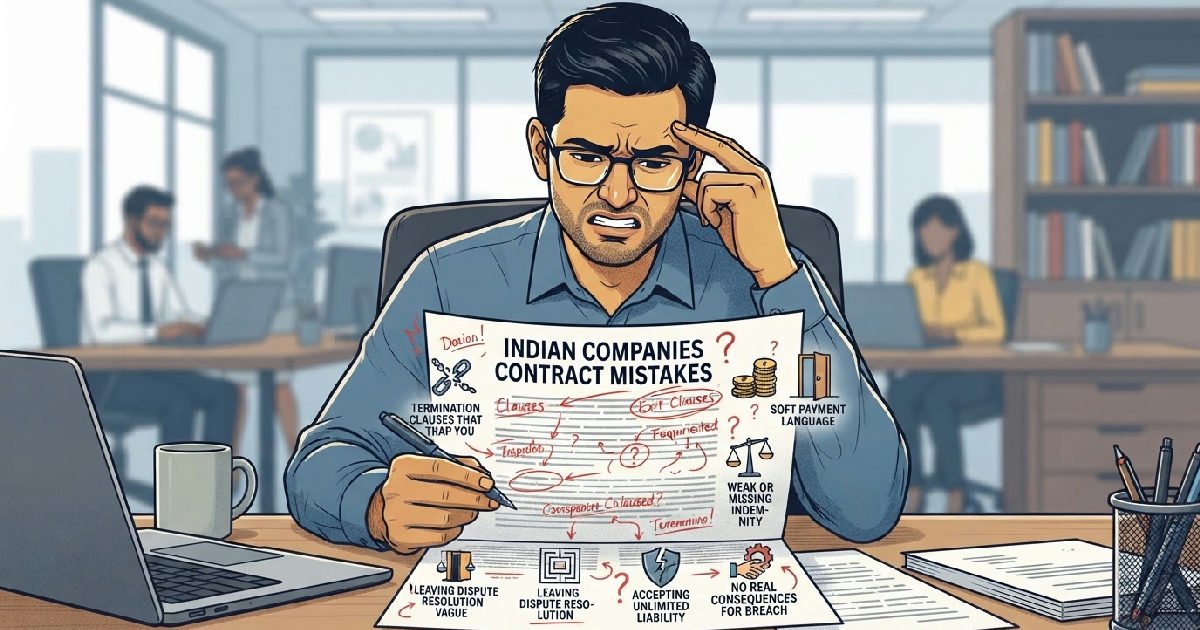
Indian companies frequently face substantial financial setbacks, often amounting to crores of rupees, due to their contract drafting errors and management. These critical missteps typically go unnoticed until a commercial relationship deteriorates, leading to significant delays in payments, complex disputes, or ultimately, unrecoverable losses.
The problem isn’t always dishonesty from the other side; often, it’s the company’s own contract mistakes that leave the door open, creating vulnerabilities.
Understanding Common Indian Companies Contract Drafting Errors
This oversight allows business partners to exploit weaknesses, sometimes unintentionally, exposing companies to financial drain. The true cost of these contract deficiencies emerges slowly, often manifesting as extended legal battles and strained business relationships. Understanding these silent financial leaks is paramount for any firm operating in India today, particularly when considering complex debt recovery legal options.
Many Indian businesses operate under a dangerous illusion: that contracts are merely administrative formalities. This perspective frequently leads to boilerplate agreements, vague clauses, and a general lack of foresight regarding potential commercial friction. But the reality is far more stark, impacting operational efficiency and financial health.
When money gets stuck, a vendor disappears, or a client stops paying, the damage is already done. The contractual weaknesses, once overlooked, suddenly become glaring liabilities, transforming what should be a protective document into an expensive oversight. These subtle yet significant failures are quietly costing Indian companies crores.
Ambiguous scope of work fuels disputes and delays
One of the most pervasive and costly errors Indian companies make is treating the scope of work within a contract as a mere formality. When the language defining services or deliverables is broad or casual, it inevitably leads to differing expectations between the contracting parties.
This ambiguity creates fertile ground for future disputes. A vendor might believe a project is complete, while the client insists more work was implicitly required. Such disagreements often result in protracted arguments over job completion, significant payment delays, and even full-blown commercial disputes, eroding trust and profitability.
The hidden costs of vague deliverables
Clear, precise language in the scope of work isn’t just good practice; it’s essential protection against financial contention. Without it, companies can find themselves entangled in costly reworks or additional services that were not initially budgeted. This directly impacts project timelines and financial forecasts.
Vague scope also undermines the principle of quantum meruit. This legal tenet entitles a performing party to reasonable compensation for work performed beyond the contract’s scope and accepted by the other party. While a legal remedy exists, pursuing it through courts can be a lengthy and expensive process, draining resources and delaying resolution.
Construction projects as a prime example of scope issues
Construction projects, for instance, frequently suffer from this exact problem. Changes in the scope of work are a primary cause of disputes, alongside project delays, acceleration costs, and project disruption or termination. These issues often involve claims for unpaid amounts due to changes or unauthorized alterations by the contractor.
Ignoring this foundational element can undermine the entire commercial agreement. A well-defined scope acts as a blueprint, ensuring both parties are on the same page from the outset and mitigating the risk of costly misunderstandings later. This clarity saves both time and significant financial resources.
Soft payment terms: a direct hit to cash flow
Many contracts, while mentioning payment, fail to establish clear and enforceable terms, creating significant financial vulnerability. A lack of specific due dates, stipulated interest on delayed payments, or defined consequences for non-payment gives the other party ample room to delay, negotiate downwards, or even cease communication without genuine contractual pressure.
This “soft payment language” is a significant contributor to cash flow problems for many Indian businesses. It effectively turns a company’s receivables into an open-ended loan, often without interest. Firms find themselves chasing payments, diverting valuable resources from core operations, and hindering their ability to meet their own financial obligations.
Navigating India’s diverse payment landscape
The standard “Net 30” payment term, where payment is due within 30 days of the invoice date, remains prevalent in Indian B2B contracts. However, larger enterprises sometimes extend these to Net 60 or even Net 90, typically for significant transactions. Ambiguity about when the payment clock truly starts—is it the invoice date, delivery date, or acceptance date?—can lead to months of disputed payment timelines.
For Indian exporters, payment problems often originate in poorly thought-out contract terms.
While the Reserve Bank of India (RBI) now allows 15 months (up from 9 months previously) to realize export proceeds as per Notification FEMA 23(R)/(7)/2025-RB dated November 13, 2025, the GST clock for service exports under a Letter of Undertaking (LUT) still requires realization within one year of the invoice date.
These differing timelines demand meticulous contractual clarity to avoid penalties.
The MSMED Act’s critical protections
A crucial piece of legislation often overlooked is the Micro, Small, and Medium Enterprise Development (MSMED) Act, 2006. This Act provides significant protection for MSME suppliers, ensuring timely payments and financial stability for smaller businesses.
If a buyer, regardless of its size, has a written agreement with an MSME supplier, payment must be made within 45 days of acceptance. In the absence of a written agreement, this window shrinks to a mere 15 days. Non-compliance with these timelines triggers compounded interest at three times the RBI bank rate, currently around 18.75% per annum as of February 26, 2026.
Furthermore, non-compliance also mandates disclosure in the buyer’s annual financial statements, posing a significant reputational risk for larger companies. Understanding and adhering to MSMED Act provisions is not just good practice but a legal necessity for all businesses dealing with MSMEs.
| Payment Term / Rule | Applicability | Payment Deadline | Consequence of Delay |
|---|---|---|---|
| Net 30 (Standard) | Common Indian B2B contracts | 30 days from invoice date | No explicit contractual penalty without specific clause |
| MSMED Act (with agreement) | Buyer with MSME supplier (written agreement) | 45 days from acceptance | Compounded interest at 3x RBI bank rate (~18.75% p.a.) |
| MSMED Act (no agreement) | Buyer with MSME supplier (no written agreement) | 15 days from acceptance | Compounded interest at 3x RBI bank rate (~18.75% p.a.) |
| Export Proceeds (RBI) | Indian exporters | 15 months (from Nov 13, 2025) | Consequence not detailed in research |
| GST LUT Service Exports | Indian service exporters | 1 year from invoice date | Consequence not detailed in research |
Perilous exit clauses: trapped in bad agreements
A contract that makes termination difficult is a significant liability. When performance drops or the relationship turns toxic, companies can find themselves stuck—forced to continue, keep paying, or face heavy penalties for exiting. Poorly structured termination clauses can lead to claims of wrongful termination, adding legal complexity to an already difficult situation.
Flexible and balanced termination rights aren’t aggressive; they’re necessary tools for sound business management. They provide a clear framework for disengagement when a commercial relationship ceases to be mutually beneficial or viable, safeguarding the company’s long-term interests and resources. This clarity is crucial to avoid protracted disputes, especially in the context of money decrees and inherent powers of courts.
Indian Contract Act and termination grounds
The Indian Contract Act, 1872, provides the foundational legal framework for contractual relationships and their cessation in India. It recognizes several bases for ending obligations, including rescission, breach, and frustration. These statutory provisions underpin the importance of well-drafted termination clauses within commercial agreements.
Section 39, for example, allows a party to terminate a contract if the other party refuses to perform its obligations under the agreement. Section 56 addresses “frustration of contract,” making an agreement void if its performance becomes impossible due to unforeseen events. Meanwhile, Section 73 provides for compensation for losses suffered due to a breach of contract by either party.
Structuring clear termination provisions
Effective contracts incorporate various types of termination clauses, each serving a specific purpose. “Termination for Convenience” permits an exit without a specific reason, typically requiring a predetermined notice period, often between 30 and 90 days, and sometimes an early termination fee. This flexibility allows businesses to adapt to changing market conditions or strategic shifts.
Conversely, “Termination for Cause (Default)” is the most common type, triggered by a material breach of contract. This usually necessitates written notice and often includes a cure period, typically 15 to 30 days, to allow the defaulting party to rectify the breach.
Other forms include termination by mutual consent, automatic termination upon completion or expiry of the contract term, and force majeure clauses for unforeseen events like pandemics or natural disasters, ensuring business continuity planning.
Indian courts strictly interpret these provisions, upholding them when parties agree clearly and act in good faith within the contractual terms. Arbitrary or excessively one-sided termination provisions, however, may face challenges and risk unenforceability, emphasizing the need for equitable and legally sound drafting.
Unlimited liability and its financial threat
In the rush to close a deal, companies often sign clauses that expose them to unlimited financial risk. Meanwhile, the other party enjoys strong protections. This imbalance can make one serious claim capable of threatening the entire business, transforming a routine contract into an existential hazard for the unprepared party.
Liability caps exist for a crucial reason. Ignoring them is one of the most expensive habits in Indian business contracting. These caps aim to limit total financial exposure, typically to the contract value or fees paid over a specific period, such as 12 months. This provides a predictable ceiling for potential losses, allowing businesses to quantify their maximum risk exposure.
The necessity of liability caps for risk management
Without clear limitations, a company could be held responsible for damages far exceeding the commercial benefit derived from the contract. This puts its assets and future operations at undue risk. Properly negotiated liability caps are a critical risk management tool, preventing catastrophic financial outcomes from unforeseen circumstances or disputes.
For sectors like BFSI (Banking, Financial Services, and Insurance) and technology, where potential damages can be substantial, liability caps might even be set as a multiple of annual fees, reflecting the higher-risk nature of their services.
They provide a predictable ceiling for potential losses, enabling more strategic decision-making and fostering greater confidence in entering new commercial agreements. This is particularly vital for enforcing foreign decrees or judgments.
Enforceability under Indian law
Limitation of liability clauses are generally enforceable in India. However, they must align with legal requirements and not violate existing law, public policy, or appear immoral or unconscionable. The Indian Contract Act, 1872, allows for such provisions provided they are reasonable and not designed to unjustly enrich one party at the expense of another, maintaining fairness in commercial dealings.
Courts will scrutinize these clauses to ensure fairness and prevent exploitation. Therefore, while crucial, these clauses require careful drafting to ensure their legal validity and effectiveness, protecting companies from both excessive claims and potential legal challenges to the caps themselves, thereby ensuring long-term business stability.
Why are clear payment terms critical for businesses?
Clear payment terms are critical because they ensure predictable cash flow, which is the lifeblood of any business. They define when money is due, what happens if payments are delayed, and how disputes will be resolved. Without clarity, businesses face uncertainty, increased administrative burdens, and potential financial distress.
What is the importance of a well-defined termination clause?
A well-defined termination clause provides a structured and lawful way for parties to exit a contractual relationship. It protects companies from being trapped in underperforming or toxic agreements, avoids costly disputes over premature exits, and clarifies financial liabilities and obligations upon contract cessation, ensuring a smoother transition.
How do liability caps protect a company?
Liability caps protect a company by setting a maximum limit on its financial exposure for potential claims or damages arising from a contract. This prevents unforeseen catastrophic losses that could threaten the company’s solvency. They are a fundamental risk management tool, allowing businesses to quantify and control their potential downside.
Call or Whatapp for free consultation.
Related Service: https://arpitmarwah.com/commercial-lawyers-in-delhi/